
Lieferung heute & morgen

Qualitätsgarantie

Willkommens-Angebote freischalten: KOSTENLOSE Lieferung | Bis zu 80 % RABATT | Kostenlose 30-Tage-JoyPlus-Testphase
App herunterladen
A torque wrench is not your average spanner. It is a precision instrument, essential for the safety and longevity of components on vehicles and machinery. Whether changing a wheel on your car, servicing a carbon-fibre bicycle, or making repairs to a motorcycle, applying the correct tightening torque prevents material damage and safety hazards. However, the market is flooded with tools whose performance claims don't always hold up in practice. This guide will help you identify the crucial features and make an informed choice.
Many users invest in a tool that fails to meet their needs or even causes damage. Look out for these three common problems to avoid a bad investment.
To find the right tool for your needs, focus on these three core technical parameters.
The required torque range, measured in Newton-metres (Nm), is the most important criterion. It must precisely match your application. In parallel, the drive size (the square drive that the socket fits onto) is crucial.
The way the target torque is signalled distinguishes the two main types of torque wrenches.
A single wrench is rarely enough. A torque wrench set often provides better value for money and more flexibility. Extensions are essential for reaching hard-to-access bolts. A cost-effective alternative is a torque adapter. This digital device is placed between a standard ratchet and the socket, turning it into a precise digital measuring tool.
Here are some recommendations tailored to specific needs and use cases.
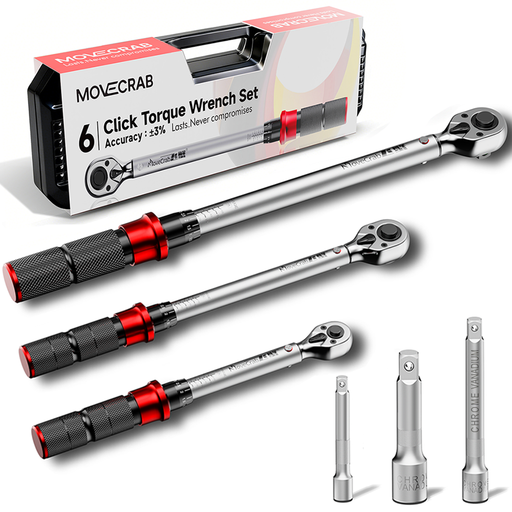
Why This Fits Their Persona: Ideal for mechanics who need reliable and broad coverage for various projects. With wrenches for 1/4", 3/8", and 1/2" drives, this set covers the entire range from bicycle to car repairs without needing to buy multiple individual tools.
Solves the problem of an unsuitable torque range by including three separate wrenches for low, medium, and high Nm values. Each wrench is optimised for its specific range.
Wide Application Range: Covers 5-220 Nm. Robust Construction: Made from heat-treated Cr-V steel for durability. Includes a calibration certificate for each wrench.
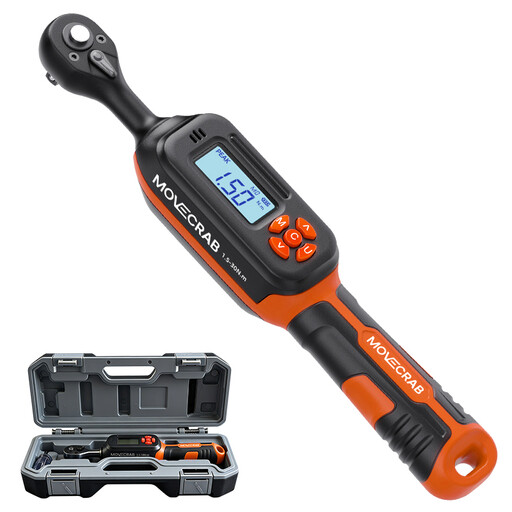
Why This Fits Their Persona: Perfect for professionals and enthusiasts working on sensitive components like carbon bicycle parts or modern engine electronics. High accuracy and clear feedback are non-negotiable here.
Addresses the problem of inaccurate calibration with a certified accuracy of ±2%. The triple-alarm system (vibration, sound, light) ensures the target value is not missed, even in noisy workshops.
High Precision: ±2% accuracy for critical fasteners. Multi-Sensory Feedback: Sound, light, and vibration prevent over-tightening. Advanced Features: Peak and Track modes, plus 10 presets for recurring tasks.
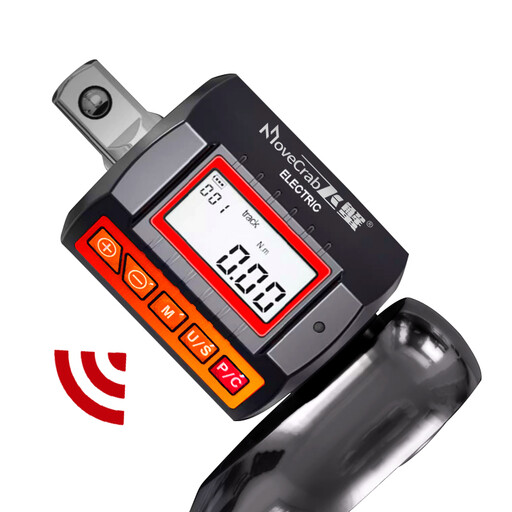
Why This Fits Their Persona: For users who already own a collection of ratchets and sockets and want to cost-effectively add precise torque measurement capabilities. Ideal for mobile use or as a supplement in a well-equipped workshop.
Provides digital precision without requiring the purchase of a complete new tool. The included adapters for 3/8" and 1/4" make it extremely versatile, solving the problem of needing a separate wrench for each drive size.
High Compatibility: Turns any standard ratchet into a digital tool. Precise Measurement: Bidirectional accuracy of ±2% (CW) and ±2.5% (CCW). Data Storage: Can store up to 1,000 readings for documentation.
We have compiled a complete, up-to-date list of products that fully meet these strict selection criteria and UK safety regulations.
1. How often does a torque wrench need to be calibrated? A general recommendation is to have a professionally used tool calibrated annually or after approximately 5,000 load cycles. For occasional private use, this is needed less frequently. However, recalibration is mandatory if the tool has been dropped or shows visible damage. Always store a mechanical torque wrench in its relaxed state (set to the lowest value) to protect the spring.
2. Can I use a torque wrench to loosen bolts? No, a torque wrench is a measuring instrument, not a lever tool. Loosening tight bolts ("breaking them loose") often requires more torque than the wrench's maximum measurement range and can damage the internal mechanism, destroying its calibration. Always use a rigid ratchet or a breaker bar for loosening. The exception is some digital models that explicitly offer a measurement function for counter-clockwise rotation.
3. What does the drive size in inches (1/4", 1/2") mean on a torque wrench? The drive refers to the size of the square stud on the head of the wrench where the sockets are attached. The drive size correlates directly with the torque range for which the tool is designed. A smaller 1/4-inch drive is used for low torques, while a larger 1/2-inch drive is designed for the high forces found in the automotive tool sector. Choosing the correct drive size ensures that both the wrench and the socket can withstand the load.