Anyone who gets hungry after exercise
If you’re looking for something ready to eat quickly after a workout, it helps to distinguish between a snack and a meal that you put together with additional protein-rich foods.


Tortilla chips can provide a source of carbohydrates after a workout, but they shouldn’t be treated as a complete meal on their own. To help you choose, compare protein, salt and ingredients per 100 g, as well as the portion you actually plan to eat. A larger pack is only practical if you can make good use of its contents.
If you’re looking for something ready to eat quickly after a workout, it helps to distinguish between a snack and a meal that you put together with additional protein-rich foods.
With a larger bag, it’s worth checking whether the pack size suits the portion you have in mind. The nutrition information per 100 g makes it easier to compare different varieties.
Salt content and ingredients can vary between salted and flavoured varieties. If you have a milk allergy or other dietary requirements, check the label on the specific pack you’re buying.
First, decide what role you want the chips to play after your workout: a side to enjoy with other foods, or simply a snack. Then compare the nutrition information and ingredients for the specific variety, and choose a pack size that suits the amount you plan to eat.
| What to consider | What to check | Who it matters to |
|---|---|---|
| Carbohydrates and protein | Compare both figures per 100 g and work out what they mean for your planned portion. If the chips are just a side, plan to include other foods too. | When I’m putting together a meal after a tough workout, I don’t want to mistake chips for a source of protein. For around 50% of shoppers, nutritional content is the main consideration. |
| Salt and ingredients | Compare the salt content per 100 g and read the ingredients and allergen information for the variety you’ve chosen. | With a flavoured variety, I want to know what I’m eating and whether it contains milk ingredients; around 30% of shoppers prioritise salt and ingredients. |
| Pack size | Compare the pack weight with the portions you actually plan to eat. | If I only have chips as an occasional snack, I don’t want to choose a larger bag than I can make good use of. The right pack size is the most important buying consideration for around 20% of shoppers. |
The salted varieties listed by Chio, REWE and EDEKA24 contain 5.2 to 7.7 g of protein per 100 g. So if you eat chips on their own, don’t treat them as equivalent to a meal you’ve put together yourself.
If you like, have tortilla chips as a side, add foods of your choice and include a drink. Base the nutrition information on the portion you eat.
According to REWE, ja! Nacho Cheese contains 7.8 g of protein and 1.61 g of salt per 100 g, while ja! Salted contains 7.7 g of protein and 0.7 g of salt. The Nacho Cheese variety also contains milk ingredients.
Choose the cheese variety for its flavour, not just for its protein content. Compare the salt and ingredients on the packs themselves.
The salted own-brand varieties listed by REWE and EDEKA24 each come in a 300 g pack. The pack weight doesn’t tell you how much you’ll want to eat at once.
Decide on a portion before you eat, then compare its weight with the nutrition information per 100 g.
The ja! Nacho Cheese variety listed by REWE contains, among other things, lactose, cheese powder and milk protein. A similar-looking variety may have different ingredients.
Check the ingredients and allergen information on the specific pack every time you buy, especially if you need to avoid certain ingredients.
REWE sells salted tortilla chips and a Nacho Cheese variety in 300 g packs.
EDEKA24 sells salted Gut & Günstig tortilla chips in a 300 g pack.
Chio Tortillas Salted are a salted branded variety, sold in a 110 g bag.
ALDI SÜD sells SUN SNACKS salted tortilla chips in a 300 g pack; ALDI Nord lists a range of varieties in 300 g bags.
This product is a flavoured tortilla chip variety in a smaller bag. If you’re planning to have chips as a side after a workout, check the information for this specific variety and add other foods to your meal to suit your needs.
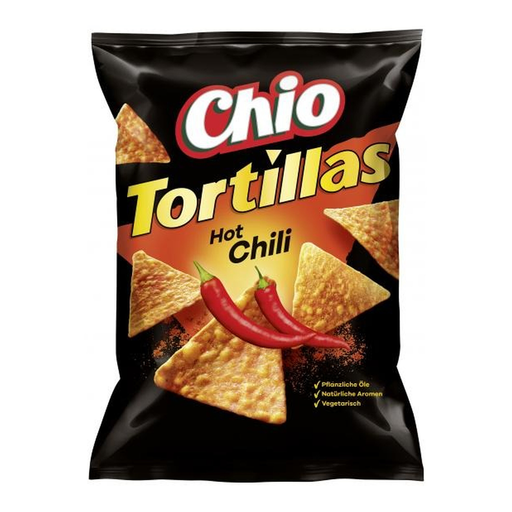 Image unavailable
You can enjoy these tortilla chips as a snack alongside a meal you’ve put together yourself after a workout. Check the nutrition information and ingredients for the Hot Chili variety on the pack before deciding on a suitable portion.
You shouldn’t plan to have tortilla chips on their own as a complete meal. The varieties covered here contain 5.2 to 7.8 g of protein per 100 g, according to Chio, REWE and EDEKA24. If you have chips as a source of carbohydrates, you can add other suitable foods and a drink.
There’s little difference between the two ja! varieties: REWE lists 7.8 g of protein per 100 g for Nacho Cheese and 7.7 g for the salted variety. Nacho Cheese also contains 1.61 g rather than 0.7 g of salt per 100 g, as well as milk ingredients. These figures don’t tell you anything about other brands.
Read the ingredients and allergen information, as well as the nutrition details for the specific tortilla chip variety. The pack weight and best-before date can also help you decide whether it suits how you plan to use it.
No, the Nutri-Score can’t answer that question on its own. According to Verbraucherzentrale, it’s a voluntary nutrition label. When planning your meal, you should also consider protein, salt, ingredients and the portion size you’ll actually eat.