
Lieferung heute & morgen

Qualitätsgarantie

Willkommens-Angebote freischalten: KOSTENLOSE Lieferung | Bis zu 80 % RABATT | Kostenlose 30-Tage-JoyPlus-Testphase
App herunterladen
A modern bedside lamp with a touch-dimming function promises convenience: A light tap is all it takes to adjust the brightness—ideal for evening reading or for gentle light in the morning. But the market is flooded with models whose real-world functionality often falls short of their advertising claims. Many users get frustrated with unreliable sensors or impractical extra features.
As your Joybuy Product Recommendation Officer, I'm here to help you cut through the noise. In this guide, I'll walk you through the three most common pitfalls of buying and highlight the key technical features you should look for to find a long-lasting and functional lamp for your bedroom.
Before you make a decision, you should be aware of these common problems, which often only become apparent after a few weeks of use.
To avoid the issues mentioned above, focus on the following three core parameters. They are crucial in determining the quality and longevity of your new bedside table lamp.
A good touch sensor should be not only precise but also intuitive to use. Look for models where a large surface area—ideally the entire lamp base—acts as the sensor. This saves you from fumbling for a small, specific spot in the dark. Some lamps also offer a memory function that remembers the last brightness setting. This is a clear convenience feature and an indicator of well-engineered electronics.
A high-quality dimmable bedside lamp should cover a wide dimming range, ideally from 100% down to below 10%. Stepless dimming functions, controlled by a long press on the sensor, offer the greatest flexibility. Additionally, the ability to change the color temperature is a significant advantage:
If you opt for a model with USB ports, check the technical specifications. A USB-A port should offer at least 5V/2A of power output to charge a smartphone in a reasonable amount of time. Modern lamps increasingly feature USB-C ports, which often support faster charging speeds. A crucial quality indicator is whether the charging port works even when the lamp is turned off.
Here are three recommendations tailored to different needs, all of which meet the quality criteria mentioned.
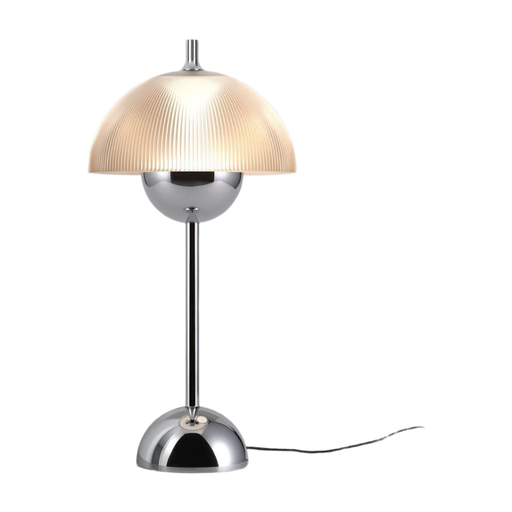
Why This Fits Their Persona: Ideal for users seeking a modern bedside lamp with a sculptural character. The focus is on aesthetics and simple yet effective lighting control, without superfluous extra features.
The 4-step dimming function provides a practical range of brightness levels, thus avoiding the pitfall of an impractical dimming range. The touch control is reliably integrated into the design.
The lamp features a memory function that recalls the last brightness setting. Its design, with the striped acrylic shade, creates a soft 360° light.

Why This Fits Their Persona: Perfect for those who seek maximum functionality. This lamp combines stepless dimming, variable color temperatures, and a USB charging port in a single, modern device.
This model addresses all three pitfalls: its stepless dimming offers full control, the touch control in the base is responsive, and the integrated USB port supplies power even when the lamp is off.
The combination of 3 color temperatures (Warm, Neutral, and Daylight White) and stepless brightness control makes it extremely versatile—from mood lighting to a task lamp.

Why This Fits Their Persona: An excellent choice for users looking for a balance of modern design, useful features, and an accessible price point. The combination of wood and metal complements many interior styles.
The memory function prevents the constant need to readjust brightness, counteracting the problem of unstable controls. The stepless dimming from 5% to 100% offers a very practical range.
It offers features often found only in higher-priced models, such as 3 color temperatures and stepless dimming. The eye-friendly LED light reduces strain during reading.
We have compiled a comprehensive, up-to-date list of products that meet these selection criteria.
1. How does a touch-dimmable bedside lamp work? Most touch lamps use a capacitive sensor. This sensor registers the slight change in the electrical field caused by the touch of your finger. A microcontroller inside the lamp interprets this signal and then controls the brightness of the LEDs.
2. Does a touch lamp consume power when it's off? Yes, but only a minimal amount. The touch sensor must be constantly supplied with a very low voltage to be able to react to a touch. However, this standby power consumption is extremely low, typically well under one watt, so it's barely noticeable on your electricity bill.
3. Can you change the bulb in an LED bedside lamp? That depends on the model. There are two main types: