Keeping several seating areas cool
If several people are sitting apart from one another, the outlet height and oscillation range should suit the layout. Check which seats the airflow will actually reach.


For a pleasant breeze where you actually sit in the conservatory, consider the outlet height, oscillation range and the right speed setting. A fan does not lower the room temperature. In strong sunlight, shading and ventilating when the air outside is cooler are separate measures, as explained by the German Environment Agency.
If several people are sitting apart from one another, the outlet height and oscillation range should suit the layout. Check which seats the airflow will actually reach.
When reading or chatting, what matters is how much noise the fan makes at the setting needed to provide the airflow you want. A manufacturer's figure for the lowest setting does not automatically reflect how noisy it will be at higher settings.
A slim design can be useful where space is limited. When choosing where to put the fan, also allow for its base, walkways and the clearance needed for oscillation.
First, check that the airflow reaches the seats in use. Then consider the noise level at the setting you need, the space the fan takes up and how easy it is to operate while you are in the room.
When using a tower fan in an occupied conservatory, the key factors are airflow distribution, noise, floor space, controls and operation.
| What matters | What to look for when buying | Who is it important to? |
|---|---|---|
| Airflow at the seats | Compare the outlet height, adjustable speed settings, oscillation range and distance from the intended position. The oscillation angle alone does not guarantee a particular airflow reach. | If I want a breeze to reach several seats, the height and airflow distribution need to suit the room. Around 36 % of consumers mainly look for airflow to reach the places they use. |
| Noise at a useful airflow setting | Assess noise figures only in the context of the stated setting and test conditions; the key factor is the setting you are likely to need. | If I want to chat or read in peace in the conservatory, what matters is the noise level when the airflow is sufficient, not just at the quietest setting. Around 29 % of consumers prioritise quiet operation. |
| Floor space and design | Check the footprint, including the base, as well as walkways and the oscillation path at the intended position. | If floor space is limited, I want to position the fan without obstructing walkways or the airflow direction I have planned. Around 21 % of consumers mainly consider whether the fan will fit the available space. |
| Operation and controls | Check whether you can operate the fan from your seat and whether it has an automatic shut-off option. To estimate your own electricity costs, use the power consumption, hours of use and your personal electricity tariff. | If I want to adjust the airflow while I am in the room or avoid leaving the fan running unnecessarily, easy controls and a timer are important. Around 14 % of consumers prioritise these features. |
A fan moves the air and can affect how warm people feel, but it does not remove the heat inside a conservatory.
Choose a fan for the breeze you want at the seats. Plan for shading and ventilation when the outside air is cooler separately.
The figures for the Rowenta VU6670 and Philips CX5550/01 each refer to the lowest setting. They do not tell you how noisy the fan will be at the airflow setting needed for your seat.
Compare noise figures only alongside their respective operating conditions, and, if possible, assess the setting you actually plan to use.
The base and space needed for movement also affect the footprint. Even a fan with a slim casing can obstruct walkways or the airflow direction you want.
Check the full footprint, walkways and oscillation path before choosing a position.
The 303143 tower fan is a useful model to compare if airflow distribution and a slim design are important to you.
The Eole Infinite VU6670 is a useful model to compare if you want wide horizontal airflow and remote control operation.
The CX5550/01 from the 5000 Series is another model to compare for airflow and noise figures.
The 519S and 307S are further tower fan models included in a German editorial comparison.
The products below are designed to circulate air indoors. The selection includes tower fans as well as devices with additional heating, air purification or humidifying functions.
 No image available
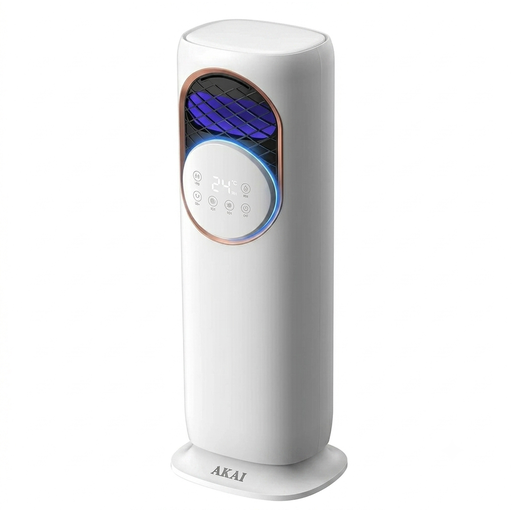
For anyone looking for a single appliance that combines air circulation with heating, air purification and humidifying functions.
The product name describes a fan with a heater, air purification and humidifying functions.
 No image available
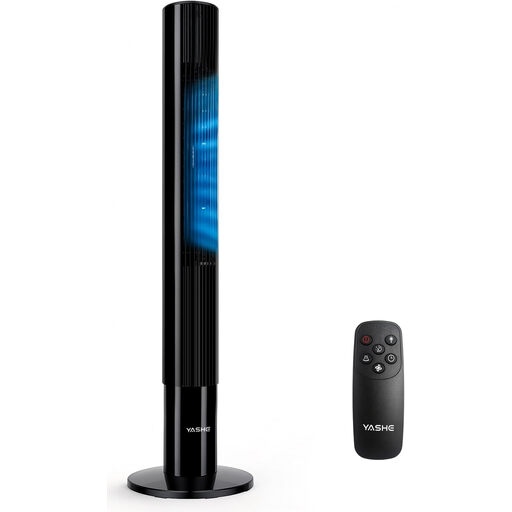
For anyone who wants to adjust the airflow across several seats spread around the room and operate the fan from their seat.
The product name lists 85° oscillation, three speeds, two modes, a 12-hour timer, remote control and an LED display. Assess the 28 dB figure in the context of the fan's operating conditions.
 No image available
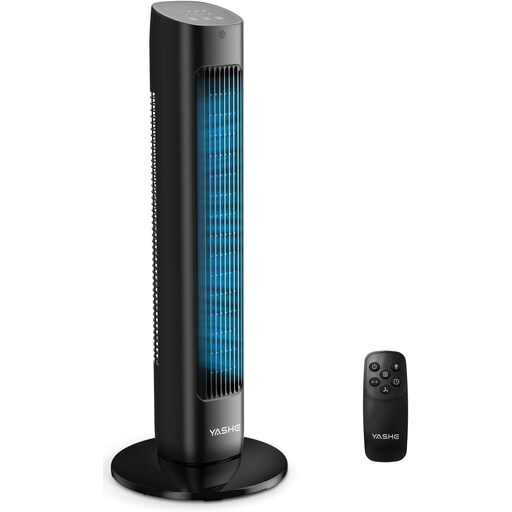
An option for anyone comparing tower fans with remote control and a height of 80 cm, as stated in the product name.
The product name also lists 28 dB; assess this figure alongside the operating conditions.
 No image available
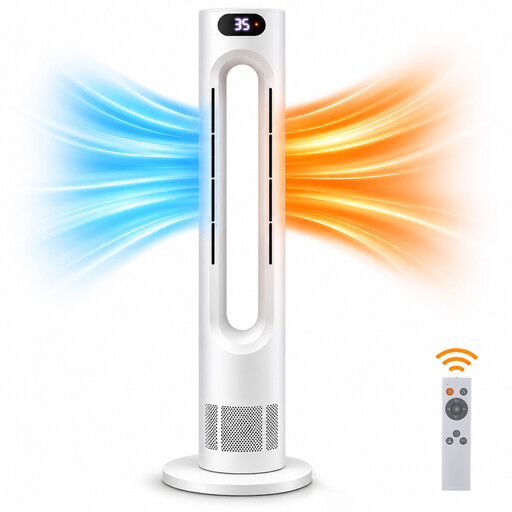
For anyone considering a fan that combines air circulation with a heating function and adjustable airflow distribution.
The product name lists 25 W in fan mode, 1.700 W heating power, ten cooling settings, three heating settings and 75° oscillation. It also includes a remote control and a nine-hour timer.
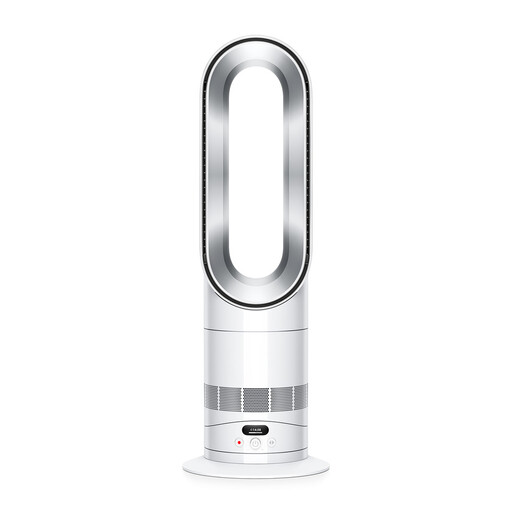 No image available
For anyone comparing cooling fans that can be operated via an app and remote control.
The product name lists app and remote control operation; the product description presents the appliance as a fan heater with a cooling function.
A tower fan moves the air, which can affect how warm people feel, but it does not remove heat from the room. The German Environment Agency recommends using shading in strong sunlight and ventilating when the outside air is cooler.
Direct the outlet and oscillation range towards the seats in use, and follow the safety instructions in the manual for your specific model. The Rowenta VU6670 has an IP20 rating; this does not mean it is suitable for a wet location. If the fan may be exposed to moisture or direct sunlight, check the manual for the permitted operating conditions.
Follow the cleaning and care instructions for the specific model. Rowenta offers a model-specific search for replacement fan parts. If a product is faulty, distinguish your statutory rights against the seller from any voluntary manufacturer's guarantee. For consumer purchases in the EU, the statutory guarantee period is at least two years from receipt of the goods.
Products covered by the relevant EU harmonisation rules must carry the CE marking. It represents the manufacturer's declaration of conformity and is not an independent quality mark. According to the Verbraucherzentrale, online consumer purchases generally come with a 14-day right to cancel from receipt of the goods; you must notify the seller that you wish to cancel.