For a regular spot where you sit or sleep, a carefully directed airflow may be best. If you want the breeze to reach several places in turn, the direction and oscillation range of a moving model are key. Compare noise and airflow at the same setting you’ll actually use, and check that the base and sweep area will fit in the space you have in mind. A fan moves air and can make people in the room feel cooler, but it won’t lower the room temperature like an air conditioner, as the German Consumer Advice Centre explains.
Who is a tower fan suitable for?
Airflow for several seats
If you share a small living space or move between seats, consider whether the airflow reaches several places where you spend time, rather than being felt only directly in front of the fan. COMPUTER BILD and IMTEST both treat air distribution and oscillation as factors to consider.
Noise-sensitive sleepers
If you’ll use the fan while sleeping or concentrating on work, it’s important to consider the airflow and noise together at the same setting. A low noise rating on a weak setting tells you little about whether the breeze will be strong enough where you need it.
People short on space
In a compact home, a slim footprint and easy storage are useful. Remember to factor in the base, cable routing and the space needed for the fan to oscillate.
What to look for when buying
First, think about where you want the breeze to reach and whether a steady airflow or moving between different seats matters more. You can then weigh up noise, floor space and running costs to suit the way you’ll use the fan.
| Buying criterion |
What to check |
Who it matters most to |
| Airflow at your seats |
Check the position, outlet direction, airflow height and oscillation range against the seats you actually use. |
If I want to cool several seats, the airflow should reach them in turn as the fan oscillates. Around 36% of consumers prioritise broader air distribution. |
| Quiet operation and a breeze |
Assess noise and airflow at the same setting; consider the night mode, display and timer in relation to your sleep or work routine. |
If I want a breeze while sleeping or working without unnecessary disturbance, both factors matter to me. Around 29% of consumers prioritise quiet operation. |
| Footprint and stability |
Allow for the dimensions including the base, cable routing, clear space for oscillation and a stable position. |
If there’s very little free space in my home, I need a spot that fits without losing sight of the airflow where I sit. Around 21% of consumers prioritise footprint and stability. |
| Operation and care |
Check the power consumption of the specific model version, how many hours you plan to use it and the cleaning instructions. |
If the fan will be running often, I want to understand how its energy use and care will fit into my daily routine. Around 14% of consumers prioritise ongoing running costs and upkeep. |
Common buying mistakes
-
Confusing air movement with cooling a room
A fan moves air and can make people in the room feel cooler, but it doesn’t remove heat from the room like an air conditioner.
Before you buy, decide whether you want a personal breeze or a lower room temperature.
-
Comparing only the lowest noise rating
At its quietest setting, the airflow may be too weak where you need it; at a higher setting, the operating noise may be more noticeable.
Assess the noise and cooling effect at the same setting you need, and in the place where you plan to use the fan.
-
Measuring only the slim tower
The base, cable and oscillation also take up space and may affect where you can position the fan.
Measure the footprint, including the base, and leave enough clear space for the fan to move.
An overview of key brands
Dreo
COMPUTER BILD covers the 519S and 307S as tower fans with various settings and comfort features. Its assessments apply to the models tested there.
- For the 519S, COMPUTER BILD highlights its settings and comfort features.
- For the 519S, COMPUTER BILD notes a limited oscillation range and clearly audible noise at the highest setting.
Levoit
The TempSense 36 DC and Classic 36 DC are documented tower fan models with several settings for adjusting airflow.
- For the TempSense 36 DC, model LTF-F362-AEUR, Levoit lists 15 settings and horizontal oscillation.
- These details apply to this model; check the dimensions and features of the exact model version you’re considering.
Rowenta
The Eole Compact VU6220F0 is described as a more compact model, while the Eole Silence Force VU7050F0 offers more settings and features, according to the manufacturer.
- Rowenta lists six settings and a timer for the Compact, and 12 settings and a remote control for the VU7050F0.
- Rowenta gives conflicting power and voltage figures for the VU7050F0 on the same product page. Only rely on these figures once they’re clearly confirmed for the specific model version.
Brandson
F.A.Z. Kaufkompass reviews the Brandson 303143 in its tower fan test; the assessment applies to this model.
- The test rates the 303143 positively for air distribution and build quality.
- The rating can’t be applied to other models from the brand across the board.
Philips
COMPUTER BILD covers the Philips 5000 Series model tested there as a range with a night mode and timer.
- COMPUTER BILD gives the tested series a positive rating for its even airflow and slim design.
- The same test notes the remote control’s short operating range as a drawback; the series name alone doesn’t identify a complete model version.
Joybuy products
The Joybuy models below are tower fans designed to circulate air around your home; some versions also list extra features such as heating or air purification. For the exact version, check CE compliance and make sure the instructions and warnings are available in German.
 No image available
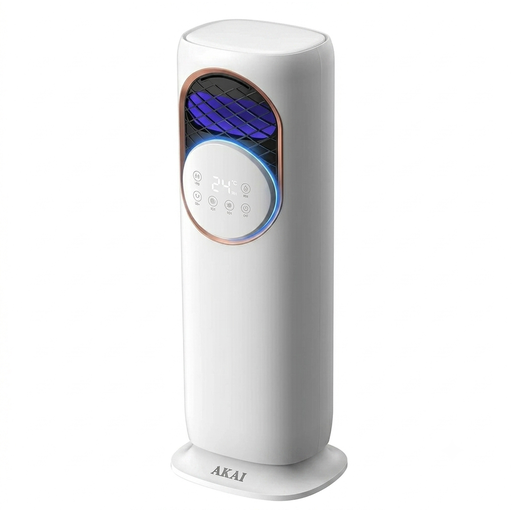
AKAI AKIC41-R 4-in-1 tower fan
If you’re looking for more than air circulation, the product title also lists heating, air purification and humidification.
Check whether this combination suits the way you plan to use it.
View at Joybuy
 No image available
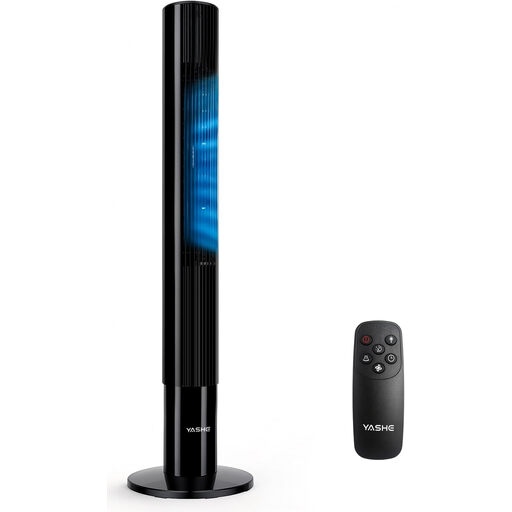
YASHE NDTFT17RH-S tower fan, 110 cm
If you use several seats, the stated oscillation is worth considering; check that its range suits the space where you’ll put the fan.
The product title lists 85° oscillation, three speeds, two modes, a 12-hour timer, LED display and remote control.
View at Joybuy
 No image available
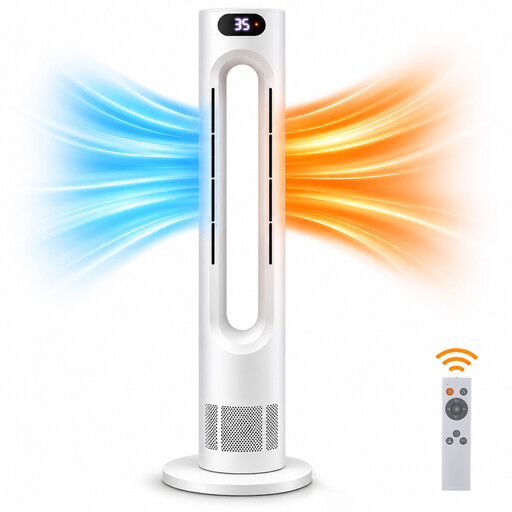
Rosnek tower fan with heating function, 103 cm
If you want heating as well as a fan, the product title lists both functions. Heating is an additional feature and doesn’t indicate how widely the fan distributes air.
The title lists ten cooling settings, three heating settings, 75° oscillation, a 9-hour timer and a remote control. It gives the fan’s power as 25 W and the heater’s as 1700 W.
View at Joybuy
 No image available
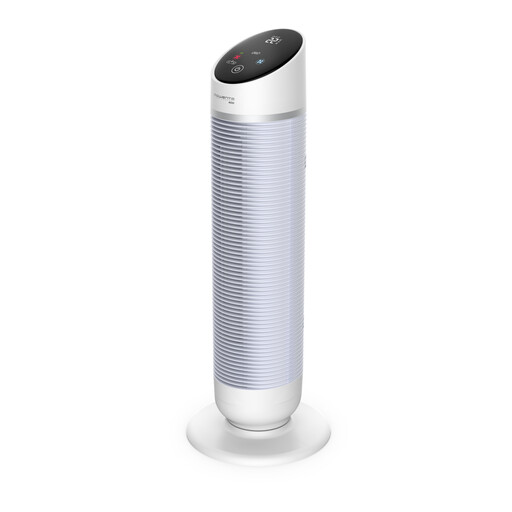
Rowenta HQ8120 3-in-1 tower fan
If you’re considering extra functions as well as a fan, the title also lists heating and air purification.
A remote control and timer are also listed in the product title. Check which of these features you’re likely to use.
View at Joybuy
 No image available
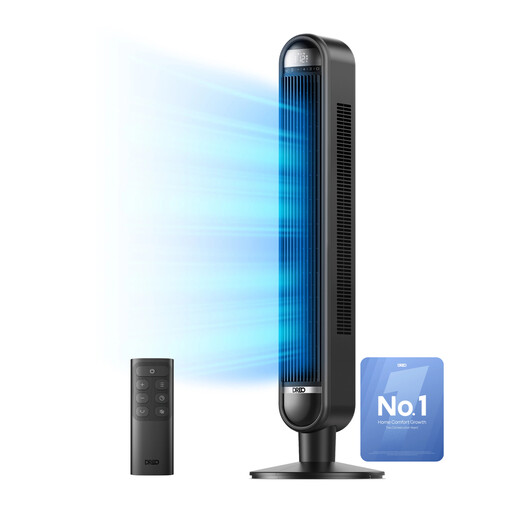
DREO 42 Inch Tower Fan
If you’ll use the fan across several seats, the stated oscillation is relevant; check that its range suits the position you have in mind.
The product title lists 90° oscillation, six speeds, four modes, a 12-hour timer, plus remote control and touch controls. Follow the supplier’s advice to keep the remote control’s button cell battery away from children.
View at Joybuy
Frequently asked questions
Will a tower fan cool down the whole room?
No. A tower fan moves air and can make people in the room feel cooler, but it won’t lower the room temperature like an air conditioner. If the room temperature is the main issue, you’ll also need to consider shading and ventilating when it’s cooler outside, as the German Consumer Advice Centre recommends.
Where should I put a tower fan in a small flat?
Choose a stable spot where the airflow can reach the seats you use, and leave room for the base and oscillation. Ventilating when the outside temperature is suitable helps to refresh the air; circulating air with a fan isn’t a substitute.
How should I plan for cleaning and electricity use?
Clean the fan according to the instructions for the specific model version. To estimate energy use, multiply the power consumption in watts by the number of hours used, then divide by 1000; the rated power alone won’t necessarily tell you the consumption at every setting.
What should I consider when buying a tower fan for use in Germany?
For the specific electrical appliance, check CE compliance and make sure the instructions and warnings in German are clear. According to information from the European Union, the CE marking is a manufacturer’s declaration, not an independent quality mark. Under Section 10 of the German Electrical and Electronic Equipment Act (ElektroG), a fan that has reached the end of its useful life must be collected separately from unsorted municipal waste.


