
Lieferung heute & morgen

Qualitätsgarantie

Willkommens-Angebote freischalten: KOSTENLOSE Lieferung | Bis zu 80 % RABATT | Kostenlose 30-Tage-JoyPlus-Testphase
App herunterladen
A toy airplane for kids can be a building set, role-play accessory, airport model, or simply an easy-to-use toy aircraft. For parents, grandparents, and gift buyers, however, the selection is not always easy to navigate. A high piece count, numerous functions, or colourful packaging alone says little about whether a model is suitable for the child’s age, available play space, and interests.
The overview page for toy airplanes features a wide range of options. Before buying, three checks can help: Is the recommended age appropriate? Are the accessories and dimensions practical for everyday use? And is the set primarily suited to building, role play, or open-ended play?
A children’s airplane building set with many pieces can offer extensive building and play opportunities. For younger children, however, a high piece count may also lead to lengthy construction times and frustration. A 118-piece set may be more suitable for a child aged 4 and over than a model with 887 bricks that is recommended only from age 8.
The key factors are therefore not just the number of bricks, but also:
Electronic features can enhance a passenger airplane toy. However, they require batteries, may stop working when the power source runs out, and are often less flexible than manual accessories. When choosing a battery-operated model, buyers should check whether batteries are included, how securely the battery compartment closes, and whether the volume can be adjusted.
For travel or quieter homes, manual models, sticker books, or a simple toy airplane may be more practical.
Many airplane and airport sets list the dimensions of the assembled model separately from the package size. A model measuring around 47 cm in length requires significantly more space on a play table than a compact helicopter toy. Vehicles, figures, and accessories take up additional room.
Before ordering, it is therefore worth checking:
The manufacturer’s age recommendation is a central selection criterion. Sets with small bricks or accessories are generally unsuitable for children under 3, as they may contain small parts that can be swallowed. Even for older children, the recommended age range should match their fine-motor skills and attention span.
Also look for the CE marking and information about the applicable toy-safety requirements. The CE marking is not a quality seal; it indicates that the manufacturer has declared conformity with relevant EU requirements. Safety and warning information on the product page or packaging should be read before purchase.
Depending on the model, the products listed are made from ABS plastic or other types of plastic. For building sets, precise connections are important; for play figures, buyers should look for features such as movable doors, rotors, or ramps. Marketing terms such as “realistic” should be assessed against specific functions:
For a children’s airplane building set, it is also worth checking whether the pieces can be disassembled after construction and whether replacement or expansion sets are available.
A LEGO City airplane generally combines building with role play. A passenger airplane, for example, may include airport staff, travellers, and luggage. A rescue airplane toy is more suited to children who enjoy creating emergency-response stories. A model airplane designed for display, on the other hand, is not automatically intended for regular play.
For children between the ages of 4 and 10, the following categories can serve as a useful guide:
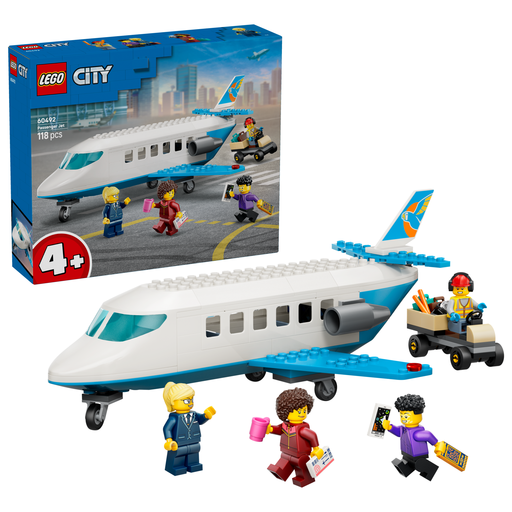
Why it stands out: According to the product details, this LEGO airplane is designed for children aged 4 and over. It includes 118 pieces, four minifigures, and a luggage cart.
The accessible age recommendation and starter brick make it easier to get started. The key play functions are manual and do not depend on batteries.
Openable fuselage, cockpit, and luggage compartment; stated model dimensions: approximately 27 cm long and 20 cm wide.
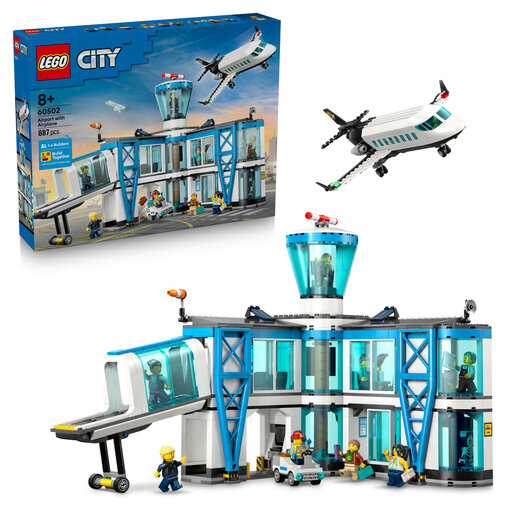
Why it stands out: According to the product details, this airport playset is intended for children aged 8 and over. It includes 887 bricks, nine minifigures, and several airport areas.
The contents are clearly specified, including the terminal, passenger jet, jet bridge, tow vehicle, and accessories. This makes it easier to assess the actual scope of play.
Rotating metal detector, luggage scanner, and adjustable flight information display; the assembled airport building is stated to be approximately 28 cm high.
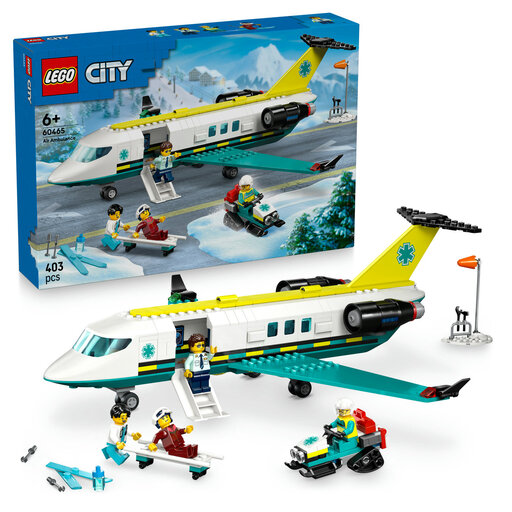
Why it stands out: According to the manufacturer, this rescue airplane toy is designed for children aged 6 and over. It combines an aircraft model with a snowmobile, airport setting, and four figures.
Its rescue focus is clearly defined: medical equipment, a loading ramp, and an openable fuselage take centre stage instead of vague promises about additional features.
403 bricks, an openable fuselage, and a pull-out laboratory with a screen and workstation, according to the product description.
For children who prefer recreating rescue missions with a helicopter toy, the LEGO City 60503 Coast Guard Helicopter is a good choice. According to the product details, the model includes 551 pieces, four minifigures, a winch, and an open rescue cabin.
An alternative for fans of classic role play is the PLAYMOBIL 71203 City Life Rescue Helicopter. The set is designed for children aged 4 and over and includes a stretcher, rescue equipment, and three figures, among other accessories. For a larger passenger aircraft with several ground vehicles, consider the LEGO City 60367 Passenger Airplane. According to the product details, it is suitable for children aged 7 and over and includes nine minifigures and four airport vehicles.
Our complete selection of toy airplanes includes models for different age groups, play styles, and budgets. Before buying, always check the recommended age, contents, and safety information.
For children aged 4 and over, simpler building sets such as the LEGO City 60492 Passenger Jet or manual PLAYMOBIL models are worth considering. The manufacturer’s age recommendation, a manageable piece count, and adult supervision are important, particularly when small parts are included.
How long a toy remains appealing depends more on its play concept than on its price. Models with openable cabins, figures, luggage, vehicles, or rescue accessories support a variety of scenarios. A display-only model, by contrast, may lose its appeal more quickly if the child prefers role play.
Manual building sets generally do not incur ongoing energy costs. Battery-operated models require the appropriate batteries and should have a securely closable battery compartment. Compatible product lines may also offer expansion sets later; these are usually sold separately.