
Lieferung heute & morgen

Qualitätsgarantie

Willkommens-Angebote freischalten: KOSTENLOSE Lieferung | Bis zu 80 % RABATT | Kostenlose 30-Tage-JoyPlus-Testphase
App herunterladen
Toy cars for children vary considerably in their power source, controls, materials, space requirements and recommended age. A small model car is easy to store, while a children’s racetrack or electric ride-on car needs considerably more room. With an RC car for children, you also need to consider batteries, range and how easy the remote control is to use.
As Joybuy’s Product Recommendation Officer, I pick out the most important product features and match them to specific use cases. This makes it easier to avoid buying a vehicle that promises plenty of features on the packaging but doesn’t suit your child’s age or your home in everyday use.
A toy car for children aged 3 and over isn’t automatically suitable to use with every accessory. Small racing cars, components, road signs and plug-in connectors may not be suitable for younger children. For RC vehicles, parents should also check whether the remote control is easy for little hands to use.
The manufacturer’s age recommendation is an important starting point. For products with small parts, you should also check the warning label. A model car for collectors aged 14 and over, for example, is not the same as a sturdy vehicle for free play in a child’s bedroom.
A remote-controlled car usually needs batteries for the remote control and a rechargeable battery or additional batteries for the vehicle. A claim such as ‘rechargeable’ alone tells you little about charging time, the connection or whether you’ll need replacements. Before buying, check:
For an electric ride-on car for children, the combination of speed, remote control and seat size is also important. A vehicle may have suitable technical features but still be unsuitable for tight indoor spaces or uneven paths.
A large children’s racetrack needs a space that can be kept clear for regular use. How well a remote-controlled car performs on smooth floors, grass or paved paths depends on its design. Product details such as dimensions, suspension and drive system can help you choose.
Parents should also supervise the area when children are using a remote-controlled vehicle. Doorways, stairs, roads, water and delicate furniture are not suitable places to drive.
For children aged 3 and over, simple vehicles without hard-to-reach small parts are usually a good choice. Pull-back and friction-powered cars are easy to use in imaginative play. A toy car transporter adds loading, parking and transporting to the play scenario.
From around 5 or 6 years old, children may enjoy more complex controls, a racetrack or an RC car. However, suitability depends on fine motor skills, concentration and adult supervision.
2.4 GHz remote controls are useful for remote-controlled cars when several vehicles are being used in the same area. For electric ride-on vehicles for children, soft start, a limited speed and a parental remote control are relevant safety features, according to the product description.
A pull-back drive needs no batteries and is easy to use. An RC vehicle with four-wheel drive and a stunt function offers more action, but usually needs more space and supervision.
Look for rounded edges, sturdy wheels, a suitable vehicle size and enough storage space. A storage feature can be useful for sets with several cars. A foldable racetrack set or a transporter with an integrated parking area is easier to put away after play.
For collector’s models, scale and materials matter more than driving features. Metal parts, opening doors and a detailed interior are better suited to display and careful play than to the sandpit.
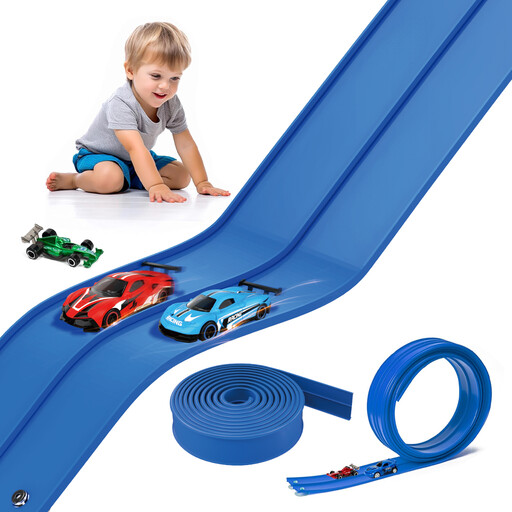
Why this product suits this profile: The flexible dual-lane track can be set up indoors or outdoors for children aged 3 and over, then rolled up after play.
According to the product details, it needs no batteries and has no permanently installed power connection.
A 4.5-metre flexible track, two lanes and four friction-powered cars, according to the description.
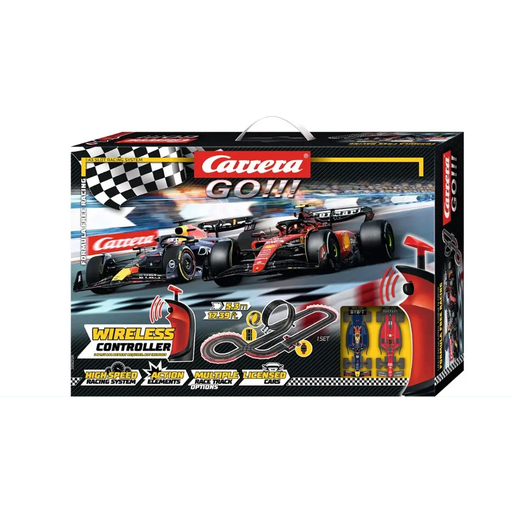
Why this product suits this profile: This set is designed for children aged 5 and over, as well as adults who prefer structured racing play with two vehicles.
The track length and assembled footprint of around 180 × 75 cm are clearly stated.
Two officially licensed slot cars, wireless controllers and a stated track length of around 5.3 metres.
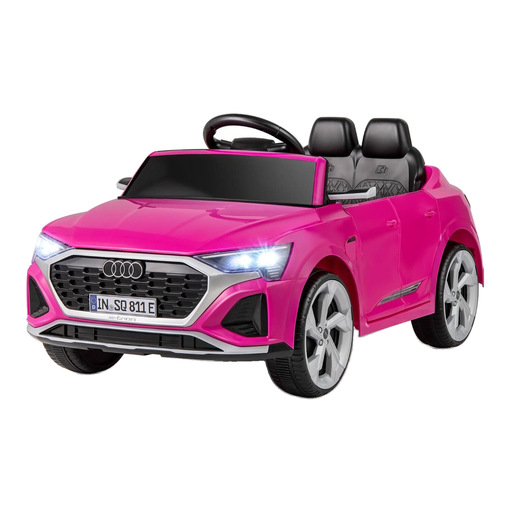
Why this product suits this profile: According to the product details, this electric ride-on car is designed for children aged 3 and over, and offers both manual operation and parental remote control.
Three speed settings, soft start and a stated speed of 3–5 km/h make it easier to understand how the controls work.
A 12-V battery, two 12-V motors, seat belt, LED lights and lockable doors, according to the product details.
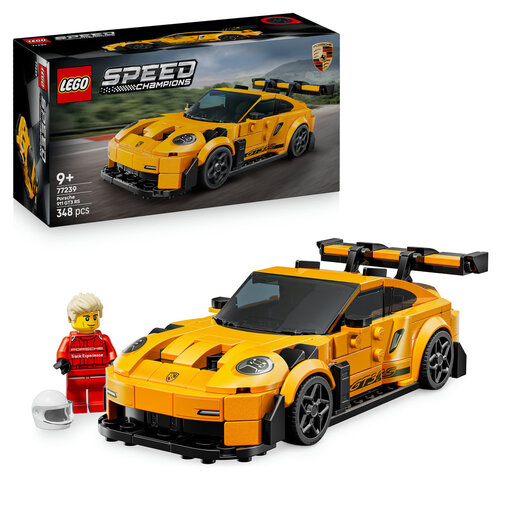
Why this product suits this profile: This LEGO racing car is designed for builders aged 9 and over, as well as adult fans of building sets and model cars.
The recommended age, number of pieces and model dimensions are clearly stated, making it easier to plan the build and display space.
348 building pieces, a driver minifigure and stated dimensions of 16 cm long and 5 cm high.
We’ve put together a complete, regularly updated list of products that meet these strict selection criteria and fully comply with the safety regulations in force in the EU.
For children aged 3 and over, options include simple pull-back cars, flexible racetracks, toy car transporters and electric ride-on vehicles specifically approved for this age group. Always check warnings about small parts, and initially supervise children when they use remote-controlled models.
Battery life depends on battery capacity, the driving surface, motor power and how much the lights are used. Specific details about the battery, charging process and what’s included are more reliable than general advertising claims. If buying a replacement, make sure the voltage, connector and shape match.
It depends on the assembled track length and layout. A Carrera track may need a larger, level surface, while a flexible track can be rolled up after use. Before buying, compare the stated overall dimensions with the space available in your child’s bedroom.