
Lieferung heute & morgen

Qualitätsgarantie

Willkommens-Angebote freischalten: KOSTENLOSE Lieferung | Bis zu 80 % RABATT | Kostenlose 30-Tage-JoyPlus-Testphase
App herunterladen
Toy cars for children range from simple push-along cars and interactive learning toys to remote-controlled vehicles and electric ride-on models. However, the wide choice can make comparisons difficult. A flashing vehicle is not automatically suitable for a baby, while a large set can quickly become impractical in a child’s room.
Three common purchasing mistakes occur particularly often:
For babies from around 6 months, large, rounded baby toy cars without loose small parts are generally more suitable. Moving elements can encourage attention and reaching movements, but should only be used under supervision. For toys with small vehicles, detachable figures or accessories, the warning about choking hazards is essential.
An RC car for children should be suitable for their motor development. Very young children need just a few clearly identifiable controls. With a remote-controlled children’s car, you should also check whether adults can take over control and whether batteries are included.
Look for information about the material, manufacturer, responsible person in the EU and the CE marking. This is a legally relevant declaration of conformity, but it is not an independent quality seal. For products intended for toddlers, rounded edges, a stable base and robust construction are also useful points to check.
The European standards series EN 71 sets out requirements for toy safety. Nevertheless, you should read the specific product information, as age recommendations, battery details and warnings may vary from one model to another.
A children’s racing track requires a level surface and, once assembled, often takes up considerably more room than the packaging suggests. For an electric vehicle for children, you should also consider speed, charging time, battery capacity, maximum load and the safety belt. A remote-controlled model can be useful for parental control.
With a toy car with lights and music, look for volume control and an automatic shut-off function. Battery-powered models involve ongoing costs, while electric ride-on vehicles also require charging time and a suitable place for storage.
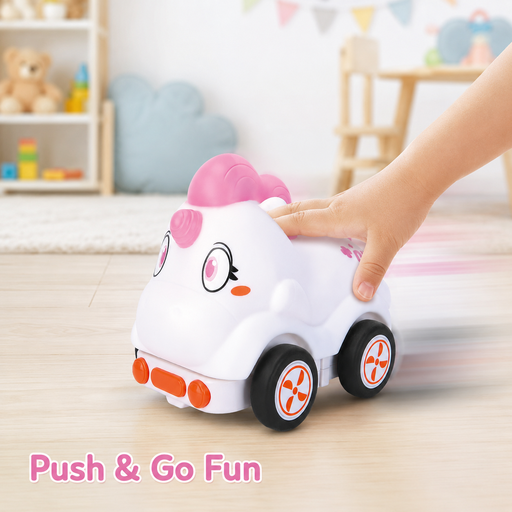
Why this product suits this profile: This push-along car can be used without a remote control or charger. Light and sound effects add to imaginative play, making it suitable for family activities or as a small gift.
Operation is limited to pushing and rolling the car. This means there are no ongoing charging costs and no complicated controls.
Inertia drive with light and sound effects; supplied as a single pack. The colour or design may be selected at random, according to the product information.
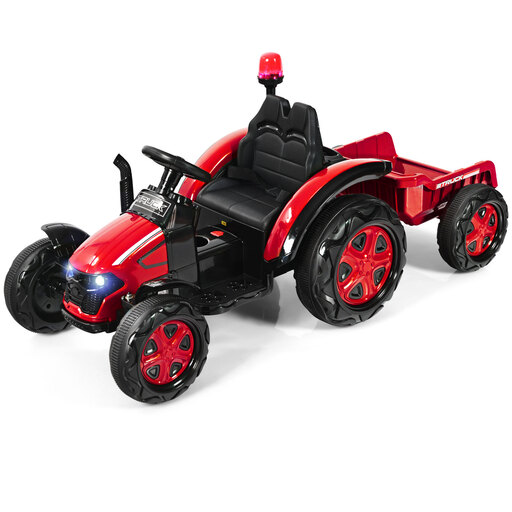
Why this product suits this profile: This electric vehicle for children is designed for outdoor surfaces such as grass, asphalt or sand and, according to the product information, is intended for children aged 3 to 8.
The technical specifications state the speed, charging time, maximum load and dimensions. This helps you assess the actual space and care requirements before buying.
12-volt battery, 3 to 8 km/h, 30 kg load capacity, trailer and 2.4 GHz remote control; a safety belt and instruction manual are also specified.
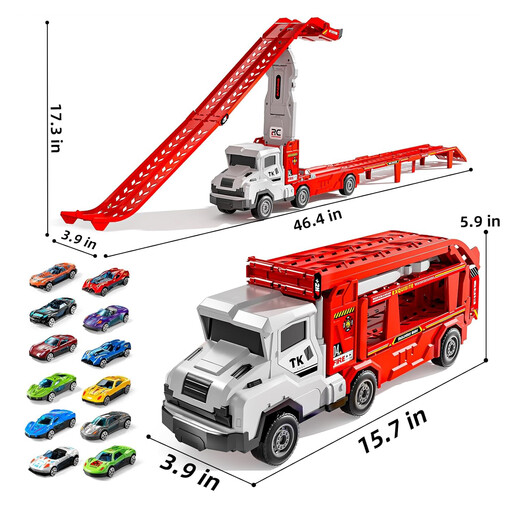
Why this product suits this profile: This car transporter with toy cars combines storage, push-along play and racing. It is suitable for children who collect vehicles and enjoy playing with siblings or friends.
The vehicles have clearly described functions: transporter, storage and a fold-out racing track. This reduces the amount of accessories that may go unused after a short time.
Includes one transporter, twelve die-cast cars and two fold-out racing lanes; designed for racing together with two or four players.
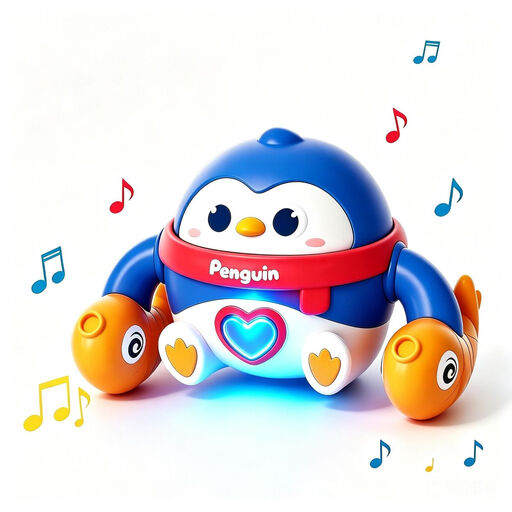
Why this product suits this profile: According to the product information, this rolling baby toy car is intended for children aged 6 to 36 months. Movement, light and music functions encourage observation and interaction.
The product description states the material, age range and that batteries are not included. This allows you to check safety and ongoing costs in advance.
360-degree rolling movement, motion sensor, LED light and music; according to the supplier, made from BPA-free ABS with rounded edges.
We have put together a complete, regularly updated list of products that fully meet these strict selection criteria and the safety regulations applicable in the EU.
This depends on the controls, vehicle size and warnings. Products with small parts are often unsuitable for children under 3. An RC car for children should have age-appropriate, simple controls. For younger children, supervised use is recommended.
Battery life varies depending on the motor, lights, music, usage time and battery quality. For an electric vehicle for children, charging time and battery capacity are particularly important in the technical specifications. Battery-powered models should be switched off after play and stored in a dry place.
For a gift for boys and girls, versatile models that support open-ended imaginative play are practical. A transporter with several cars is ideal for playing together, while an interactive learning toy for younger children can offer manageable functions such as rolling, buttons, lights or sounds. Age, safety information, space requirements and the child’s interests remain the key considerations.