
Lieferung heute & morgen

Qualitätsgarantie

Willkommens-Angebote freischalten: KOSTENLOSE Lieferung | Bis zu 80 % RABATT | Kostenlose 30-Tage-JoyPlus-Testphase
App herunterladen
A toy cash register is more than just a plaything—it's a gateway to imaginative worlds where children become shopkeepers, cashiers, and customers. In a pretend play shop, they learn to handle numbers and money, develop social skills, and refine their fine motor skills in a fun, engaging way. However, the market is flooded with models that vary widely in quality and functionality. Before you make a decision, it's crucial to understand the common weaknesses that can quickly spoil the fun.
As your Joybuy Product Recommendation Officer, I'm here to help you separate the wheat from the chaff. In this guide, I'll show you the three most common pitfalls when buying a kids' cash register with a scanner and explain which features truly matter.
Many toy cash registers look promising at first glance but turn out to be a poor purchase after a short time. Pay special attention to these three weaknesses:
To avoid the pitfalls mentioned above, you should check three key aspects before buying. These features determine whether a supermarket checkout toy will provide lasting joy or just gather dust in a cupboard.
The heart of a good toy cash register is its electronics. An integrated calculator with basic arithmetic functions allows children to actually add up the prices of the "sold" goods. This promotes numerical literacy far more than mere sound effects. The scanner is equally important: it should emit a light signal and a realistic beep when "scanning." This immediate feedback makes the role-playing experience significantly more immersive and understandable.
Your child's safety is the top priority. Look for the CE mark, which confirms that the product meets the applicable EU requirements for safety, health, and environmental protection. High-quality models are typically made of ABS plastic, a robust and non-toxic material. The edges should be rounded to prevent injuries. Also, check the manufacturer's age recommendation and warnings about small, swallowable parts, especially if younger siblings are in the household.
A well-thought-out set allows for an immediate start to role-playing. A good package includes:
A complete set prevents you from having to buy additional accessories and ensures the play experience is whole from the very beginning.
Not every toy cash register suits every child. We have selected some products from our range that cater to different needs and play preferences.
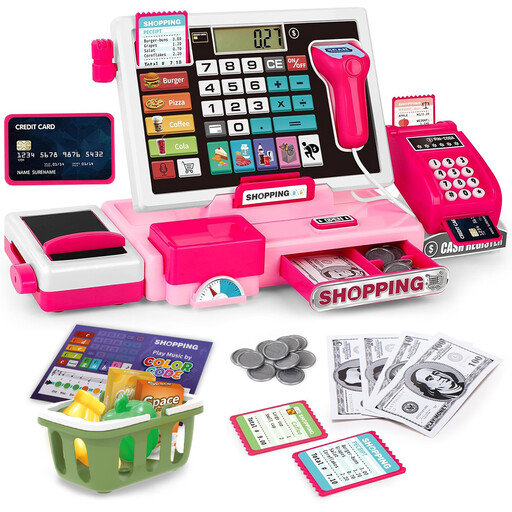
Why This Fits Their Persona: Ideal for children who want to dive straight into a comprehensive pretend play shop experience. This pink toy cash register comes as a complete set with everything needed to start playing immediately—from the register to the groceries.
Avoids the trap of insufficient accessories by including a shopping basket, play food, and play money. The working calculator prevents the disappointment of a non-functional dummy.
Multifunctional with a real calculator and an additional piano mode. Promotes both basic mathematical and musical skills.
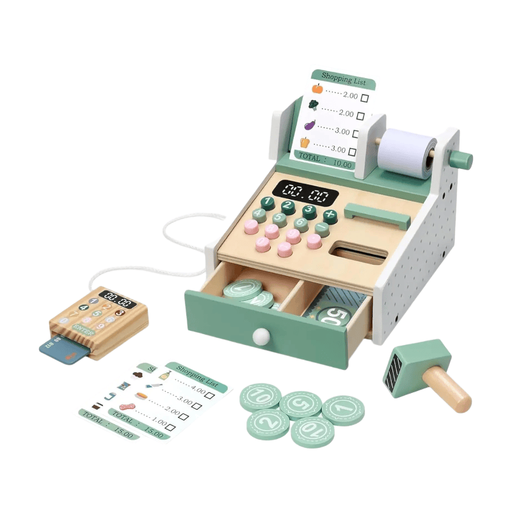
Why This Fits Their Persona: A straightforward and focused option for parents looking for a basic play shop register. It's well-suited for introducing the concept of shopping without overwhelming the child with too many features.
Focuses on the core functions of a cash register, thus avoiding overloaded, potentially faulty electronics. A direct way to learn the basic procedures of checking out.
Clean, simple design that stimulates the imagination and focuses on the essentials of role-playing. Ideal for younger children or as an addition to an existing play shop.

Why This Fits Their Persona: Perfect for parents whose main goal is to foster mathematical skills. If the child is more interested in number puzzles than role-playing, this device offers a targeted, playful learning platform as an alternative to a classic cash register.
This is a pure educational toy and therefore bypasses the typical flaws of role-play electronics. It focuses uncompromisingly on calculation functionality and provides a robust learning environment.
Screen-free, interactive learning with over 50,000 math problems. Specifically promotes arithmetic skills in addition, subtraction, multiplication, and division.
A toy cash register is a wonderful start to the world of learning. If you want to discover more toys that promote early childhood development, we have put together a suitable selection for you.
Most manufacturers recommend toy cash registers for children 3 years and up. At this age, children begin to understand role-playing and can handle simple counting tasks. For younger children, you should choose models without small, swallowable parts and always supervise their play.
Most electronic toy cash registers require standard AA or AAA batteries. It is advisable to check the product description before purchasing, as batteries are often not included in the box. To avoid disappointment on a birthday or Christmas, you should order a matching set of batteries at the same time.
A slightly damp cloth is usually sufficient for cleaning. Do not use aggressive cleaning agents or disinfectant sprays, as they can damage the plastic surface or the electronics. Never fully submerge the toy in water. Make sure that no moisture gets into the battery compartment or other openings.