
Lieferung heute & morgen

Qualitätsgarantie

Willkommens-Angebote freischalten: KOSTENLOSE Lieferung | Bis zu 80 % RABATT | Kostenlose 30-Tage-JoyPlus-Testphase
App herunterladen
A toy crane truck needs to look good on the shelf, but that’s not all that matters. For children, what counts is whether the crane arm moves, whether the vehicle stands steady, and whether the features still work reliably after many play sessions. Parents and grandparents also pay close attention to the age recommendation, materials, small parts, and the space available.
An extendable crane arm looks appealing on the packaging. However, without fold-out stabiliser legs or a sufficiently heavy vehicle body, the construction vehicle toy can easily tip over when lifting small objects. For more realistic play, stability and a controllable mechanism are more important than a long list of accessories.
A small SIKU crane in 1:55 scale fits nicely in a child’s hands and can be stored away without taking up much room. A large crane vehicle for children in 1:16 scale, on the other hand, needs considerably more space. Before buying, you should check the dimensions, play area and any existing vehicles, so the new model fits in with the garage, carpet landscape or play table.
A crane truck for ages 3 and up may contain small moving parts, hooks or ropes. The age rating is therefore not just a marketing label. With models recommended for ages 4 or 6, parents should check whether the child can safely operate the mechanism. The warnings on the packaging and the manufacturer’s information are what matter.
Metal parts often give a vehicle more weight and can help compact models stand steadily. Plastic, on the other hand, allows for larger components, moving superstructures and easy handling. With a toy crane, a combination of both materials is often practical: the vehicle body can be robustly made, while the boom, supports and accessories are made of plastic.
Also important are clean-fitting joints, rounded edges and clear care instructions. With plastic models such as a Bruder crane truck, you should regularly check that the crane arm, stabiliser legs and doors are still working safely.
For creative role play, the following features are relevant:
A construction crane toy with many moving parts may require more supervision. For younger children, a smooth, straightforward mechanism is usually more suitable than a complex model with strings and lots of small parts.
Pay attention to the stated age group, the warnings and the product information on toy safety. The EU Toy Safety Directive and the EN 71 series of standards relate, among other things, to mechanical and physical properties. This information does not replace adult supervision.
For everyday use, also consider:
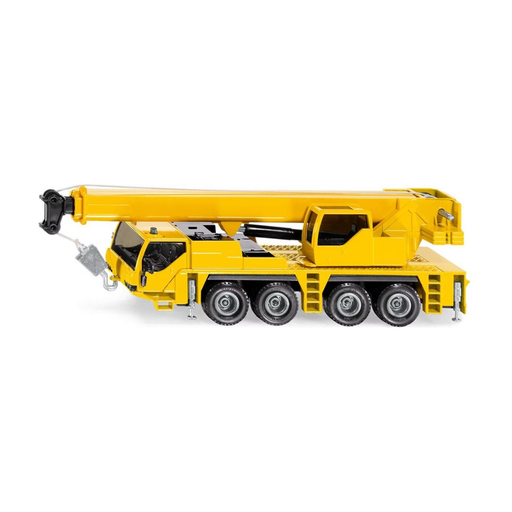
Why this product fits the profile: This compact model is recommended for children aged 3 and over and requires no batteries. It is ideal for small play areas and as an addition to other SIKU vehicles.
The 1:55 scale and compact dimensions reduce space issues. Extendable supports and a double telescopic boom offer more function than a static display model.
Metal-plastic construction, rotating cab, manual winch and extendable metal supports.
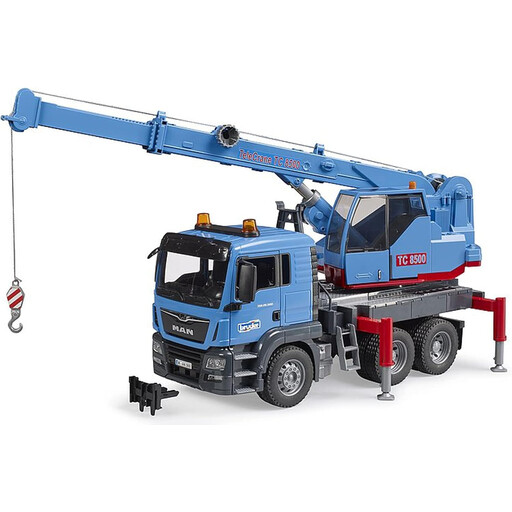
Why this product fits the profile: This 1:16 scale model is designed for children aged 4 and over and offers a large vehicle with several manually operated elements for longer role-play scenarios.
Four stabiliser legs address the typical tipping problem when the crane is extended. Operation is manual, so there are no ongoing battery costs.
360-degree rotating crane, functional cable pulley with overload protection and robust plastic construction.

Why this product fits the profile: This crane vehicle is aimed at children aged 4 and over who frequently play with construction vehicles and want to recreate various loading tasks.
The extendable crane arm can be locked; stabiliser legs and fold-down side panels support controlled loading processes. The accessories are designed for specific play scenarios.
360-degree rotation, telescopic arm, grab bucket, pallet fork and two pallets included.
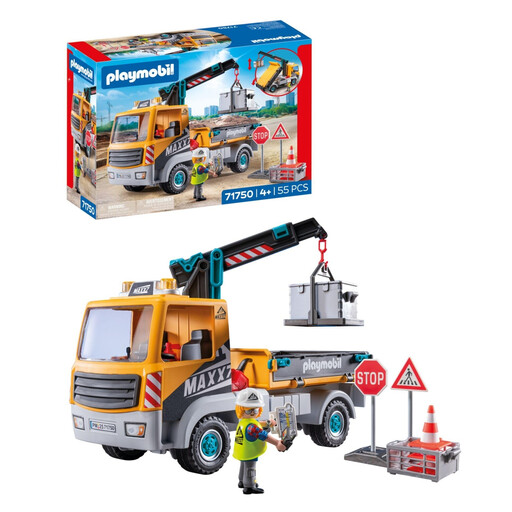
Why this product fits the profile: This model combines a crane vehicle with a tipping loading area and drop-side panels. It is recommended for children aged 4 and over and can be combined with other PLAYMOBIL worlds.
The functions are clearly focused on transport and construction site logistics. The care instructions recommend regular checks of the telescopic arm, loading area and side panels.
Manual operation, extendable and swivelling telescopic arm, tipping loading area and expandable play system.
We have put together a complete, regularly updated list of products that fully meet these strict selection criteria and the safety regulations in force in the EU.
That depends on the individual model. Some SIKU vehicles are recommended from age 3, while larger models from Bruder and PLAYMOBIL often carry a recommendation from age 4. If the vehicle contains ropes, hooks or small accessories, you should pay particular attention to the warnings and supervise younger children.
Many models work entirely manually. This means there are no battery costs during play. Individual vehicles with light and sound modules do need batteries; you should therefore check the product description before buying. For regular play, manual functions are often easier to handle and store.
After playing, loose accessories should be collected and moving parts checked for visible damage. Plastic models should be cleaned with a dry or slightly damp cloth, unless the manufacturer states otherwise. Excessive force on the crane arm, prolonged exposure to sunlight and use outside the intended area can put strain on the material and mechanism.