
Lieferung heute & morgen

Qualitätsgarantie

Willkommens-Angebote freischalten: KOSTENLOSE Lieferung | Bis zu 80 % RABATT | Kostenlose 30-Tage-JoyPlus-Testphase
App herunterladen
A toy excavator should look like more than just a real construction vehicle. The right size, moving parts, durable materials and suitability for your family’s day-to-day life are all important. Whether you’re looking for a sandbox excavator, a toy excavator for the playroom or an electric ride-on excavator, not every model is right for every age.
Lights, sounds, remote controls and motorised drive can look appealing in product photos. But for younger children, easy-to-reach controls and a straightforward design are often more practical. A complex vehicle can quickly end up unused if your child can’t operate its features independently.
An age recommendation such as “from 2 years” or “from 3 years” isn’t just a marketing detail. It can depend on factors including the design, small parts and how the toy is operated. Even with construction vehicles that look robust, parents should check the warnings, maximum load and information on the packaging.
A large wheel loader or ride-on excavator needs plenty of room to move around. In a small home, a compact toy excavator with manual controls may be a better choice. On the other hand, narrow plastic wheels aren’t always practical on uneven sand. Before buying, consider the space available, the route it’ll travel and the type of surface.
For an excavator for children aged 2 and over, simple, easy-to-grip controls and a sturdy design are important. A single central handle for the excavator arm may be easier for toddlers to understand than several separate levers. Depending on the model, an excavator for children aged 3 and over may have extra features such as motorised drive or sound effects.
Check the following:
The manufacturer’s age recommendation shouldn’t be replaced by a general assessment. For example, the Bruder 03413 is listed as suitable from 24 months; the product information also includes a warning for children under 18 months. Always follow the information provided on the product and its packaging.
Reinforced or high-quality plastic can be a practical choice for regular indoor and outdoor play. Rather than relying on a general material description, look for moving joints, rounded parts, sturdy wheels and a shovel that can withstand regular use.
A Bruder excavator or Lena excavator will often have practical mechanical features such as a movable shovel and excavator arm. Even so, check that the size and weight are right for your child. A heavier model may be stable, but younger children could find it difficult to push or turn.
For the sandbox, look for a shovel mechanism that can scoop up and tip out sand. Compact models with smooth-rolling wheels are often more practical in a playroom. A toy wheel loader is operated differently from a tracked excavator: its loading shovel is the main feature, while an excavator may also have a swivelling body and movable arm.
A toy bulldozer can also be a useful addition if your child enjoys pretending to push and level things. Ride-on models, on the other hand, need more space, a level surface and close supervision.

Why it’s a good fit: This mechanical excavator is designed for children aged 2 and over and needs neither batteries nor assembly. It’s an easy-to-use choice for play indoors, outdoors or in the sandbox.
It’s operated using a functional excavator arm and a handle. There’s no complicated electronics, batteries or extra set-up to worry about.
Reinforced plastic, approx. 35 cm long, with a fully functional arm and handle.

Why it’s a good fit: This model has a movable excavator arm and a body that swivels through 360 degrees. According to the product information, it’s suitable for children aged 24 months and over.
The main features are operated mechanically. This makes them easier to control than models whose play value relies mainly on sounds or battery-powered effects.
360-degree rotation, an arm that raises and lowers, and an adjustable blade at the front.
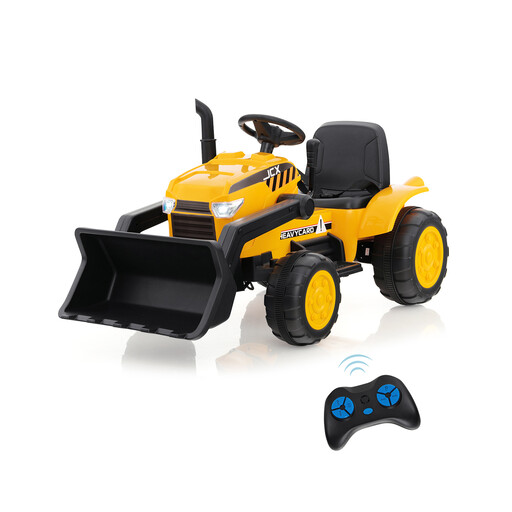
Why it’s a good fit: This electric ride-on model is designed for children aged 3 to 8 and combines powered driving with a manually operated excavator arm. It’s intended for use on level indoor and outdoor surfaces.
The product information lists a slow-start function, seat belt, remote control with emergency brake and a maximum load of 30 kg. Check that these features suit how you plan to use it before buying.
12-volt drive, three speed settings via remote control, and an adjustable excavator arm with a control lever.
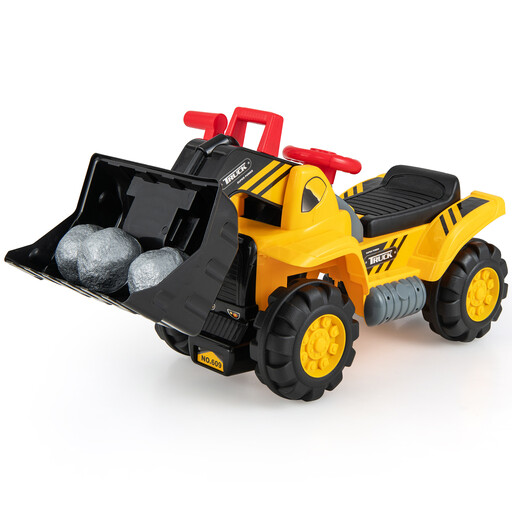
Why it’s a good fit: This ride-on vehicle is designed for children aged 3 and over, with a maximum load of 25 kg. It’s a good choice for families looking for a toy bulldozer to use on level surfaces such as wood, concrete or paving.
The product information lists non-slip wheels, a tip-resistant design and a clearly stated weight limit. The surface it’s used on still matters, though.
Adjustable blade, storage space under the seat and four HDPE wheels with a non-slip design.
We’ve put together a complete, regularly updated list of products that meet these strict selection criteria and the safety regulations in force across the EU.
Mechanical models with a movable arm and shovel are usually a good choice for the sandbox. They don’t need batteries and can scoop up, lift and tip out sand. Look for a stable base, joints that move smoothly and a size your child can manage independently.
Its lifespan depends on the materials, how often it’s used and how it’s stored. Reinforced plastic can be suitable for regular play. After playing in the sand, remove any larger particles from the joints and wheels. Storing the toy somewhere dry and out of direct sunlight can help reduce wear on the materials.
The main costs for electric models are the electricity needed to recharge them and, where applicable, batteries for the remote control or sound features. You should also check the charging time. The product information for a model with a 12-volt battery lists a charging time of 8 to 12 hours. Always follow the manufacturer’s specific operating and charging instructions.