
Lieferung heute & morgen

Qualitätsgarantie

Willkommens-Angebote freischalten: KOSTENLOSE Lieferung | Bis zu 80 % RABATT | Kostenlose 30-Tage-JoyPlus-Testphase
App herunterladen
A toy excavator should do more than just look yellow. Parents, grandparents and other family members often look for realistic details, but can overlook important differences in age recommendations, mechanisms and space requirements. When buying a toy excavator for a child, unclear product information or too many small parts can quickly lead to the wrong choice.
1. Not checking the size of the parts against the age recommendation
A model may be labelled as suitable for children aged 3 or 4 and over, while also requiring adult supervision. Small figures, accessories or detachable parts mean children may need closer supervision. Take particular care with products containing small parts if buying for children under 36 months.
2. Assuming moving parts can withstand rough play
An excavator with a shovel, rotating cab or extendable arm offers plenty of ways to play. However, that doesn’t necessarily mean its mechanisms are designed to withstand rough pulling, climbing or large amounts of sand. Before buying, check whether it’s a model for imaginative play or a sturdy toy for outdoor use.
3. Underestimating how much space it takes up
Construction vehicles can take up considerably more room than product photos suggest. A vehicle measuring 40 to 70 centimetres long may not fit on every shelf. Sand and water tables also need to be stored and cleaned, and require a suitable space to set them up.
The age label is a useful starting point, but it doesn’t replace checking the warnings. If you’re buying a toy excavator for a child aged 3 and over, check:
The CE marking indicates that the manufacturer has taken the relevant EU requirements into account. However, it isn’t a quality mark and, on its own, says nothing about the product’s durability or educational value.
Plastic is commonly used for toy construction vehicles. It’s not just the material, such as ABS or reinforced plastic, that matters: the joints and how they’re made are important too. The shovel arm should move smoothly and shouldn’t jam during normal use.
For children aged around 2 and over, simple, sturdy models with few detachable parts are often easier to manage. Models for older children can be more complex: a rotating cab, tipping skip, crane arm or extra tools can add to imaginative play. With construction toys for children, it’s also worth checking whether screws, pieces and tools can be tidied away neatly after play.
Manual vehicles don’t need batteries and are ready to play with straight away. A remote-controlled excavator for children or a motorised ride-on model, on the other hand, needs batteries, charging time and a suitable, flat surface. Before buying, check the charging time, range, remote control, braking function and maximum user weight.
For the sandpit, choose models with surfaces that are easy to wipe or rinse clean. Electronic components shouldn’t be used in sand or water. For an indoor construction set, compact dimensions, a manageable number of accessories and sturdy mechanisms are key.

Why it suits this profile: This toy excavator, measuring around 35 cm, is suitable for children aged 2 and over, requires no assembly and can be used indoors or outdoors.
The product details specify reinforced plastic, a moving arm and no assembly requirement. That makes it straightforward to get started, but you should still follow the safety information on the packaging.
Manual operation, a length of around 35 cm and simple features that are easy for young children to manage.
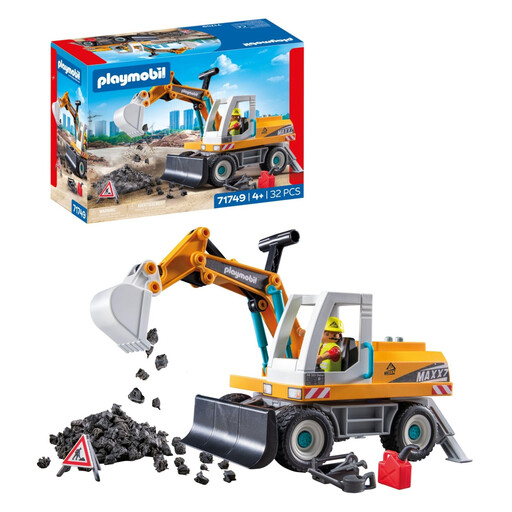
Why it suits this profile: This construction vehicle toy is aimed at children aged 4 and over. It combines a driver’s cab with a large shovel, a moving arm and an extra hand shovel.
The shovel is operated using a handle, so how it works is clearly explained. The set doesn’t need batteries, but you should still bear in mind the small parts and age recommendation.
Measures 39 × 29 × 16 cm, with a manually operated shovel and the option to add other PLAYMOBIL play worlds.
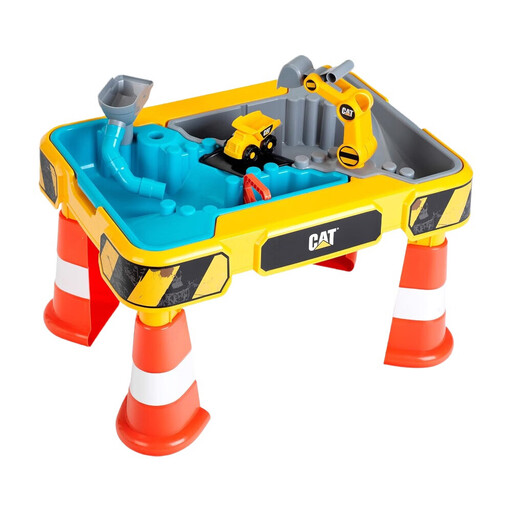
Why it suits this profile: For families with a garden or patio, this play table creates a dedicated space for play, with an excavator arm, dumper truck, pipes, stoppers and removable tubs.
The dimensions of 64 × 48 × 40 cm and removable tubs make it easy to plan for the space needed and cleaning. That helps avoid surprises when using it outdoors.
Combines sand and water play, with removable tubs that can be cleaned using a mild cleaning product and water.
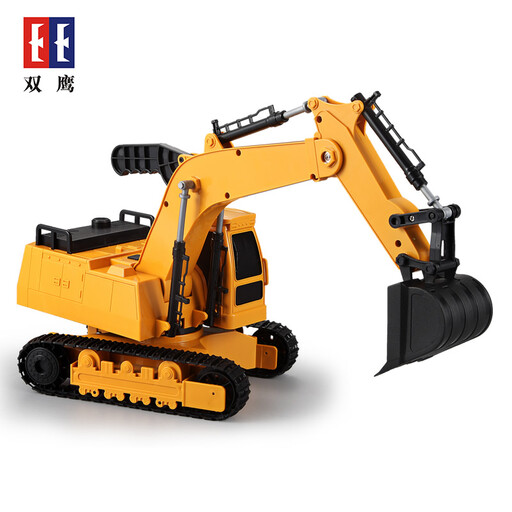
Why it suits this profile: According to its product description, this manual model is designed for children aged 3 and over. It features a cab that rotates through 360 degrees, rubber tracks and a moving shovel mechanism.
The product description lists specific features rather than making vague claims about realism. Even so, check the full safety information before ordering.
Manual operation, a rotating cab, rubber tracks and a moving boom for imaginative, hands-on play.
We’ve put together a complete, regularly updated list of products that meet these strict selection criteria and the safety requirements in force in the EU.
It depends on the design and accessories. Some simple, sturdy vehicles are available for children aged 2 and over. Models with figures, tools or small push-fit parts are often aimed at children aged 3 or 4 and over. Always follow the manufacturer’s information and the warnings on the packaging.
Its lifespan depends on the plastic, joints, how it’s used and how it’s stored. After outdoor play, clean the toy and store it somewhere dry. Prolonged exposure to direct sunlight and frost can affect the plastic and colours. Check moving parts regularly for cracks, looseness or unusual play.
Battery-powered or electric models incur the cost of batteries or electricity. Charging time, battery capacity and the availability of replacement parts are also worth considering. A manual excavator needs no power supply, making it handy for spontaneous play indoors or outdoors.