
Lieferung heute & morgen

Qualitätsgarantie

Willkommens-Angebote freischalten: KOSTENLOSE Lieferung | Bis zu 80 % RABATT | Kostenlose 30-Tage-JoyPlus-Testphase
App herunterladen
A toy police car can be much more than a vehicle with blue lights. Depending on its features, it can inspire police role-play with figures, accessories, pursuits and rescue missions. But choosing one isn’t always straightforward for parents, grandparents and other family members. Product images often show lots of features, while important details about batteries, small parts or exactly what’s included can be easy to miss.
The description ‘police vehicle with lights and sounds’ doesn’t tell you exactly how those features work. Some models need batteries, while others are entirely manual. On some sets, the light bar is decorative rather than electronic. Before buying, check:
For example, the PLAYMOBIL Porsche 911 Carrera 4S Police requires four AAA batteries, which product information states are not included. By contrast, the PLAYMOBIL SWAT Vehicle with Spike Strip has a non-electronic, decorative light bar.
A police playset with lots of pieces can look appealing. What matters, though, is whether the accessories suit the child’s age and play style. Small walkie-talkies, imitation weapons, handcuffs or hooks can quickly get lost when younger children are playing, and call for appropriate supervision.
A set with fewer pieces but a figure, opening doors and enough room for other vehicles may offer more play possibilities over time than a pack with lots of small individual parts.
A 1:16 scale police car is considerably larger than a small toy vehicle. That can be useful for figures and realistic features, but it also takes up more storage space. Check the product dimensions and consider whether the vehicle will fit comfortably on the play mat, shelf or table where you plan to use it.
For a police toy aimed at children aged 4 and over, the manufacturer’s age recommendation should be appropriate for the child’s stage of development. A ‘not suitable for children under 36 months’ label doesn’t automatically mean a toy is right for every younger four-year-old. If the set contains lots of small accessories, close adult supervision is a good idea.
Also check regularly:
For plastic toys, clear and verifiable information from the manufacturer about materials and safety is important. Look for references to EN 71, the European series of standards for toy safety, as well as clear details about the manufacturer and the responsible person in the EU.
This information is no substitute for checking the product yourself. Don’t continue using a damaged police car, especially if it has sharp broken edges or loose small parts.
For imaginative role-play, practical features are often more important than looks alone. Useful features can include:
If you often combine a vehicle with other sets, check that it’s compatible with the same product range. This is relevant, for example, with PLAYMOBIL Police and BRUDER vehicles used with bworld figures.
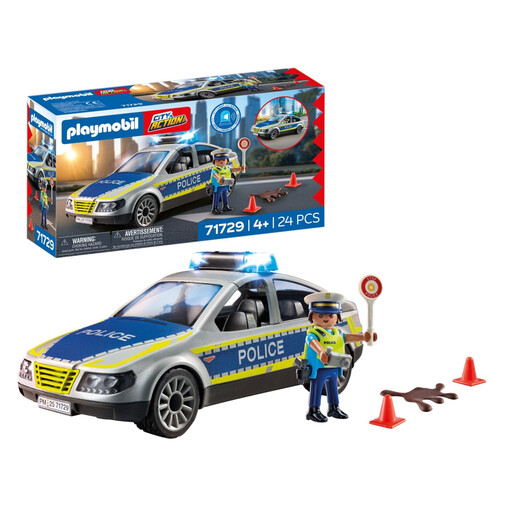
Why this product suits this type of buyer: This patrol car is operated manually, is designed for children aged 4 and over, and makes a straightforward introduction to police role-play.
There are no extra battery costs. Its features are clearly geared towards patrols, securing accident scenes and gathering evidence.
Manual operation, a police figure and compatibility with other PLAYMOBIL ranges.
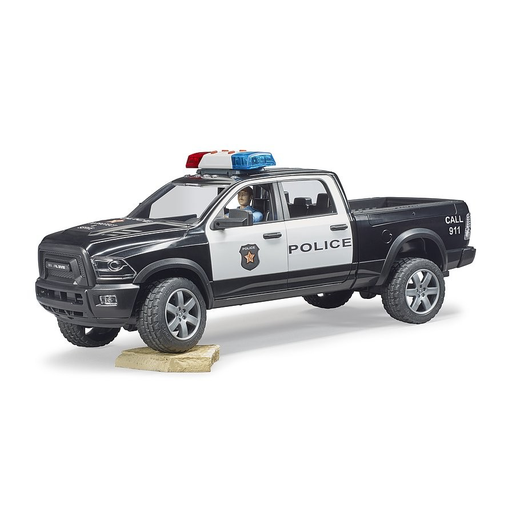
Why this product suits this type of buyer: The 1:16 scale, opening doors, steerable front axle and included police figure provide several interactive features for regular play.
The product information clearly states that three LR44 batteries are required and not included, so you can factor them in when you buy.
Opening doors for up to four bworld figures, a tailgate and suspension axles for different play surfaces.
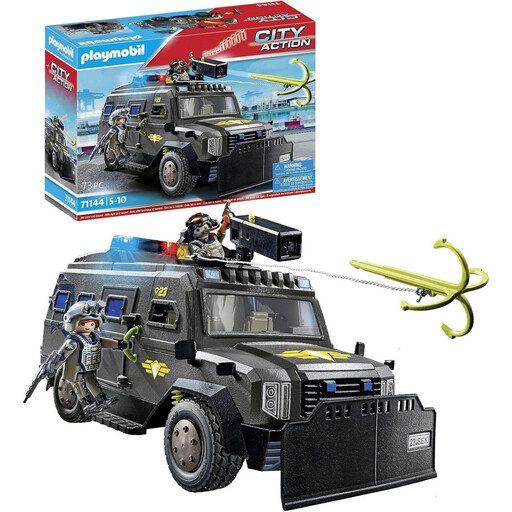
Why this product suits this type of buyer: This SWAT vehicle toy is designed for children aged 5 and over, and is aimed at children who enjoy creating detailed missions with lots of accessories.
The age recommendation, required AAA battery and 73-piece set contents are clearly stated. That makes it easier to assess the supervision and costs involved in advance.
All-wheel-drive styling, two figures, 71 accessories, and lights and sounds.
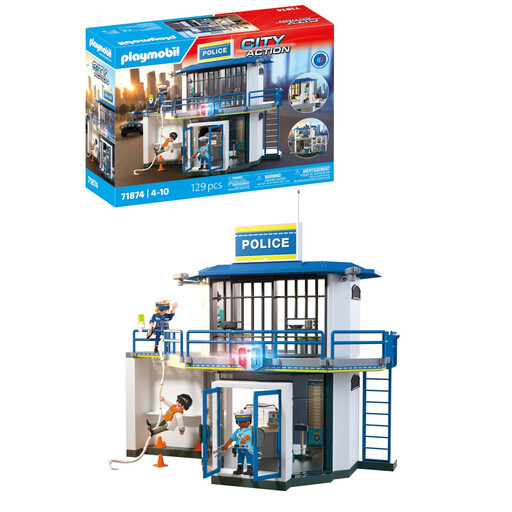
Why this product suits this type of buyer: The station gives an existing police car a permanent setting for investigations, pursuits and role-swapping.
With 129 pieces and stated dimensions, it’s easier to work out how much space you’ll need. The many components should be checked and put away after play.
An interrogation room, evidence storage, photo and escape features, and a clear setting for group play.
We’ve put together a complete, regularly updated list of products that meet these strict selection criteria and fully comply with the safety regulations in force in the EU.
Choose models with a clear age recommendation of 4 and over, a manageable number of accessories and sturdy, easy-to-use features. With larger sets containing lots of small parts, adults should supervise the first few play sessions and check the pieces regularly.
How long they last depends on the materials, where they’re played with and how they’re handled. Avoid leaving vehicles exposed to moisture, heat or direct sunlight for long periods. For models with lights and sounds, it’s also a good idea to remove the batteries before storing them for a long time and to keep the battery compartment dry.
The main extra costs are replacement batteries. Check the battery type, how many are needed and whether they’re included. A manually operated police car has no battery costs during use, while electronic models can offer extra lights and sounds.