
Lieferung heute & morgen

Qualitätsgarantie

Willkommens-Angebote freischalten: KOSTENLOSE Lieferung | Bis zu 80 % RABATT | Kostenlose 30-Tage-JoyPlus-Testphase
App herunterladen
A children’s toy shop can inspire all kinds of play in a child’s bedroom, nursery or pre-school: choosing goods, naming prices, paying, shopping and creating stories together. However, playsets vary considerably in terms of equipment, space requirements and safety considerations. A low price says little about whether a toy till will remain practical in everyday use.
Lights, sounds and buttons look appealing in product photos. What matters, however, is whether the set still allows varied scenarios after the initial trial. If play money, food, a shopping basket or a scanner are missing, additional items will need to be bought. Therefore, check the complete list of items included rather than relying on the picture alone.
Small coins, pretend food and components are common in toy shops for children aged 3 and over. They can pose a choking risk for children under 36 months. The recommended age must match the child’s stage of development. Adult supervision is particularly advisable when small parts, batteries or assembly are involved.
A large shop stand will not automatically fit in every child’s bedroom. Children also need room to move around when stocking shelves or playing with a shopping basket. Before buying, check the external dimensions, assembly type, footprint and fixings. With a wooden children’s shop, it is also important to check whether shelves, drawers and connections can be inspected regularly.
Pay attention to the age range specified by the retailer and the warnings on the packaging and product page. Toys with small parts often carry a restriction for children under 3 years of age. Also check:
A CE marking should be present on the product or its packaging. It does not replace checking whether the set is suitable for the child’s specific age and intended use.
A basic toy till may be enough for children’s first shop games. A children’s till with scanner adds typical supermarket routines to role play. It is not just the sound and lighting effects that matter, but also how easy the till is to use in practice:
An integrated calculator can support number and money games. Even so, the controls should remain easy to understand and should not rely solely on electronic effects.
Plastic sets are usually lightweight and can be cleaned with a dry or damp cloth. Wooden models often provide more storage space, but require more room and need to be assembled. Compare the dimensions with the intended location. Storage for play money and small accessories should also be taken into account. A dedicated drawer or several compartments can make tidying up every day easier.
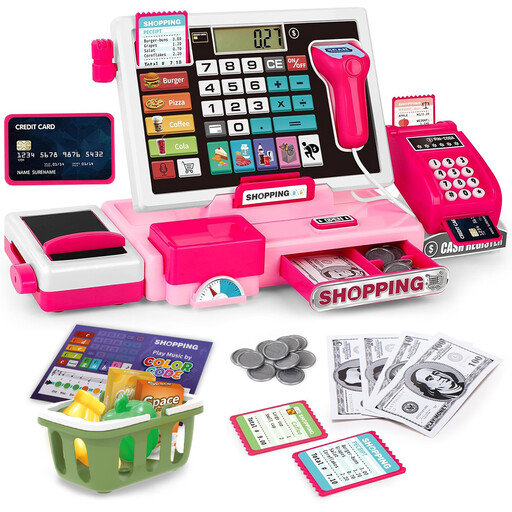
Why this product suits this profile: This set combines a till, scanner, play money, credit card, shopping basket and pretend food in a compact package. It is designed for children aged 3 and over and is a good introduction to role play centred around shopping.
The stated contents include several key accessories. This means a separate accessory purchase is not necessarily required for children’s first shopping scenarios.
37,49 × 8,99 × 19 cm, 720 g, integrated calculator, plus light and sound functions. According to the product details, batteries are not included.
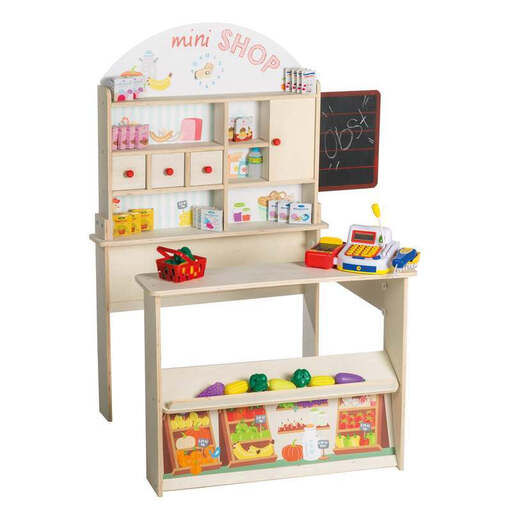
Why this product suits this profile: This shop stand made from laminated wood is designed for families or settings looking to create a permanent play area with storage and a clearly defined footprint.
The external dimensions of 112,5 × 90 × 75 cm make it easier to assess the space needed before buying. Three drawers, shelves and a counter provide organised storage.
Laminated wood, a side chalkboard, three drawers and a large counter. The shop stand is delivered flat-packed and must be assembled.
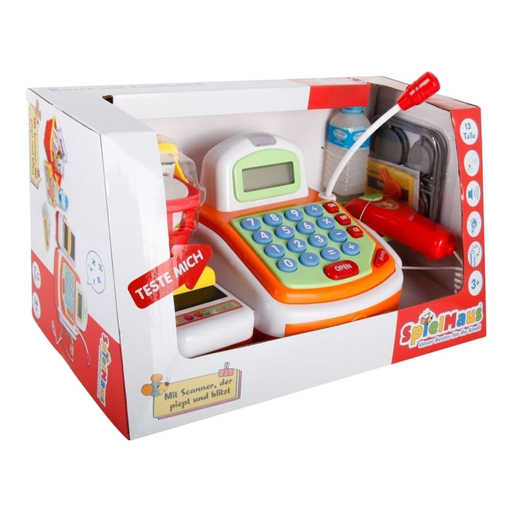
Why this product suits this profile: This set is suitable for several children or regular group play, with goods moving along a conveyor belt as they act out different shopping scenarios.
The conveyor belt expands the play beyond simply paying for goods. The product description states that play money and a scanner are included; the safety information should be checked before use.
Conveyor belt, toy till, scanner and accessories for supermarket scenarios. According to the retailer, the set is designed for children aged 3 and over.
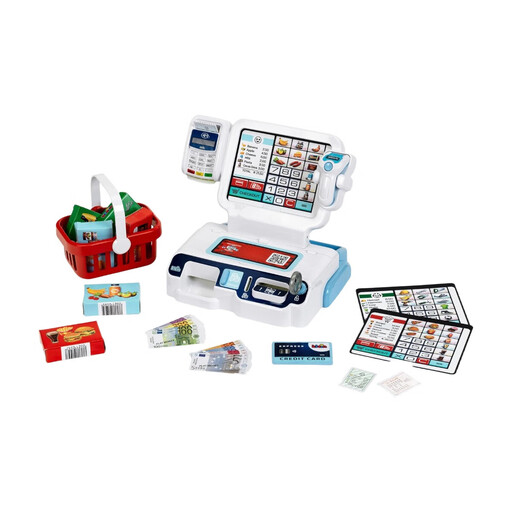
Why this product suits this profile: Anyone looking specifically for a children’s till with a scanner and interchangeable play themes gets a station for supermarket, restaurant or DIY shop role play.
The three interchangeable display images clearly show the intended uses. This means the set is not limited to a single shopping scenario.
36 × 21,7 × 22 cm, 0,93 kg, scanner with light and sound, plus a keyboard with sound function. Requires two AAA batteries, which are not included.
We have put together a complete, regularly updated list of products that fully meet these strict selection criteria and the safety regulations applicable in the EU.
Many sets are designed for children aged 3 and over. However, the specific age guidance, the small parts included and the child’s stage of development are decisive. For younger children, only a set expressly marked as suitable should be used. Adult supervision is advisable when using electronic tills and play money.
For first role-play games, a till, play money, a shopping basket and some pretend food are useful. A scanner, conveyor belt or additional sales areas can expand the scenarios. Before buying, check whether the accessories are actually included or merely shown in the product images.
The service life depends on the materials, build quality and how the toy is used. Plastic parts should be checked regularly for cracks and sharp edges. With a wooden stand, inspect the screws and connections. Battery-powered functions may stop working when the batteries run out, so the set should still offer meaningful play without its electronic effects.