
Lieferung heute & morgen

Qualitätsgarantie

Willkommens-Angebote freischalten: KOSTENLOSE Lieferung | Bis zu 80 % RABATT | Kostenlose 30-Tage-JoyPlus-Testphase
App herunterladen
A toy police car can bring vehicles, figures and accessories together for all kinds of role-play. But flashy lights and sound effects or lots of accessories don’t automatically make a set the right choice. What matters is the recommended age, build quality, play value and whether the set suits your child’s everyday life.
When buying a police vehicle with lights and sounds, check which batteries it needs and whether they’re included. For example, the Bruder 02505 RAM 2500 Police Pickup requires 3 LR44 batteries, which the product information says are not included. Larger PLAYMOBIL vehicles may also need AAA batteries.
There’s another difference to look out for: some models have a decorative light bar that doesn’t work electronically. The PLAYMOBIL City Action SWAT Vehicle, for example, has a flashing light bar with no electronic function. If you’re expecting a siren and working lights, read the product description carefully before buying.
A police playset with figures, a walkie-talkie, handcuffs, toy weapons or other accessories offers more ways to play, but it may also contain lots of small parts. The recommended age is more than just a marketing detail: it indicates the intended use and flags any potential choking hazard.
There are several sets suitable for children aged 4 and over. If your child often loses pieces or still needs help sorting them, a single police vehicle with one figure may be more practical than a large set with more than 50 parts.
A 1:16 scale model can add plenty of detail to play, but it also needs more room. According to the product information, the Bruder RAM 2500 measures around 50 × 19 × 17 cm when assembled. A model of this size won’t fit in every toy box, and it needs enough room to move around on a carpet or table.
Before you buy, it’s worth checking:
For a police car for children aged 4 and over, check that the manufacturer’s age guidance is suitable for your child’s stage of development. Always follow warnings about small parts. For electronic models, check the guidance on the battery compartment and safe battery storage too.
The toys listed in the product information are mostly made from plastic. Even so, check the wheels, doors, figures and accessories regularly for damage. Don’t continue using broken small parts. An adult should help with assembly and supervise younger children during play.
A toy police car with working doors, steering or an opening tailgate makes for hands-on play without batteries. Lights and sounds can add to the fun, but they’re not right for every child – especially if noise could be disruptive at home.
Here’s a useful way to compare the options:
A police toy with figures is ideal for role-play with clear roles: police officer, incident commander, motorcyclist or suspect. If several children will be playing, sets with at least two figures or multiple vehicles are often a better choice.
A police pickup toy often has room for several figures and accessories. A SWAT vehicle toy, on the other hand, focuses more on mission scenarios involving items such as a shield, walkie-talkie or roadblock. Think of these labels as play themes, rather than depictions of real-life operations.
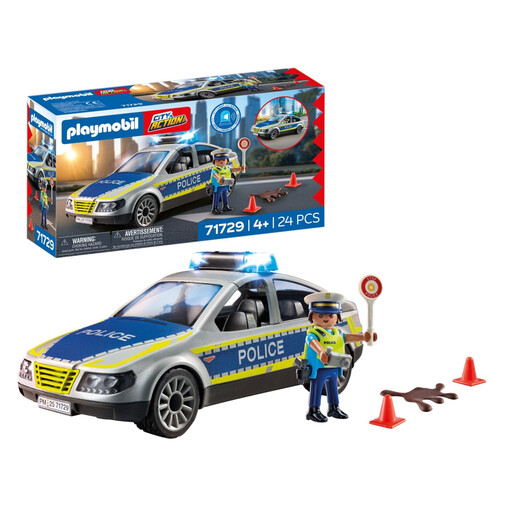
Why this product suits this profile: This manual vehicle is designed for children aged 4 and over, and offers a simple introduction to the PLAYMOBIL police play world.
According to the product information, it doesn’t need batteries. That means no extra battery costs and fuss-free play.
Ideal for manual role-play, with notebook accessories and the option to connect it to other PLAYMOBIL sets.
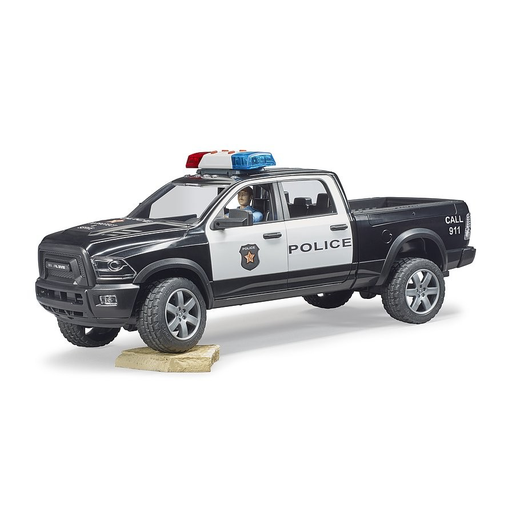
Why this product suits this profile: This 1:16 scale model is ideal for children who prefer a large vehicle with moving parts and an unmistakable police look.
The product information clearly states the vehicle’s size and scale, which doors open and which batteries are required. Buyers can check the space needed and any ongoing costs before making a purchase.
Opening doors and tailgate, steerable front axle, suspension and a police figure included.
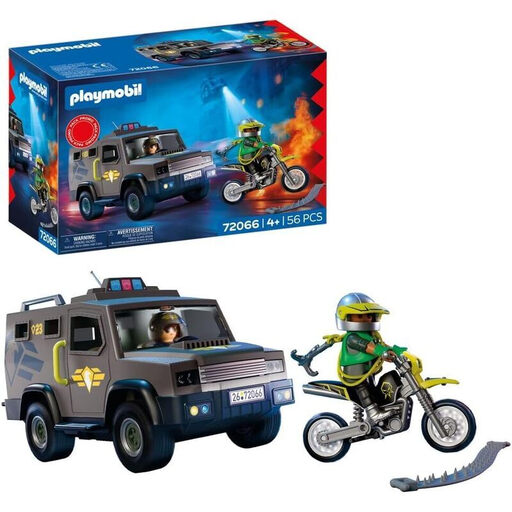
Why this product suits this profile: This set is designed for children aged 4 and over who want to create chase scenarios with several figures, vehicles and accessories.
According to the product description, the light bar isn’t electronic. That means there are no batteries to change, and it’s clear that the feature is different from a working lights-and-sounds module.
56 parts, two figures, a motorbike, roadblock, removable roof and boot storage.
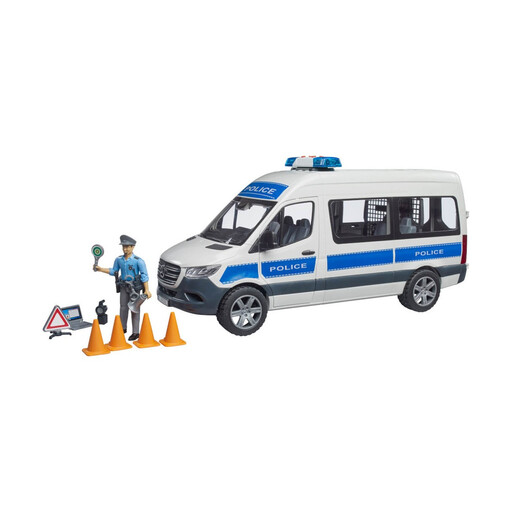
Why this product suits this profile: This large Sprinter is designed for children aged 4 and over who enjoy regular patrols and team missions with the included figure.
The integrated lights-and-sounds module is explicitly listed as a feature. Buyers won’t mistake it for a purely decorative light bar.
1:16 scale, a bworld police figure included, and electronic lights and sounds for mission scenarios.
We’ve put together a complete, regularly updated list of products that meet these strict selection criteria and fully comply with the safety regulations in force in the EU.
A vehicle on its own may be enough for short play scenarios. For longer police role-play, add elements such as a station, a second figure or another emergency vehicle. According to the product information, the PLAYMOBIL City Action Police Command Centre 71873 contains 253 parts and is designed for children aged 4 and over. Features include a control room, fingerprint scanner and helipad.
For children who prefer building, the LEGO City 60481 Rides – Police Truck may be a good choice. It has 71 parts and is recommended for children aged 5 and over. Building comes first, before the vehicle is brought into their own stories.
Look for models with a clear age recommendation of 4+, a manageable number of accessories and easy-to-understand features. If there are small parts, an adult should supervise the first few play sessions. A single vehicle is often easier to manage than a large police playset.
No. Some models have a decorative light bar that doesn’t need batteries, while others have a working lights-and-sounds module. Check the product description for details such as battery type, power supply and electronic features.
Its lifespan depends on the materials, how often it’s played with and how it’s stored. Check moving doors, wheels and electronic modules regularly for damage. Damp, heat and direct sunlight can affect plastic, colours and electronics. Storing the toy somewhere dry and removing the batteries if it won’t be used for a while can help keep it working properly.