
Lieferung heute & morgen

Qualitätsgarantie

Willkommens-Angebote freischalten: KOSTENLOSE Lieferung | Bis zu 80 % RABATT | Kostenlose 30-Tage-JoyPlus-Testphase
App herunterladen
Toys for babies and toddlers should keep them engaged, stimulate their senses and suit their stage of development. In practice, though, bright colours, lots of features and broad marketing claims don’t automatically make for a good buying decision. What matters is being able to check details such as age suitability, materials, stability, dimensions and care instructions.
A toy with music, lights, a shape sorter and moving parts may seem versatile. But if it’s only recommended for children above a certain age, or is too complicated to use, some of its features may go unused at first. So check that your child’s abilities are suited to the way the toy is intended to be used.
The CE mark and references to EN71 are useful points of reference. But they’re no substitute for reading the specific product description. Also check:
A CE mark is not a quality seal for educational value. It indicates that relevant EU requirements have been met, provided the mark has been applied correctly.
A large developmental toy for babies can take up a lot of room in a child’s bedroom, living room or at a childminder’s. Electronic toys also need their batteries changed and require cleaning. Fabric or padded developmental play equipment needs different care from a plastic cube or wooden toy. Measure the space you have available and check the care instructions before you buy.
For babies aged around 6 months and over, choose toys with easy-to-grasp parts that are simple to use. A play gym, a simple sensory toy or a drum with large controls can keep them entertained during tummy time. For children aged 1 and over, you could also consider shape sorters, baby activity centres, baby walkers and simple peg toys.
From around 2 to 3 years, role play, more challenging sorting activities and movement games become more appealing. A toy cutting set with small parts should only be used in line with its stated age limit. The age guidance is not an exact prediction of a child’s development; it’s intended as a guide to safe, suitable use.
For plastic toys, smooth surfaces, rounded edges and secure battery compartments are important features. With wooden toys, look for splinter-free surfaces, sturdy joints and clear information about the materials. The FSC mark, as shown on the Hauck shape sorter described here, relates to the wood’s origin and does not automatically cover every aspect of the toy.
Check toys regularly for cracks, loose parts, damaged wheels or protruding edges. Even a suitable product should be taken out of use if it becomes damaged.
A baby walker should be used on a flat surface that’s free from obstacles. Information about adjustable wheels or rubber grips is useful, but it doesn’t replace supervision. For musical toys for babies, adjustable volume is helpful, especially in homes with several people or during quiet times.
Also check whether batteries are included. They’re not supplied with several of the products mentioned here. Never immerse the electronic module of a play mat or activity centre in water.
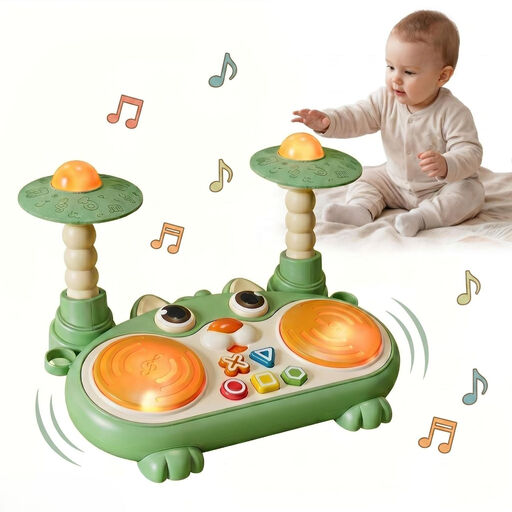
Why it suits this profile: This compact toy combines drum pads, lights, animal sounds, and shape and colour sorting. It’s ideal for families looking for several simple play activities in one small toy.
The stated age range of 6 to 36 months and large controls make it clear how the toy is intended to be used. The product description specifies BPA-free ABS and rounded edges; batteries are not included.
Several hands-on features, shape sorting and light effects in a compact design.
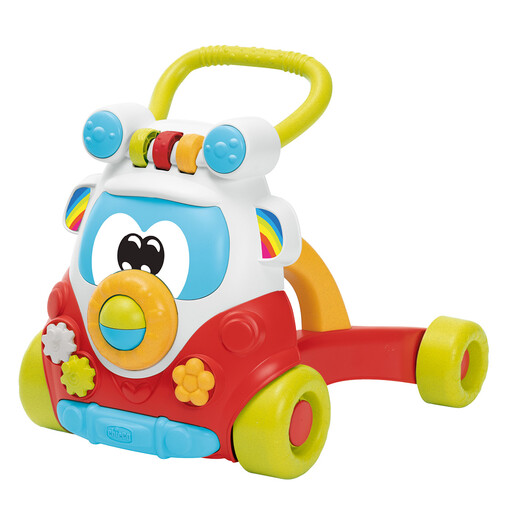
Why it suits this profile: This 2-in-1 baby walker has a wide design and five mechanical activities. The product details give its dimensions as 33 × 42,5 × 37 cm, its weight as 1,4 kg, and its recommended age range as 9 to 24 months.
The clear age guidance and weight limit of 20 kg help prevent the walker being used beyond its intended limits. The safety information explicitly rules out sloping surfaces, stairs and unsupervised play.
Five hands-on activities, four large wheels and materials including polypropylene and ABS.
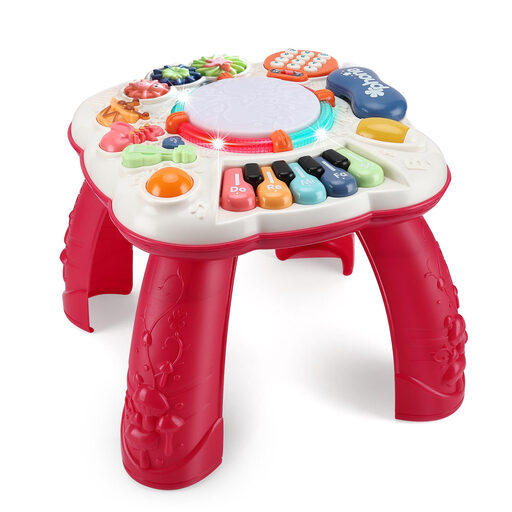
Why it suits this profile: The table has six play areas, including piano keys, a drum, gears and a phone. The legs can be removed so it can first be used as a floor play board, then as a table as your child grows.
The product description mentions adjustable volume and a quiet mode. This makes it easier to adapt the musical toy to your home and the time of day.
Can be used on the floor or as a standing toy, with six activity areas and compact dimensions of around 30 × 30 × 31 cm.
We’ve put together a comprehensive, regularly updated list of products that meet these strict selection criteria and fully comply with the safety regulations in force in the EU.
Terms such as ‘Montessori’ or ‘learning toy’ don’t automatically mean a product has been assessed for educational quality. Check what your child will actually do with it: grasp, turn, sort, stack, press, balance or move.
Plastic surfaces can usually be cleaned with a soft, damp cloth and a mild soapy solution. Electronic modules must not be immersed in water. Wooden toys should only be wiped with a barely damp cloth and then left to dry completely. Always follow the care instructions for the specific product.
That depends on the age and weight limits, as well as your child’s stage of development. For example, the models in this selection are listed as suitable for children aged 9 to 24 months or 12 to 36 months. Stop using the walker once your child can walk confidently, reaches the weight limit or starts using the product in a way it wasn’t intended for.
You may need to factor in the cost of batteries as well as the purchase price. Check whether batteries are included and what type is needed. Adjustable volume or a quiet mode can also be useful if the toy is used regularly at home, when you’re out and about or in shared spaces.