
Lieferung heute & morgen

Qualitätsgarantie

Willkommens-Angebote freischalten: KOSTENLOSE Lieferung | Bis zu 80 % RABATT | Kostenlose 30-Tage-JoyPlus-Testphase
App herunterladen
When buying toys for babies and toddlers, it’s not just about colours, brands or a long list of features. What matters is whether the toy suits your child’s age, surroundings and actual way of playing. Between 3 months and 5 years, children’s grasp, desire to move and interests change quickly. A product that seems suitable today may be too small, too noisy or no longer interesting a few months later.
An activity cube or play station with lights, music, buttons and spinning features may sound impressive at first. In practice, it can be confusing, or some features may hardly get used. So check whether it’s easy for your child to use at their age, and whether the toy is still useful without batteries.
A toy for children aged 1 and over isn’t automatically suitable for an 8-month-old baby. Age recommendations take factors such as part size, the force needed to use the toy, movements involved and potential risks into account. This is especially important: a product labelled ‘not suitable for children under 3 years’ shouldn’t be given to younger children, even if they already play carefully.
Baby activity toys, baby bath toys and frequently used motor skills toys come into contact with hands, floors or water. Smooth surfaces are usually easier to wipe clean than hard-to-reach recesses. With electronic toys, the battery compartment and casing should be kept dry. Before each use, it’s worth checking quickly for cracks, loose parts or damaged seams.
The age recommendation on the packaging and product page is your first guide. For building and construction toys, you should also check the size of the bricks. LEGO DUPLO for toddlers, for example, uses larger bricks than classic LEGO sets. Even so, product information may mention small parts. Children should be supervised in accordance with the manufacturer’s instructions.
For toys intended for babies under 3, key things to check include detachable small parts, easily accessible batteries and sharp edges. CE marking is relevant in the EU, but it doesn’t replace checking the age recommendation, warnings and condition of the product.
ABS plastic, wood and PVC can have different care requirements depending on the product. Look for:
For a wooden baby walker, for example, safe use on a level surface matters more than having lots of extra play features. For an inflatable bouncy animal, on the other hand, consider the child’s seating position, air pressure, weight limit and distance from stairs or roads.
Interactive toys and musical toys for children often need batteries. Before buying, check whether batteries are included, what size you need and whether the toy has a volume control. This is particularly useful in flats or when siblings share toys.
The dimensions should also suit your home. A race track may take up considerably more space when assembled than the packaging suggests. Compact motor skills toys, stackable bricks or an activity cube are good options for smaller rooms.
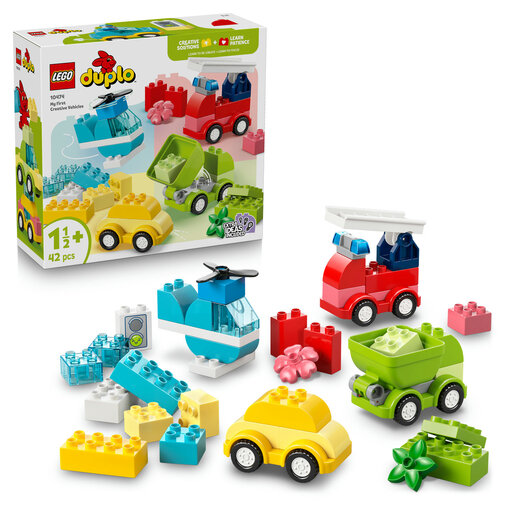
Why this product suits this profile: According to the product information, this set is suitable for children aged 18 months and over. It contains 42 bricks and three vehicle bases, offering several simple ways to build for beginners.
The large bricks are designed for little hands. The age recommendation and warning about small parts still apply.
42 pieces, three vehicle bases and moving elements such as a propeller, tipping function and ladder.

Why this product suits this profile: For children aged 2 and over, this set offers 22 large bricks and several ways to rebuild the construction vehicles. It’s a good fit for families who prefer a straightforward, reusable building concept.
Rather than relying solely on electronic effects, play centres on building, rebuilding and imaginative play. The bricks can be cleaned by hand.
22 pieces, two figures and several vehicle combinations described; the set doesn’t need batteries.

Why this product suits this profile: According to the product information, this lightweight ball is suitable for children from 3 months to 3 years. It can be used on a play mat or in shallow water with constant supervision.
Its uses are clearly limited: don’t submerge it, use it only in shallow water and check it regularly for cracks or any small parts coming loose.
Described as waterproof, with a lightweight design and visible movement inside the transparent ball.
We’ve put together a complete, regularly updated list of products that meet these strict selection criteria and fully comply with the safety regulations in force in the EU.
Choose products with a clear age recommendation, sturdy construction and parts that are large enough. Options include simple vehicles, activity tables, peg toys and selected motor skills toys. Electronic products should have a secure battery compartment.
Lifespan depends on the material, how often the toy is used and how well it’s cared for. Plastic bricks can usually be wiped clean with a damp cloth. With electronic toys, batteries, switches or cable connections can limit how long they remain usable. Check toys regularly and discard any damaged parts.
As well as the purchase price, you may need to factor in the cost of batteries. Check whether batteries are included, how many are needed and whether the product has an automatic shut-off or volume control. Battery-powered toys should also be kept dry and out of babies’ reach.