
Lieferung heute & morgen

Qualitätsgarantie

Willkommens-Angebote freischalten: KOSTENLOSE Lieferung | Bis zu 80 % RABATT | Kostenlose 30-Tage-JoyPlus-Testphase
App herunterladen
Toys should suit a child’s age, home and play habits. Yet striking product photos, long feature lists and seemingly good-value sets can easily lead to the wrong purchase. There are three common pitfalls to watch out for:
The age recommendation is a useful guide, but it doesn’t replace checking the specific warnings. Toys with small parts can pose a choking risk to younger children. Even when buying baby toys for children aged 1 and over, parents should check that all parts are securely attached and that there are no damaged edges or loose components.
For battery-operated products, relevant details include a secure battery compartment, an automatic shut-off and the correct battery size. For example, the VTech RC Race Track Tut Tut Baby Flitzer requires four AA batteries; the product description also mentions a lockable battery compartment. Check the small-parts warning against the recommended age before buying.
For wooden toys, look for smooth surfaces and clear information about the materials, and check the toy regularly for signs of damage. According to the product description, the hauck shape-sorting and motor skills toy is made from FSC-certified wood and includes eight shaped blocks. Plastic toys should have a surface that’s easy to wipe clean. For bath toys, choose a design that minimises the amount of water that can collect inside.
A toy for everyday use should also suit the space where you’ll store it. A folding transport lorry may take up less room than a permanently assembled race track. For larger sets, check the dimensions when assembled, not just the size of the packaging.
Motor skills toys offer age-appropriate opportunities for grasping, fitting, sorting or movement. That doesn’t automatically mean they have an educational or therapeutic effect. Instead, check the following:
For children aged around 1 to 8, different categories may be suitable: learning toys and sorting games for younger children, toy cars and race tracks for imaginative play, and active-play toys for energetic play sessions.
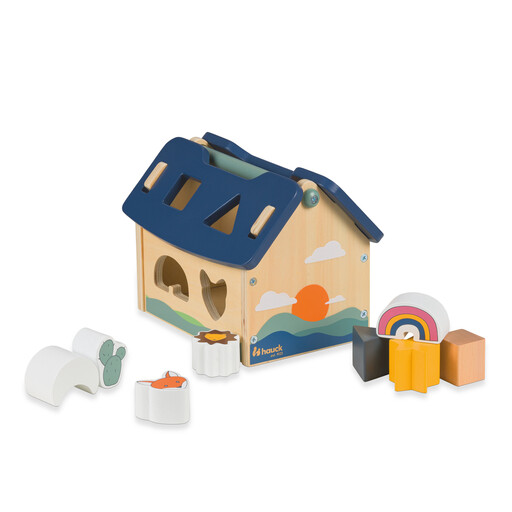
Why this product suits this profile: Designed for children aged 12 months and over, this shape-sorter house combines storage with a simple play activity. It’s a good choice for families looking for a compact learning toy that helps develop motor skills.
The product description gives the recommended age, materials, number of blocks and specific warnings. This makes it easier to judge what the toy is intended for than a list of features alone.
Eight shaped blocks, a removable roof and FSC-certified wood, according to the product details.

Why this product suits this profile: The track has several features for playing together and can be assembled in different ways. It’s a good fit for families looking for an interactive children’s race track with clearly explained features.
The product details list the track components, sensors, batteries, dimensions and warnings. This makes it easier to check the space needed, power requirements and age restrictions before buying.
Two vehicles, eleven sensors and several track sections listed; the product description states that four AA batteries are required.
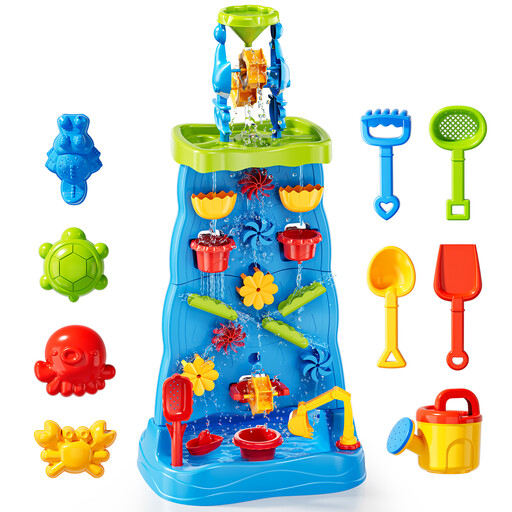
Why this product suits this profile: This set is designed for families with a garden, patio or suitable play area. It includes accessories for water and sand play, and can be assembled together.
The product includes visual assembly instructions and accessories such as a spade, rake, bucket and moulds. Clean and dry all the parts thoroughly after use.
32-piece set, with stated dimensions of 41 × 31 × 78 cm; designed for outdoor sand and water play.
We’ve put together a complete, regularly updated list of products that meet these strict selection criteria and fully comply with the safety regulations in force in the EU.
When choosing toy cars and race tracks, consider the number of vehicles, the length of the track and how much storage space you have. A transport truck toy with 12 die-cast cars and a folding double track could be a good option for playing together; the product details list an intended age range of around 3 to 8 years. Still, check the specific age recommendation and the size of the individual parts.
Active-play toys such as an inflatable jumping unicorn need a clear space, a stable environment and constant supervision. According to the product description, the toy must not be used near stairs, roads, steep slopes or swimming pools. With bath toys, you should also make sure children are never left unsupervised around water.
Simple sorting, stacking and fitting toys with suitably large parts may be suitable for children aged 1 and over. The specific age recommendation, warnings and the level of supervision required are all important when choosing a toy. It should have no damaged areas or small parts that can come loose easily.
Lifespan depends on the material, how the toy is used and how well it’s cared for. Check wooden toys regularly for splinters and loose parts. Plastic parts can usually be cleaned with a damp cloth. Battery-operated products should be stored in a dry place and not used if the battery compartment is damaged.
As well as the purchase price, you’ll need to budget for replacement batteries. Check how many batteries the toy needs and whether it has an automatic shut-off. If the toy is used regularly, a model that takes rechargeable batteries may be more practical for your household, provided the manufacturer allows their use.