
Lieferung heute & morgen

Qualitätsgarantie

Willkommens-Angebote freischalten: KOSTENLOSE Lieferung | Bis zu 80 % RABATT | Kostenlose 30-Tage-JoyPlus-Testphase
App herunterladen
Toys for babies and toddlers should be enjoyable, support their development and work well in everyday family life. The choice ranges from sensory toys and educational toys to creative, musical and active-play toys. However, the sheer variety can make comparisons difficult.
Three common purchasing mistakes particularly often lead to unsuitable purchases:
The age recommendation is a useful starting point. Products with small removable parts are particularly critical for children under three, as they may pose a choking hazard. When choosing toys for children from 1 year, parents should therefore check whether buttons, toy figures or accessories can come loose.
According to the product details, the metal case Theo Klein 2883 Hot Wheels Collector's Case is intended for children aged three and over and carries the warning “Small parts – choking hazard”. It is therefore not suitable for babies or younger toddlers, but for children who already play purposefully with small vehicles and can store them under supervision.
Look for:
For electronic toys, volume control and mute functions are practical additional features. However, they do not replace adult supervision. Products with light and sound effects should not be used continuously in close proximity to a child’s face or ears.
A suitable product should match the child’s stage of development and its intended use. For example, a baby activity table with removable legs can initially be used on the floor. Later, it can serve as a standing activity toy. For travel, however, lightweight LCD writing tablets or compact activity cubes are usually more practical.
Storage requirements also matter: a vehicle case with compartments encourages sorting, while a Montessori toy with a small number of clearly defined activities is more likely to encourage calm, independent discovery. The description “Montessori-inspired” is not a guarantee of a particular educational approach. What matters is the specific play activities described.
The following recommendations categorise the products by age, features and usage situation. The details come from the respective product information. Safety and age recommendations should be checked again on the product page before purchase.

Why this product suits the profile: This compact cube combines several activities while taking up very little space. It is therefore ideal for families looking for a versatile toy for smaller rooms or when travelling.
The eight play modes described are clearly visible on the product, including a piano, guitar, telephone, gears and windmill. This makes it easier to assess the range of functions before buying.
Compact dimensions of 23 × 23 × 24 cm, a carry handle and an age recommendation of 1 to 3 years according to the product description.
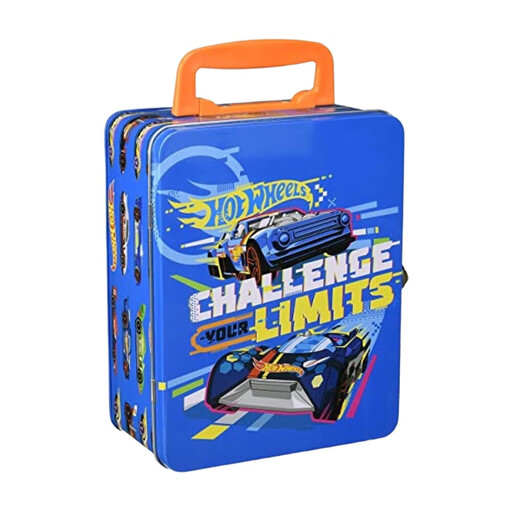
Why this product suits the profile: For children who already have a vehicle collection, the focus is not on additional electronics but on organised storage.
Rather than promising several play modes, the product clearly describes its function: storing up to 18 vehicles in a 1:64 scale. The age warning for children aged 3 and over is clearly stated.
Metal case, carry handle, dimensions of 21 × 15,5 × 8,5 cm and space for up to 18 compatible vehicles according to the product details.
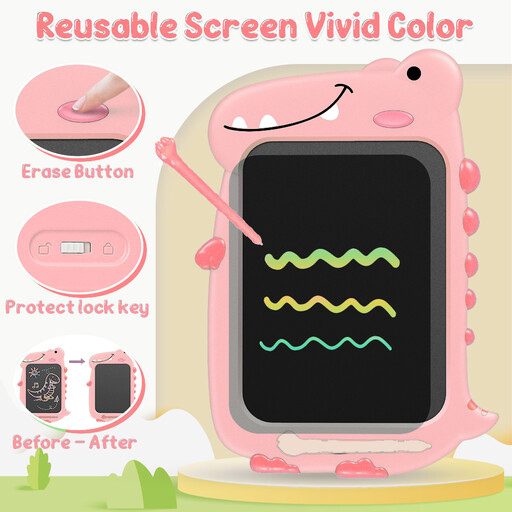
Why this product suits the profile: This reusable LCD writing tablet for children is ideal for creative breaks at home, while travelling or when waiting. It requires no paper or pens.
Its use is clearly defined: draw, write and erase at the touch of a button. This avoids the overloaded learning menus that would be unnecessary for a short creative activity.
10-inch writing surface, ABS plastic, rounded edges and an age recommendation of 3 to 8 years according to the product description.
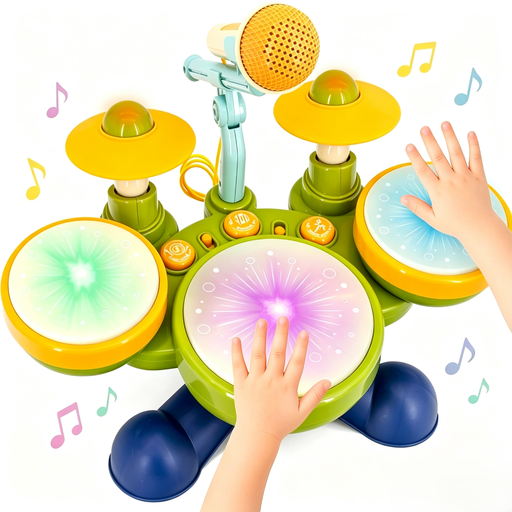
Why this product suits the profile: According to the description, this children's drum kit is aimed at 1- to 3-year-olds and combines drum pads, cymbals and a microphone. It is suitable for households where making music together is encouraged.
The volume can be adjusted according to the product details. Before buying, also check the recommended age, battery requirements and included components.
Three illuminated drum pads, two adjustable cymbals, a removable stand and microphone according to the product description.
We have put together a complete, regularly updated list of products that fully meet these strict selection criteria and the safety regulations applicable in the EU.
For musical toys for children, the volume control should be easy to reach. Also check whether batteries are included. According to the descriptions, batteries are not included with several of the products mentioned.
An LCD writing tablet usually requires a button cell for its erase function. The battery compartment should not be easily accessible to children. When buying a scooter, suitable protective equipment, a non-slip deck and stable steering should also be considered. The tricycle scooter described is intended for children aged 3 to 10; it should be used according to the child’s abilities and under supervision.
When choosing a gift for children, their interests and everyday routines matter more than the longest possible list of features. A creative child may regularly enjoy using a writing tablet, while an active child may benefit more from a scooter. For babies, simple grasping, tactile and cause-and-effect activities are often easier to understand than complex electronic devices.
Age-appropriate grasping, tactile and movement toys without loose small parts may be suitable. A rolling penguin or simple sensory toy should only be used on a safe, clear surface and under supervision. The specific age recommendation and warnings on the product page are decisive.
Lifespan depends on the material, use, cleaning and storage. Electronic toys can be damaged by leaking batteries or frequent falls. Check the casing, cables, battery compartment and removable parts regularly. Damaged products should no longer be used.
In addition to the purchase price, you may need to buy batteries and, where applicable, replacement parts. Check whether batteries are included and which type is required. Volume control and an automatic switch-off function can be practical in everyday use, but they do not automatically reduce battery consumption.