
Lieferung heute & morgen

Qualitätsgarantie

Willkommens-Angebote freischalten: KOSTENLOSE Lieferung | Bis zu 80 % RABATT | Kostenlose 30-Tage-JoyPlus-Testphase
App herunterladen
Toys for children should suit the child’s age, environment and interests. At the same time, parents, grandparents and other relatives need to pay attention to safety information, materials, dimensions and what’s actually included in the box. An eye-catching design alone says little about whether a product will be used regularly in everyday family life.
“From 3 years” or “for children aged 3 to 12 years” is only a first pointer. What also matters are notes on small parts, supervision, protective equipment and intended environment of use. A product may be designed for a particular age group, yet still be unsuitable for unsupervised play, road traffic or certain body sizes.
With RC cars for children, batteries, chargers or rechargeable batteries are not always fully included. Even a bowling and ring toss game may, for example, be supplied without a ball. Before buying, you should therefore check:
“Off-road capable”, “indestructible” or “for all ages” mean little without concrete data. More practical are verifiable details such as maximum load, wheel diameter, material, dimensions, remote control frequency, battery voltage or recommended age group.
For toys from age 3, small parts and choking hazards should be checked especially carefully. With a children’s scooter, handlebar height, body weight and how the foot brake is operated are also relevant. A model with an adjustable steering column can fit for longer, but it doesn’t replace checking the maximum load.
Requirements vary for vehicles, too: a simple construction vehicle toy is often suitable for role play, whereas a remote-controlled stunt car needs more precise hand-eye coordination and sufficient space.
Look for verifiable information on materials, rounded edges and sturdy, smooth-running mechanisms. For outdoor toys, water resistance, UV protection, dry storage and cleaning after use also count. References to standards such as EN 71 can offer additional guidance. The product description and the safety information on the packaging remain decisive.
A kite belongs in an open field or on a suitable section of beach, not near roads, trees or power lines. Throwing games need sufficient distance from people and fragile objects. For a sledge, choose a controlled slope; for the Hamax Lenkbob SNO Formula, the product information recommends use from age 3 under supervision.
For vehicles with light and sound, also consider volume, the surface and the range. A 2.4 GHz remote control can be handy for playing in parallel, but you should still check the actual range stated in the product description.
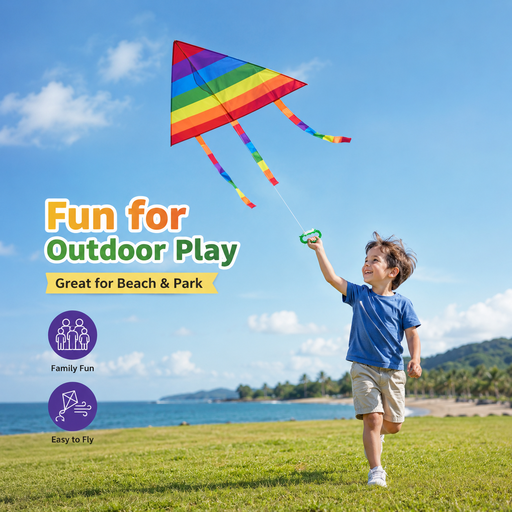
Why this product suits the profile: This single-line kite is a straightforward option for park, beach and family activities, with no need for a battery or charger.
The contents are clearly stated as one piece. That makes it easier to plan for any missing accessories and ongoing energy costs.
Colourful delta design, manual operation and versatile outdoor use. Use in open spaces under supervision as per the product information.

Why this product suits the profile: For families who look for clearly described functions, scale and contents with construction vehicle toys.
The product details specify 1:16 scale, dimensions, materials, battery type and the four cones included. That makes pre-purchase checks easier.
Work platform with a stated lift height up to 70 cm, four cones, plus light and sound module. Recommended from age 4.

Why this product suits the profile: For children who ride outside regularly and need a foldable scooter with adjustable handlebar height.
The details state three handlebar heights, a weight of about 2.8 kg and a maximum load of around 50 kg. Protective gear and use away from traffic remain essential.
Foldable design, rear-wheel brake and an LED feature on the deck. According to the product information, the deck lighting requires two AA batteries.
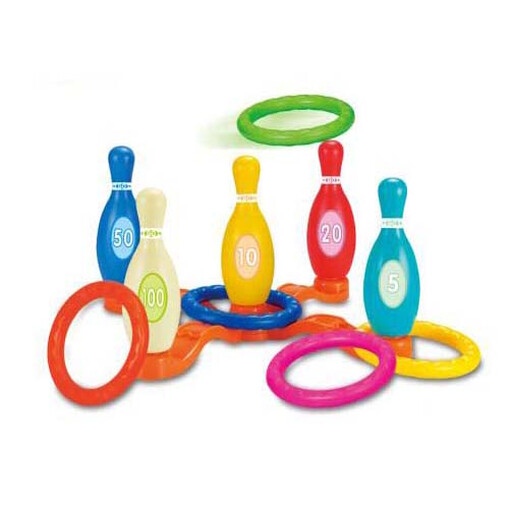
Why this product suits the profile: A manual throwing game for children aged 3 and over that can be used indoors and outdoors on a flat surface.
The product information lists ten pins and five rings. You’ll need a ball for bowling, which, according to the description, is not included.
Two ways to play, pins about 20 cm high and manual use with no batteries. The product details state PP plastic and a recommended age from 3 years.
For younger children, fire engine toys, dinosaur cars and simple role play can be appealing. For the dinosaur pull-back car set with six vehicles, however, note the small parts warning: it is not suitable for children under 36 months.
From around age 5, a frisbee ball, a throwing game or a Phlat Ball are good choices for the garden, park and beach. The WAHU Phlat Ball Junior measures 10.2 cm as a ball and 15.2 cm as a disc; use is stated from age 5. For winter activities, a sledge with a brake and steering option could be suitable. A children’s bicycle or a 4-in-1 preschool bike should be chosen with particular attention to body height, seating position and available protective equipment.
If you’re looking for an RC car for children, distinguish between simple operation and stunt functions. A 2.4 GHz RC stunt car with LED lighting and double-sided driving is, according to the product name, intended from age 6. For younger children, friction vehicles or a straightforward construction vehicle toy are usually easier to assess.
We’ve compiled a complete, continuously updated list of products that fully meet these strict selection criteria and the safety regulations in force in the EU.
Simple, easy-to-grip products without freely accessible small parts can be suitable, such as a bowling and ring toss game, fire engine toys or age-appropriate outdoor toys. Always check the warning notice and supervise play if the manufacturer recommends it.
Service life depends on load, surface, storage and care. For scooters, pay particular attention to the maximum load, the braking function and the condition of wheels and handlebars. For RC cars, the battery, charge cycles, impact loads and cleaning after driving on sand or damp surfaces are key.
RC cars usually need a battery and charging accessories; remote controls may require additional batteries. A scooter with battery-powered deck lighting needs suitable AA batteries. Manual products such as kites, a frisbee ball or a ring toss game generally don’t incur energy costs after purchase.