
Lieferung heute & morgen

Qualitätsgarantie

Willkommens-Angebote freischalten: KOSTENLOSE Lieferung | Bis zu 80 % RABATT | Kostenlose 30-Tage-JoyPlus-Testphase
App herunterladen
Finding toys for children aged 3 and over may seem straightforward at first. But many products are promoted on the basis of their large number of pieces, flashing effects or supposed educational value. What matters is not how many features a toy has, but whether it suits the child’s age, surroundings and actual play habits.
A large set can look appealing at first glance. But without clear instructions, suitable storage or useful ways to combine the pieces, many of them may go unused. When choosing magnetic building blocks and other construction toys, it’s worth checking the number and size of the pieces, as well as the suggested builds.
The label ‘Ages 3+’ is no substitute for supervision. Depending on the product, small parts, magnets, battery compartments and detachable accessories may pose a risk. Magnetic building blocks in particular should be checked regularly for cracks or exposed magnets. According to their product details, blind-box figures are often intended for older children.
Depending on the model, an RC car for children may need rechargeable batteries, a charging cable and additional batteries for the remote control. Vehicles with lights and sound may also raise questions about replacement parts and maintenance. Before buying, check whether batteries are included, how the toy is charged and whether it can be used only on smooth floors or outdoors too.
The minimum age should match the child’s stage of development. Products with small parts that could be swallowed are generally unsuitable for children under 3. The warning is particularly important for magnetic toys: swallowing magnets can cause serious injuries. Children should therefore use magnetic building blocks only under appropriate supervision.
Look for:
ABS plastic is used in many vehicles and building sets. However, the material description alone doesn’t tell you how long a toy will last. Rounded edges, durable joints and easy cleaning are more important. A bag or storage compartment in the play set can help keep all the small pieces together.
For vehicles, you should also check the dimensions. A large crane lorry needs more room than a small model car. Foldable race track sets or vehicles that can be packed away in their transporter after play are a good choice for flats.
For remote-controlled toys, range, controls and power supply all matter. Some models charge via USB, while the remote control needs separate AA batteries. An RC vehicle for outdoor use should have plenty of ground clearance, grippy tyres and a sturdy body. For younger children, a battery-free vehicle with manually operated parts may be easier to use.

Why this product suits this profile: This 28-piece set is designed for hands-on building, needs no batteries and comes with a storage bag. The 5.5-cm blocks are suitable for creating simple patterns and first 3D constructions.
The manageable number of pieces means less sorting. There are no ongoing battery costs, although damaged pieces should still be removed regularly.
The product description lists ABS plastic, smooth edges, reinforced magnets and a storage bag.

Why this product suits this profile: This construction vehicle is aimed at children aged 4 and over, with manually operated features for imaginative play: a rotating, extendable crane, support legs, pallet fork and grabber.
Play value doesn’t depend on lights or sound effects. The mechanical features are operated directly on the vehicle and need no batteries.
Listed features include a 1:16 scale, ABS plastic, a 360-degree crane function and compatibility with bworld figures.
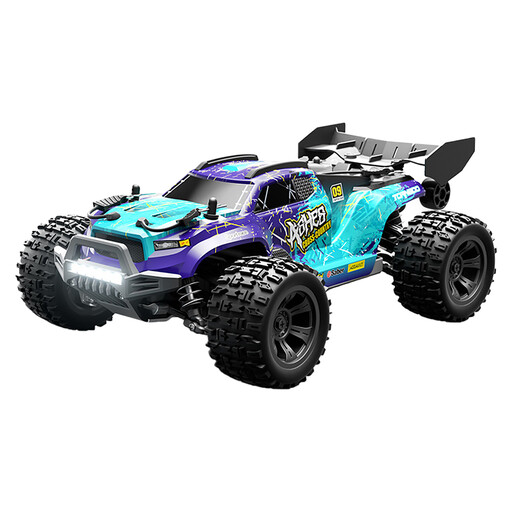
Why this product suits this profile: This remote-controlled toy is designed for teenagers and adults interested in off-road driving. Four-wheel drive, LED headlights and treaded tyres make it suitable for sand, grass and other uneven surfaces.
The product details list a rechargeable battery, USB cable and remote control requiring three AA batteries, which aren’t included. This makes it easier to budget for extra costs in advance.
Its listed technical features include a 1:18 scale, 4WD, an aluminium chassis, a 2.4-GHz remote control and a 7.4-volt battery.
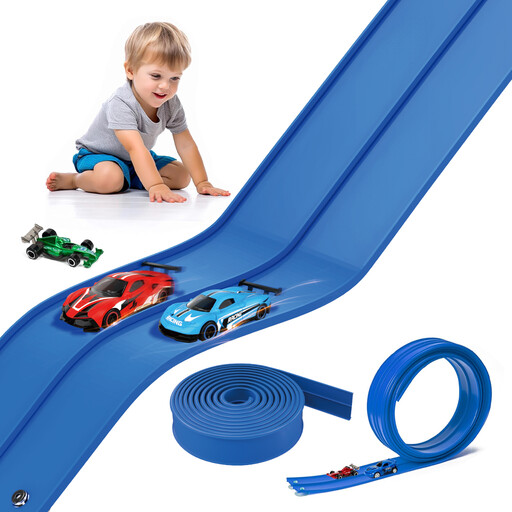
Why this product suits this profile: The flexible dual-lane track can be shaped into straights, bends and loops for children aged 3 and over. Four friction-powered cars are included; no batteries are needed.
The track rolls up after play and doesn’t need a power supply. This saves space and avoids ongoing costs.
The product description lists a 4.5-metre flexible track, two lanes, suction cups and four friction-powered cars.
We’ve put together a complete, regularly updated list of products that meet these strict selection criteria and fully comply with the safety regulations in force in the EU.
For imaginative play, consider construction vehicles, fire engine toys or a crane lorry with movable parts. A fire engine with lights and sound can be appealing, but it needs batteries and shouldn’t be chosen on effects alone. A set with several vehicles and a play mat, on the other hand, offers different scenarios for playing together.
Dinosaur toys and RC dinosaurs appeal to children with a particular interest in the subject. Check the volume, battery requirements and any small moving parts. Collectible figures and blind-box figures are generally more suitable for older children. With a random selection, there’s also no guarantee which figure you’ll get. For children aged 3 and over, always follow the specific warning label on the product.
Simple construction sets, manually operated vehicles, race tracks and age-appropriate role-play sets may all be suitable. The manufacturer’s age recommendation, the size of the parts and regular checks for damage are what matter. Adult supervision is particularly important when magnets and small parts are involved.
Their lifespan depends on the materials, construction and how they’re used. Magnetic building blocks shouldn’t be thrown or subjected to excessive force. Check the casings regularly for cracks and dispose of any pieces as soon as the magnets become visible or loose. A storage bag helps prevent loss and improper storage.
That depends on the battery, charger and remote control. Some RC models come with a rechargeable battery, but still need additional AA batteries for the remote control. Before buying, check the product details for what’s included, charging time and the types of batteries required.