
Lieferung heute & morgen

Qualitätsgarantie

Willkommens-Angebote freischalten: KOSTENLOSE Lieferung | Bis zu 80 % RABATT | Kostenlose 30-Tage-JoyPlus-Testphase
App herunterladen
Toys for children should be enjoyable, suitable for their age and reliable in everyday use. The choice ranges from educational toys for babies and construction toys to RC toys, board games for children and experiment kits. The sheer variety can make choosing difficult: eye-catching packaging says little about whether a product suits a child’s motor development, the space available or the family’s routines.
This buying guide from the Joybuy Product Recommendation Officer explains the most important criteria and presents a selection for different user profiles.
The age recommendation is not simply a marketing detail. It depends, among other things, on small parts, the force needed to operate the toy, game rules and supervision. A construction toy with lots of small building blocks may be suitable for a six-year-old, but pose a choking risk to babies and toddlers.
Even with toys for ages 3 and over, you should check whether the child can already handle moving parts, remote controls or small toy figures safely.
Lights, music, sounds and several remote-control modes can be appealing. However, they often increase maintenance requirements and battery consumption. The key question is whether the features suit the intended use. For short play sessions in the living room, a mechanical wind-up toy may be more practical than a rechargeable vehicle.
Descriptions such as ‘eco-friendly’ or ‘skin-friendly’ should not replace checking specific information. Look out for:
For products containing chemicals, such as a children’s experiment kit, direct adult supervision is particularly important.
The age recommendation is the first filter, but it is not the only one. Babies and toddlers benefit from simple shapes, easy-to-grip elements and basic cause-and-effect functions. For example, a musical sorting game can combine pressing, grasping and matching.
For toys for ages 6 and over, rules, planning and more intricate construction become relevant. With board games for children, the number of players should also suit your household. A one-player game serves a different purpose from a family game for four players.
A remote-controlled car needs a level surface and sufficient distance from furniture, pets and fragile items. Models with drifting or rollover functions are best used in a spacious area. Indoor toys for 8-year-olds should be chosen based not only on age, but also on the space available. You can find more suitable options in the indoor toys for 8-year-olds category.
With construction toys, the number of pieces, storage options and how easy the instructions are to understand are also important. The larger the model, the more important it is to have a permanent place to build it.
For RC toys, the battery type, charging time and availability of spare parts are practical cost considerations. An integrated lithium battery must be charged according to the manufacturer’s instructions and protected from heat. With battery-powered products, check whether batteries are included.
Battery-free mechanical toys reduce ongoing energy consumption. However, they require careful handling of the wind-up mechanism and regular checks of the surface.

Why this product suits the profile: This mechanical wind-up toy needs no batteries and is ideal for short play sessions at home or on the go. It is suitable for ages 3 and over.
Energy consumption is low because no rechargeable battery or standard batteries are needed. As small parts may be present, follow the warning and do not use the product with children under 3 years of age.
Battery-free wind-up mechanism; compact dimensions of approximately 8 × 6 × 9 cm.

Why this product suits the profile: This cooperative board game is designed for children aged 6 and over and encourages shared decision-making for 1 to 4 players.
The scope of the game is clear from the number of players, age recommendation, game board, dice and animal tokens. Small parts require safe storage.
Cooperative game mode; the rotating game board and event cards create varied gameplay.
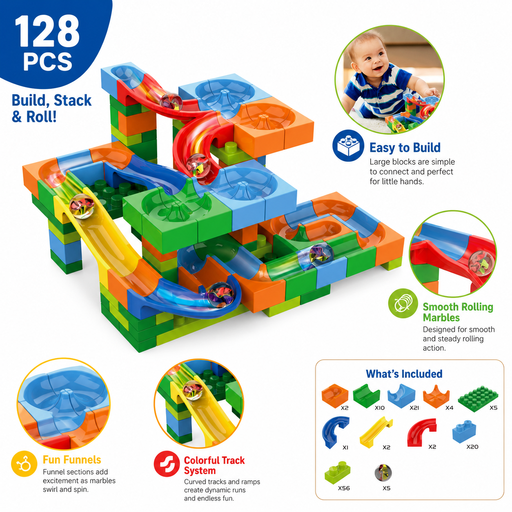
Why this product suits the profile: This set combines building and rolling for creative play sessions, family activities and repeated redesigning.
The number of pieces is clearly stated. Before buying, parents should still check the available space, storage arrangements and whether the small parts are suitable for their child.
128 building pieces; combines construction play with a marble run.
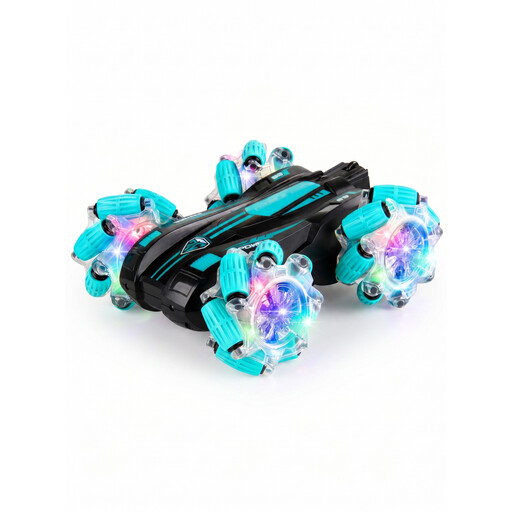
Why this product suits the profile: This remote-controlled car is designed for children who enjoy combining movement with vehicle control. It is suitable for indoor and outdoor use where there is enough space.
The controls and driving functions are clearly described. Before play, check the battery, wheels and casing, and keep a safe distance from faces, animals and fragile objects.
4WD drive; sideways drifting, 360-degree turns and two-sided driving.
We have put together a complete, regularly updated list of products that fully meet these strict selection criteria and the safety regulations applicable in the EU.
Products with straightforward operation, sturdy construction and a clear age rating are suitable. With small figures, balls or building pieces, the risk of choking must be taken into account. Supervision is particularly advisable when a child is playing with a new mechanism for the first time.
Lifespan depends on the material, level of use, storage and care. With RC models, the battery, wheels and casing should be checked regularly. Building blocks and board game pieces remain usable for longer when stored in a dry place and kept together. Plush surfaces should be checked for tears.
This depends on the type of battery, how often the toy is used and the number of charging cycles. Mechanical models do not require batteries. For electronic educational toys, a remote-controlled robot or an RC car, buyers should check whether rechargeable batteries are included, how charging works and whether replacement batteries are required.