
Lieferung heute & morgen

Qualitätsgarantie

Willkommens-Angebote freischalten: KOSTENLOSE Lieferung | Bis zu 80 % RABATT | Kostenlose 30-Tage-JoyPlus-Testphase
App herunterladen
The choice of toys for children ranges from baby toys and educational toys to board games for children. Many product descriptions promise entertainment, learning and long-lasting use all at once. But for parents, grandparents and gift buyers, what matters is whether a toy suits the child’s age, your home and the way they actually play.
Age recommendations such as ‘1 to 5 years’ can sound versatile. In practice, children’s abilities vary considerably across that age range. A toy with lots of buttons might be too complicated for a one-year-old, yet quickly lose its appeal for an older child. So check whether the product offers specific ways to play that suit your child’s age.
Lights, music, buttons and moving parts can look appealing. But more stimulation doesn’t necessarily mean more varied play. When choosing musical toys, consider whether you can adjust the volume, how easy the toy is to use and whether it can be played with quietly. For toddlers, it’s also important that individual parts aren’t easy to reach or remove.
A CE mark is no substitute for checking the product description yourself. Look at the specific age recommendation, small parts, magnets, batteries and supervision advice. With Montessori toys and toys that develop motor skills, check whether they include small balls, pegs or sorting pieces.
The recommended minimum age is a guide to safety and use, not a blanket statement about every child’s stage of development. For babies, choose easy-to-grip, easy-to-clean toys without small parts that could be swallowed. Toys for toddlers should encourage simple cause-and-effect play, sorting, turning or pressing.
From around age three, educational toys, magnetic games and simple games with rules can be appealing. For children aged six and over, cooperative board games for children are another option. From age eight, games with increasing levels of difficulty, memory challenges or tactical decisions are often a good fit.
Wood, plastic and fabric each have their own practical pros and cons. Wooden toys should have smooth surfaces and clearly stated materials. For plastic toys, look for rounded edges and sturdy construction. Products containing magnets need particular care: swallowing magnets can have serious health consequences. Keep magnetic toys away from children below the stated age limit, and check them regularly for cracks or loose parts.
Electronic educational toys need batteries or a rechargeable battery. Check whether batteries are included and how easy it is to access the battery compartment. A volume control is useful for musical toys, especially in flats or shared spaces.
Size matters too: an activity cube may take up less room than a large play centre. Outdoor toys, on the other hand, should suit the space available and the surroundings. When playing with balls, golf sets or throwing games, make sure there’s enough distance from people, windows and vehicles.
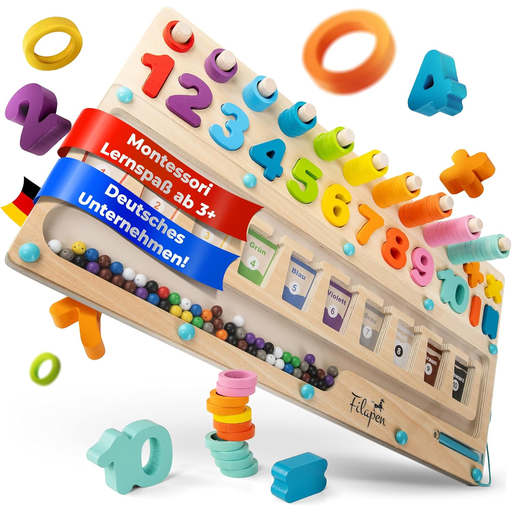
Why this product suits this profile: This wooden toy combines a magnetic pen, colour sorting and numbers from 1 to 10, offering several simple activities in a compact format. It doesn’t need batteries and is designed for children aged three and over.
The age recommendation is clearly stated. There’s no electronic overstimulation, but be sure to supervise children closely because of the small parts.
Solid wood, magnetic pen, colour recognition and number matching; packaging dimensions: 23,0 × 43,5 × 4,0 cm.

Why this product suits this profile: This cooperative board game is designed for 1 to 4 players aged six and over, making it a good choice for a game with family or friends.
The game isn’t all about speed or electronic effects. The rules, dice, event cards and rotating game board create a clearly explained way to play.
Cooperative gameplay, no batteries required, product dimensions: 26,8 × 26,8 × 6,0 cm.
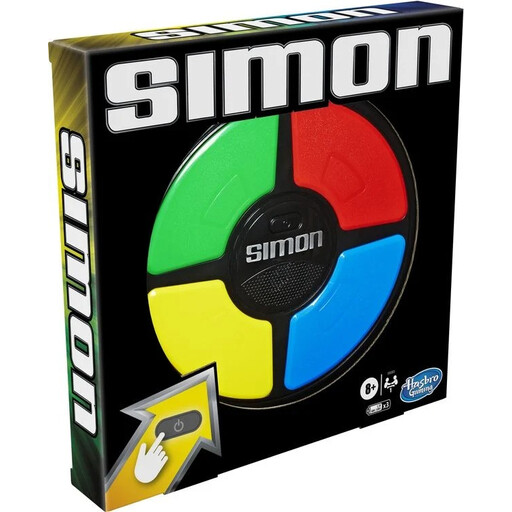
Why this product suits this profile: This electronic memory game is designed for one player aged eight and over. It’s suitable for quick solo rounds or comparing scores.
How to play is clearly explained: repeat the coloured light sequence in the same order. The minimum age of eight clearly defines who the game is for.
Light and sound signals, score storage, 26,7 × 26,7 × 4,1 cm; product information states that test batteries are included.
We’ve put together a complete, regularly updated list of products that meet these strict selection criteria and fully comply with the safety regulations in force in the EU.
For children aged around one and over, simple activity cubes, play boards and baby toys with large, easy-to-grip parts are good options. Look for a stable base, rounded edges and a clear age recommendation. Small parts, magnets and loose battery compartments should be kept out of reach at this age.
There’s no set amount of time. It depends on the child’s age, concentration and interest. Short, voluntary play sessions are often better than a long session that feels like a chore. With electronic toys, taking breaks from the noise and switching to quieter toys that develop motor skills can help create a better balance.
A suitable gift for children takes their age and interests into account, as well as where they’ll use it. Board games are great for spending time together, construction or sorting games encourage creative play, and outdoor toys get them moving. Before buying, always check the minimum age, small parts, batteries and how much space the toy needs.