
Lieferung heute & morgen

Qualitätsgarantie

Willkommens-Angebote freischalten: KOSTENLOSE Lieferung | Bis zu 80 % RABATT | Kostenlose 30-Tage-JoyPlus-Testphase
App herunterladen
Toys for toddlers should be fun, but they should also remain engaging and not raise safety concerns. Parents, grandparents and other family members face a huge choice: motor skills toys, Montessori toys, educational toys for toddlers, musical toys and construction sets can vary considerably in their recommended age range, materials, volume and style of play.
Three common buying mistakes are particularly likely to result in the wrong purchase:
When choosing baby toys from 1 year, the stated minimum age is not the only factor that matters. It is important to consider whether your child can already grip, sit or stand securely, or match simple pieces. A shape-sorting toy with large handles is suitable for different play situations from a complex construction set.
Look out for:
A gift for children from 1 year should ideally offer a simple, easy-to-understand way to play. For children from 2 years, LEGO DUPLO from 2 years, role play and larger construction sets are also worth considering.
For plastic toys, rounded edges, a sturdy casing and a securely closing battery compartment are practical points to check. For wooden toys, the surface should be smooth and free from splinters or loose coatings.
The European CE mark indicates that the manufacturer has taken the applicable EU requirements into account. The EN 71 series of standards relates to toy safety, including mechanical and physical properties. The product information should also clearly identify the manufacturer or responsible supplier.
Important: Even if the product description states that the material is BPA-free or includes a CE mark, regular checks are still essential. Damaged parts, loose seams or an accessible battery compartment mean the toy should no longer be used until it has been checked.
Musical and interactive toys often require batteries. Check whether batteries are included, what size is needed and whether the toy has an automatic switch-off function or volume control. Volume control makes toys easier to use in flats, during quiet times or when travelling. However, it is no substitute for appropriate supervision and responsible use of sound.
The dimensions are also important: a baby activity table requires floor space and should stand securely on a suitable surface. A compact shape-sorting toy or small vehicle, on the other hand, is easier to store and take with you.
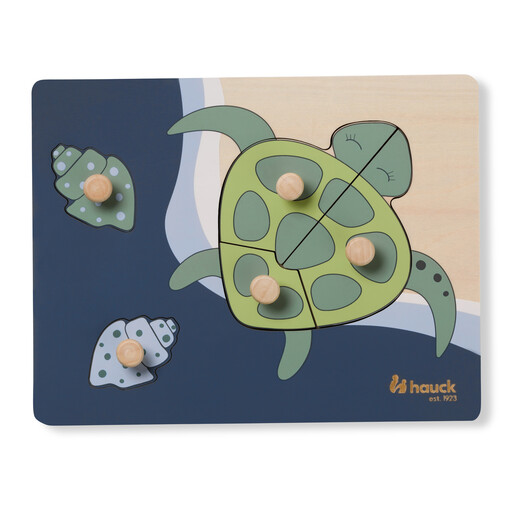
Why this product suits this profile: This wooden puzzle is designed for children from 12 months and focuses on one clearly defined activity: grasping, matching and inserting the pieces.
Instead of lots of short-lived functions, it offers a few large puzzle pieces with child-friendly wooden knobs. The recommended age and supervision notice should still be observed.
FSC-certified wood according to the product information, rounded design and compact dimensions of 22 × 17 cm.
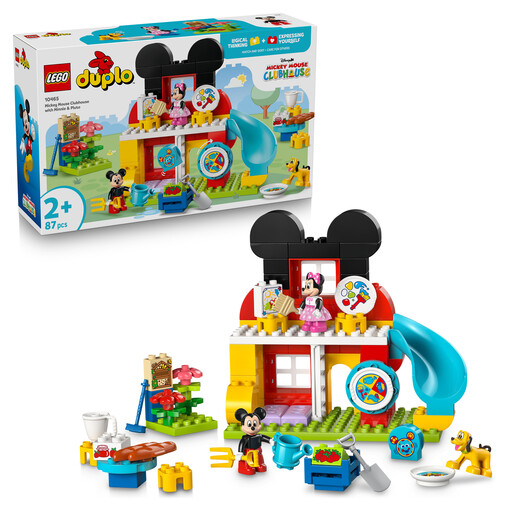
Why this product suits this profile: This 87-piece set is designed for children from 2 years and combines building with character-based and everyday role play.
The age recommendation of 2 years and over is clearly stated. The set is not classed as a baby toy from 1 year; for younger children, the small-parts warnings are particularly important.
Large DUPLO bricks, several figures, a two-storey playhouse and a rotating interactive feature according to the manufacturer’s information.
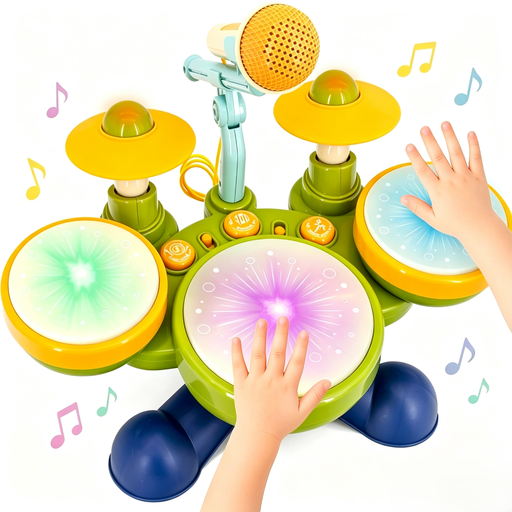
Why this product suits this profile: For families looking to introduce musical toys in a targeted way, this drum set offers several play modes for children aged 1 to 3.
The volume can be adjusted according to the product description. Before buying, plan for the batteries, floor space and direct supervision during play.
Three illuminated drum surfaces, two adjustable cymbals, a microphone and removable stand according to the supplier’s information.
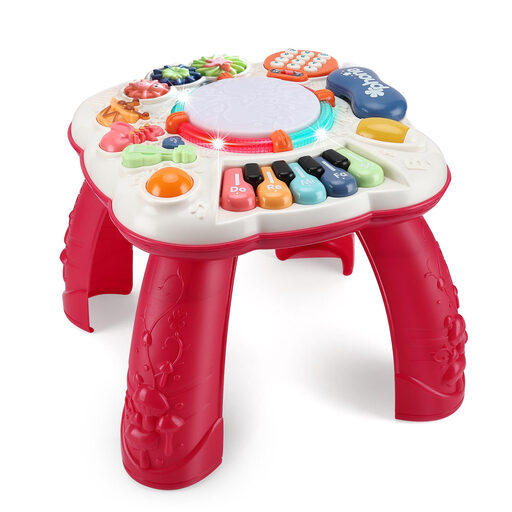
Why this product suits this profile: It can initially be used as a floor play panel and later fitted with legs to become a baby activity table.
Its adaptable design reduces the risk of the toy quickly becoming unsuitable because it is limited to one stage of development. A volume control and quiet mode are listed.
Six play areas with piano keys, a drum, gears and telephone function; batteries are not included according to the product information.
Before placing your order, it is worth carrying out a quick check of the product page:
The age limit is particularly important for soft toys. According to the product information, for example, Monchhichi Baby Monkey is intended for children from 3 years and is therefore not a suitable baby toy from 1 year. A bouncing toy such as the Chicco Bouncing Unicorn is also intended for children from 2 years according to the product information, and requires a clear, safe play area as well as constant supervision.
We have put together a complete, regularly updated list of products that fully meet these strict selection criteria and the safety regulations applicable in the EU.
Large, easy-to-grip pieces without accessible small parts are generally suitable. Examples include simple wooden puzzles, large sorting blocks, stacking toys and sturdy vehicles. Always take the manufacturer’s specific age recommendation and the child’s developmental stage into account.
Lifespan depends on the materials, workmanship, intensity of use and care. Wooden toys with only a few moving parts are often easy to check. With electronic toys, the battery compartment, buttons, cables and speakers should be inspected regularly for damage. Damaged toys should no longer be used.
For musical or interactive toys, batteries may be the main ongoing cost. Check whether batteries are included, which battery types are required and whether the toy has an automatic switch-off function. For frequent use, a model with a switchable sound function or rechargeable batteries may be more practical.