
Lieferung heute & morgen

Qualitätsgarantie

Willkommens-Angebote freischalten: KOSTENLOSE Lieferung | Bis zu 80 % RABATT | Kostenlose 30-Tage-JoyPlus-Testphase
App herunterladen
For owners of RVs, trailers, or light trucks, driving safety is paramount, especially on long journeys. Correct tire pressure is a critical factor that is often underestimated. A Tire Pressure Monitoring System (TPMS) monitors the pressure and temperature of your tires in real-time and warns you of potential dangers.
However, choosing an aftermarket system comes with several pitfalls. Many products on the market are designed for standard passenger cars and are unsuitable for the specific requirements of heavy or long vehicles. Before you make a decision, you should be aware of the most common shortcomings that can lead to a poor purchase.
To avoid these problems, you should focus on three core technical parameters. These determine whether a system is suitable for your vehicle and will function reliably.
Heavy vehicles like motorhomes, caravans, or those needing TPMS for trucks require tires with high inflation pressure, often between 5 and 10 Bar (approx. 72 to 145 PSI). Ensure that the TPMS covers a measurement range up to at least 12 Bar, and ideally up to 14 Bar (approx. 200 PSI). This guarantees that the system delivers precise measurements even at maximum load and on long trips, ensuring safety is not compromised by inaccurate data.
The distance between the rearmost tires of a trailer and the driver's cab can easily exceed 10 meters. Metal vehicle bodies and other electronic devices can interfere with the sensors' radio signal. A reliable tire pressure monitoring system with a repeater is therefore essential for long vehicles. The repeater is placed in the middle of the vehicle and amplifies the sensor signal to ensure stable and uninterrupted data transmission to the monitor.
For most vehicle owners, retrofitting an RV with TPMS using external sensors is the most practical solution. These external tire pressure sensors are simply screwed onto the existing tire valves. Installation takes only a few minutes and requires no special tools. Furthermore, changing the batteries in external sensors is straightforward and can be done yourself, which minimizes ongoing maintenance costs.
Based on these objective criteria, we have identified several models that are suitable for different user profiles and vehicle types.
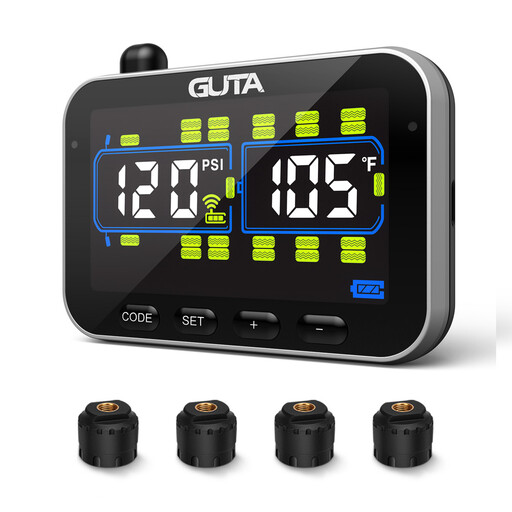
Why it's a great fit: This system is designed for the most demanding conditions. With a monitoring range of up to 14 Bar (188 PSI) and an included repeater, it is ideal for large RVs, semi-trailers, and light trucks where both high pressure and stable signal transmission over long distances are crucial.
It directly solves the two main problems: The high-pressure range prevents inaccurate measurements on heavy vehicles, and the repeater ensures a reliable signal connection.
Real-time monitoring up to 14 Bar; 6 different alarm modes (fast leak, high/low pressure, high temperature, etc.); factory-paired sensors for easy setup.
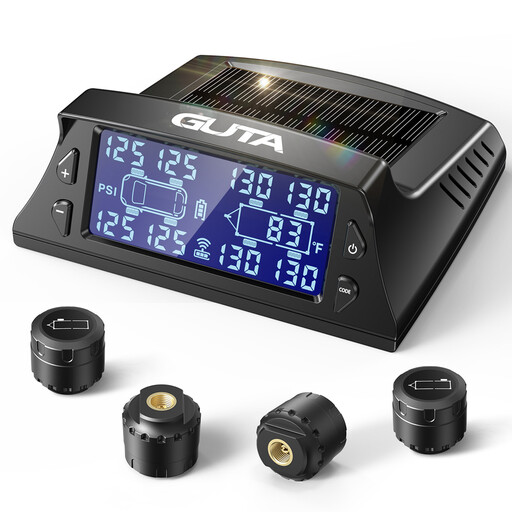
Why it's a great fit: For drivers who value convenience and less cable clutter in the cockpit in addition to safety. This system combines a high-pressure range of up to 13 Bar with a solar-powered monitor. This makes it a practical solution for sunny trips and reduces the need for a constant power supply.
It provides the necessary high-pressure range for most RVs while avoiding dependency on a 12V socket thanks to the monitor's integrated solar panel.
Pressure range up to 13 Bar; monitor with solar charging and USB-C port; sensor battery life of up to 4 years according to the manufacturer.
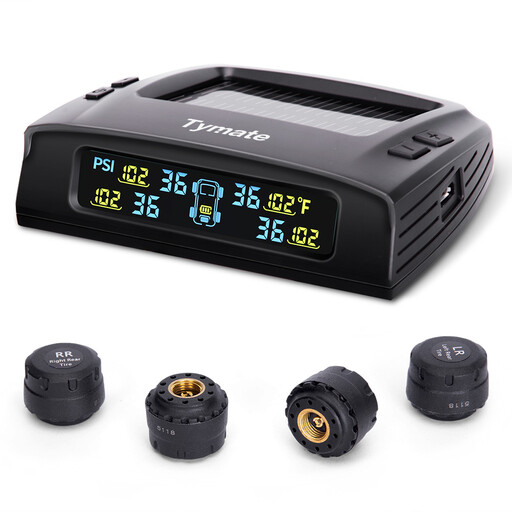
Why it's a great fit: A solid choice for owners of smaller RVs, camper vans, or large SUVs with caravans whose tire pressure is in the range of up to 6 Bar (87 PSI). It offers all essential monitoring and alarm functions in an accessible package.
By focusing on the relevant pressure range for this vehicle class, it avoids unnecessary costs for a high-pressure capability you don't need, without compromising on core features.
Reliable monitoring up to 6 Bar; color LCD display with automatic brightness adjustment; 5 alarm modes for fundamental safety.
We have compiled a complete, up-to-date list of products that fully meet these strict selection criteria and safety regulations.
Retrofitting is very simple with systems that use external sensors. The sensors are screwed directly onto the valves, much like a valve cap. The monitor is placed in the cockpit and connected to a power source. In many systems, the sensors are already paired with the monitor at the factory, so no further configuration is needed after installation. This process of retrofitting TPMS on an RV typically takes no longer than 15 minutes.
A repeater is strongly recommended if the total length of your setup (towing vehicle + trailer) exceeds about 8 meters or if the trailer's body is made of a lot of metal. The repeater captures the signal from the rear sensors and forwards it, amplified, to the monitor. This prevents signal dropouts and ensures your trailer's TPMS functions reliably at all times.
External tire pressure sensors are screwed onto the outside of the valve. Their advantage lies in their simple installation and the ability to change the batteries yourself. Internal sensors are mounted inside the tire on the rim. They are better protected against theft and mechanical damage but require a visit to a workshop for installation and battery changes, as the tire must be removed from the rim. For a straightforward retrofit, external sensors are the more common choice.