
Lieferung heute & morgen

Qualitätsgarantie

Willkommens-Angebote freischalten: KOSTENLOSE Lieferung | Bis zu 80 % RABATT | Kostenlose 30-Tage-JoyPlus-Testphase
App herunterladen
A tyre pressure monitoring system for motorhomes and trailers can display pressure and temperature readings for multiple wheels while you’re driving. Especially with long combinations, heavy loads, or extended periods of standing, choosing the right system is crucial. Not every TPMS for motorhomes is automatically suitable for a trailer or a commercial vehicle.
A system designed for cars and SUVs often works with a limited pressure range. However, motorhomes, caravans, lorries, or larger trailers may require higher tyre pressures. A trailer tyre pressure sensor should therefore cover the pressure range specified by the tyre or vehicle manufacturer.
Also, check whether the readings are given in PSI, BAR, or both. Conversion is possible, but a directly readable unit reduces operating errors.
With a long motorhome, a combination vehicle, or a semi-trailer, the sensors need to transmit data over a greater distance. A radio connection that works for a car can reach its limits with multiple axles or a long trailer.
What matters in practice:
A real-time tyre pressure monitor shows readings and can warn you of deviations. However, it does not replace checking the cold tyre pressure before you set off. The tyre and load values specified by the manufacturer also remain binding.
Check which alarms are actually available. Depending on the model, these can include rapid pressure loss, under-inflation or over-inflation, high tyre temperature, low sensor battery, and a low charge level on the display.
For a motorhome or trailer, a sufficiently wide measurement range is more important than the most compact display possible. With the following models, the stated ranges – depending on the variant – go from 0 to 8 BAR or up to 0 to 14 BAR. The manufacturers specify a pressure deviation of less than 2 PSI.
Always compare the measurement range with your vehicle’s recommended tyre pressure. A tyre pressure monitoring system with 4 sensors is suitable for a car or a single axle, while a system with an expansion option can be more practical for large vehicles and additional axles.
A tyre temperature monitor can provide an additional reading alongside the pressure. The temperature ranges of the models differ significantly. Some monitor values up to 105 °C, while others are designed for a range up to 85 °C.
The display is for information and warning purposes. It should not be equated with a diagnosis of the tyre’s condition. If readings are unusual, you should stop the vehicle safely and check the tyre.
External tyre pressure sensors are screwed onto the valves. This makes retrofitting easier, but it can increase the height at the valve. For the GUTA systems, the product information recommends installation on metal valves to support stability and safety.
Check before you buy:
A solar TPMS can reduce the effort of charging the display. Nevertheless, you should check whether a USB charging option is also available and how the display works during longer periods of non-use.
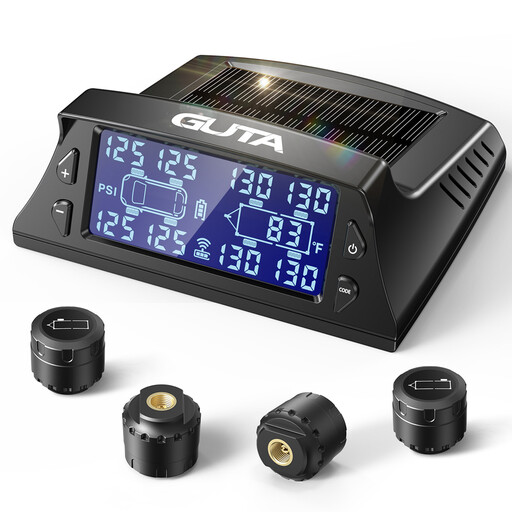
Why this product fits the profile: The set combines four external sensors with solar charging, automatic calibration, and a display for motorhomes or trailers. The stated pressure range goes up to 13 BAR or 199 PSI.
The wide measurement range prevents the system from being designed only for typical car values. Before ordering, you should check its suitability for your specific vehicle length.
Solar charging, four sensors, automatic sleep function, temperature measurement up to 105 °C, and a stated sensor lifespan of around four years.
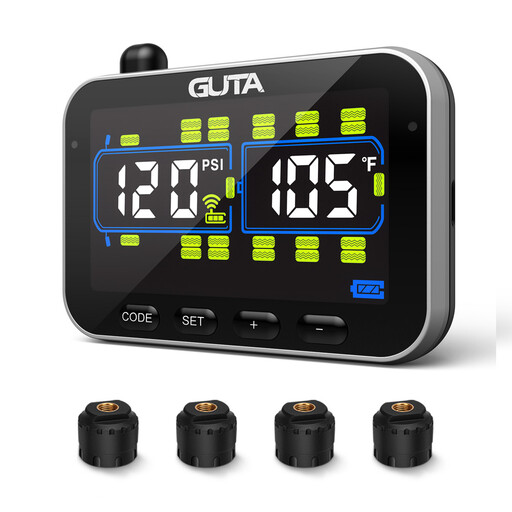
Why this product fits the profile: This model offers six alarm types, a colour LCD display, 433.92 MHz communication, and a signal booster for long vehicles. According to the product information, it supports up to 24 tyres.
The signal booster addresses the typical range issue with long combinations. The measurement range details should be checked directly against your tyre values before purchase.
Six alarm modes, 78 × 44.5 mm colour display, 850 mAh battery, pre-paired sensors, and a stated sensor lifespan of around four years.
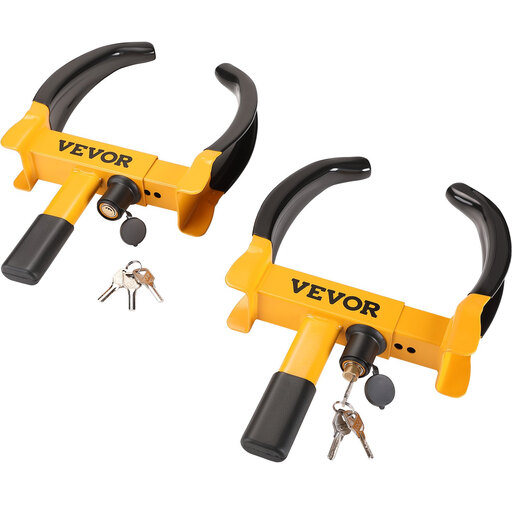
Why this product fits the profile: The wheel clamp is not a TPMS, but a mobile trailer anti-theft device for parked vehicles, caravans, SUVs, and cars.
It clearly separates the tasks: while TPMS monitors during driving, the wheel clamp is used exclusively for visible mechanical security when parked.
Two clamps, nine adjustment positions, and six keys according to the product description; steel construction and a striking yellow coating.
We have put together a complete, regularly updated list of products that fully meet these strict selection criteria and the safety regulations in force in the EU.
Before your first journey, all sensors should be assigned to the correct wheel position, and the reference values should be set according to the vehicle or tyre specifications. With external sensors, seals and valve caps should be checked regularly. The CR2032 or CR1632 batteries are consumable items and must be replaced after the stated lifespan or when a warning appears.
For frequently used vehicles, it is worth looking at the cost per sensor battery, the charging time of the display, and the availability of replacement sensors. A system with an automatic sleep mode can reduce energy consumption when stationary. For a tyre pressure monitor for lorries or very long trailers, you should also consider the actual range with a signal booster.
That depends on the measurement range, the radio range, and the number of sensors required. A car system with four sensors can be sufficient for a caravan if the pressure values and vehicle length are suitable. For long combinations or multiple axles, a model with an expansion option is more sensible.
The stated lifespans for the models mentioned are around two to four years, depending on the battery type. Temperature, radio activity, and storage conditions can affect the actual lifespan. A low sensor battery warning should not be ignored.
In addition to the purchase price, the main costs are for replacement batteries, possibly replacement sensors, and the power supply for the display. Solar TPMS can reduce the need for USB charging. Before buying, you should check the battery type, spare parts availability, and warranty conditions.