A stationary trackball can help with catalogue work when reference materials leave little room to move a mouse alongside your keyboard and screen. First decide whether thumb or finger control suits the hand you use, then check the scrolling controls, connection and software required. A trackball still needs room for its body and your hand, and it cannot guarantee a comfortable posture or freedom from discomfort.
Who can benefit from a trackball?
Catalogue designers with limited desk space
When your keyboard, reference materials and notes are close together, a stationary trackball lets you control the pointer without moving the device around. You’ll still need space for its body and your hand. Kensington describes the space-saving benefit of a stationary device, while the Federal Institute for Occupational Safety and Health also stresses the need for enough room for your mouse, keyboard and hand and arm support.
People who do a lot of reading and layout work
If you switch between long texts and small controls, check the scrolling controls, easily reached buttons and adjustable pointer speed on the model you’re considering. Kensington and Logitech list different features across their trackball ranges.
Left-handed users and those who switch hands
If you work left-handed or want to switch hands, look for a model specifically designed for use with either hand rather than one shaped for thumb control. Kensington describes the Orbit with Scroll Ring as suitable for both right- and left-handed users.
What should you look for when buying?
Thumb-operated trackball
A good fit if: you prefer to control the pointer with your thumb and want to leave the device in place while working with reference materials.
Bear in mind: a trackball shaped for thumb control isn’t described as suitable for use with either hand; check that it fits your hand and that the software supports the customisation you want.
Finger-operated trackball
A good fit if: you work left-handed or switch hands, or prefer a scroll ring for navigating long catalogue pages. Kensington explicitly describes the Orbit with Scroll Ring as suitable for use with either hand.
Bear in mind: the scroll ring, cable and body need to suit your workspace; finger- and thumb-operated models aren’t automatically interchangeable.
| Buying priority |
What to check |
Who is it important to? |
| Desk space between reference materials |
Compare the available space beside your keyboard and reference materials with the model’s dimensions and any hand rest you might use. |
If I have little room between my reference materials, I want the device to stay in place while still leaving enough room for my hand to rest comfortably. Desk space is the top buying priority for around 33% of consumers. |
| Navigating long pages |
Check whether the exact model has a scroll ring or scroll wheel. Only factor in customisable buttons if you can use the required software on your computer. |
When switching between long catalogue pages and small layout details, the right navigation controls matter to me. Around 27% of consumers say this is their top priority. |
| Operating hand and hand position |
Check whether the model is designed for the hand you use and where the ball and buttons are positioned; the manufacturer’s claims don’t prove how it will work for you personally. |
If I want to work left-handed or switch between both hands, I need a layout that suits me. The operating hand and fit are the top priority for around 20% of consumers. |
| Connection and software |
Check your computer’s ports, the software you need, the power supply and the contents of the box against the details for the specific model. |
The connection and any customisation software I need must work with my computer. Around 20% of consumers say this is their top priority. |
Common buying misconceptions
-
“Stationary” means the device takes up hardly any space
A trackball doesn’t need clear space to move around, but you still need room for its body, your hand and, if needed, a hand rest.
Measure the usable space beside your keyboard and catalogue materials, then compare it with the dimensions of the specific model.
-
Orbit and SlimBlade models are interchangeable because they share a family name
According to Kensington, the Orbit K72337EU has a scroll ring and USB cable; the SlimBlade Pro offers different scrolling and connection options.
Compare the full model number and specific controls before making your choice.
-
Programmable buttons work without checking the software
Logitech specifies Logi Options+ for customising the Logitech MX Ergo S buttons; Perixx says you need a driver to programme the PERIMICE-520 buttons.
Check that you can install and use the required software on the computer you use for catalogue work.
-
Ergonomic claims guarantee freedom from discomfort
Manufacturers’ claims describe product features, but don’t prove that a model will prevent discomfort for everyone. The Federal Institute for Occupational Safety and Health also highlights the importance of enough support space and a flexible workstation layout.
Consider the trackball, hand rest and available space together rather than relying on a stated tilt angle alone.
Key brands to consider
Logitech
Logitech’s ERGO M575S and MX Ergo S are thumb-operated trackballs designed for stationary pointer control.
- The manufacturer describes the ERGO M575S as suitable for small or busy workspaces. For the MX Ergo S, Logitech lists tilt, DPI switching and customisable buttons.
- Logi Options+ is required to customise the MX Ergo S buttons. The manufacturer’s claims about muscle strain don’t prove that the product will relieve discomfort for you personally.
Kensington
Kensington’s Orbit and SlimBlade Pro are finger-operated trackballs designed for use with either hand, with different scrolling and connection options.
- The Orbit K72337EU is described as having a scroll ring and USB cable; the SlimBlade Pro offers Bluetooth, a wireless receiver and wired operation.
- The models differ in their controls and connections. The manufacturer’s general claims about finger or thumb control aren’t an independent comparison.
Perixx
The PERIMICE-520 is a wired trackball supplied with clip-on risers for different tilt angles.
- Perixx lists USB-A, a tilting scroll wheel and clip-on risers for 0, 10 or 20 degrees for this model.
- Perixx says you need a driver to programme the buttons. The manufacturer’s website marks its own listing as sold out; this doesn’t indicate availability from other retailers.
Elecom
The guide for the wired M-HT1UR describes a larger trackball design and explains how to clean the ball supports.
- Elecom lists dimensions of 115 × 182 × 58 mm and switchable 500/1000/1500 dpi for this model.
- The operating system list in the guide includes older versions and doesn’t confirm current compatibility with every computer.
Joybuy products for catalogue work
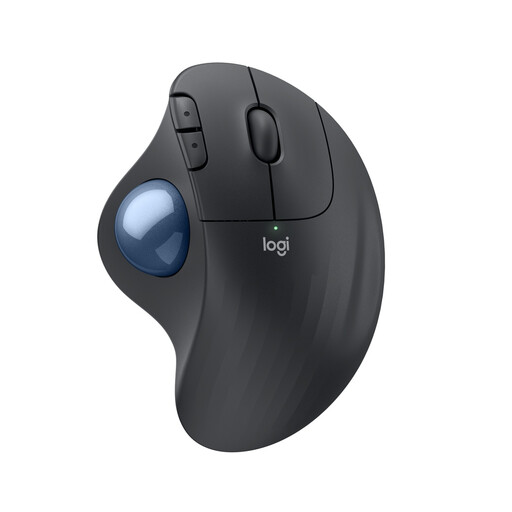
A right-handed, thumb-operated trackball for controlling the pointer at a desk with little room for mouse movement.
 No image available
Logitech ERGO M575S – Graphite
The stationary design may suit you if reference materials leave little room to move a mouse around; remember to allow space for the body and your hand.
Logitech lists Bluetooth or a Logi Bolt receiver with USB-A, and an AA battery, as features of the ERGO M575S.
If you want to customise the buttons or pointer speed, check that you can use the required Logi Options+ app on your computer.
View at Joybuy
Frequently asked questions
Thumb- or finger-operated trackball for catalogue work?
Start with the hand you use, then think about how you want to scroll through long pages. Logitech describes the MX Ergo S as thumb-operated; Kensington says the Orbit with Scroll Ring is designed for use with either hand. These features don’t establish that one option is always more precise or ergonomically better for everyone.
Do I need to install extra software to set it up?
Not for basic use with every model: Kensington describes the wired Orbit as plug and play. Kensington lists TrackballWorks for button and speed settings, while Logitech specifies Logi Options+ to customise the MX Ergo S buttons. Check your operating system and whether you can install the software if you need these adjustments.
What can I do if the ball sticks?
The Elecom guide for the M-HT1UR says to push the ball out from the back and remove dust from the three support points with a cotton bud. Take care not to damage the optical sensor, and follow the instructions for your own model.
What are my rights when buying online in Germany if the trackball doesn’t suit me or is faulty?
In Germany, online purchases from a business seller generally come with a 14-day right to cancel, although exceptions may apply. The European Union’s Your Europe website also explains that goods bought in the EU are covered by a minimum two-year legal guarantee. Cancelling because you’ve changed your mind is different from making a claim about a fault; a manufacturer’s warranty is voluntary and doesn’t replace your statutory rights.


