When marking work digitally at a cramped desk, choosing between a thumb-operated and finger-operated trackball comes down mainly to which hand you use and how you scroll. A scroll ring can be useful when working through lengthy submissions, while precise marking calls for an easily reached ball and a suitable pointer speed. Measure the space available and check the fit in your hand, the connection and any software you may need – a stationary trackball still needs room for its body.
Who is a trackball suitable for?
People marking work at a small desk
If you work on digital submissions alongside your keyboard and papers, a trackball can save the space needed to move a conventional mouse. The body still needs a permanent spot, though; Logitech and Perixx list different dimensions for their respective models.
People marking lengthy documents
When moving between pages, comments and small areas to mark, scrolling and pointer speed both matter. Kensington describes the Orbit Wireless as having a scroll ring and adjustable DPI settings.
People with specific requirements for their hands
If you use your left hand, want to switch hands or would like to try a different hand position, check whether the trackball is designed for your preferred hand and whether the controls are easy to reach. The German Social Accident Insurance (DGUV) lists trackballs as one possible input device for individually configuring a computer workstation, not as a guaranteed solution for discomfort.
What should you look for when buying?
First compare which hand you use and how you scroll, then check the space available and the connection. This will help you choose a setup that suits the way you mark work, without overlooking the space or setup required.
| What matters when buying |
What to look for |
Who this matters to |
| Space for the device and papers |
Measure the space available and compare it with the width and depth of the specific model. Perixx lists the dimensions of the PERIMICE-520 as 139 × 102 × 50 mm. |
If my keyboard and papers already take up most of the desk, I need a model that fits in the space left over. Around 31% of consumers put the space it takes up at the top of their list when buying. |
| Scrolling and precise marking |
Check whether you prefer a scroll ring or wheel and whether you can adjust the pointer speed for marking small areas. |
When I’m working through lengthy submissions and marking small areas, I want to be able to scroll and adjust the pointer speed to suit. Around 31% of consumers prioritise navigating documents. |
| Hand preference and fit |
Check which hand the model is designed for, and where the ball, buttons and scrolling controls are positioned and how easy they are to reach. |
If I work left-handed or switch hands, the ball and controls need to be within easy reach. Around 23% of consumers prioritise how the device works with their hand and how well it fits. |
| Connection and setup |
Check that Bluetooth, USB-A or any receiver you need is compatible with your computer. Also check the operating system and whether any software is required. |
If I want to use the device with my computer without a complicated setup, I need the right connection and should check in advance whether I’ll need any software. Around 15% of consumers put ease of setup first. |
Common misconceptions
-
Stationary doesn’t automatically mean tiny
You don’t need to slide a trackball across the desk, but its body still needs a permanent place. Perixx lists the dimensions of the PERIMICE-520 as 139 × 102 × 50 mm.
Measure the space beside your keyboard and papers, then compare it with the dimensions of the exact model.
-
Not every trackball is ambidextrous
The ambidextrous design of the Kensington Orbit Wireless isn’t shared by sculpted thumb-operated models.
Make sure you compare the ball’s position, the buttons and the scrolling controls with the hand you prefer to use.
-
Check setup requirements before choosing extra features
Customisable buttons are only useful if you can use the required software on your computer. Connections and what’s included in the box also vary by model.
Check whether the specific model uses USB-A or Bluetooth, which operating systems it supports, what software options are available and what’s included in the box.
Logitech says the MX Ergo S does not come with a USB-C charging cable. Check that you have a suitable cable.
Key brands at a glance
Logitech
The ERGO M575S and MX Ergo S are thumb-operated trackballs. Logitech says the MX Ergo S also offers features including tilt adjustment and customisable buttons.
- According to Logitech, the ERGO M575S offers Bluetooth LE or Logi Bolt and uses a replaceable AA battery.
- Logi Options+ is required to customise the buttons. Logitech says the MX Ergo S does not come with a charging cable. Ergonomic and noise claims are provided by the manufacturer and are not guarantees of individual results.
Kensington
The Orbit Wireless with Scroll Ring uses finger control, a scroll ring and an ambidextrous design. The SlimBlade Pro uses ball rotation to scroll and, according to Kensington, offers several connection options.
- The different control methods give you options to compare a scroll ring or rotating the ball with your marking routine.
- Specifications alone can’t tell you whether a model is right for you. Check the model number and button layout of the specific version.
Perixx
According to Perixx, the PERIMICE-520 is a wired, thumb-operated trackball with a tilting body and a four-way scroll wheel.
- A USB-A cable means you can use it without a wireless connection or changing batteries in the device.
- Perixx lists the body dimensions as 139 × 102 × 50 mm; remember to allow space for the cable too.
Elecom
According to Elecom, the DEFT PRO M-DPT1MRXBK is a finger-operated trackball with several connection options, eight buttons and horizontal scrolling.
- These features offer a technical alternative if finger control and horizontal scrolling suit the way you work.
- Check the model number, features and operating system details for the specific version on offer. Manufacturer information from Japan does not automatically confirm the terms of an offer in Germany.
Trackballs for marking work digitally
This selection includes a wireless, thumb-operated trackball for marking work when you have limited room to move a mouse.
 No image available
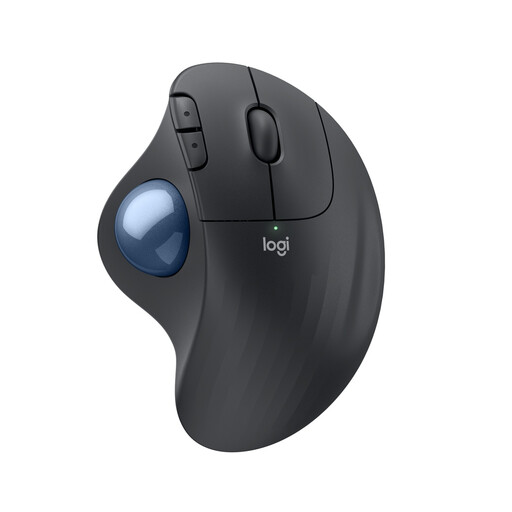
Logitech ERGO M575S, Graphite
Control the cursor with your thumb without sliding the device across the desk – a practical option for marking work when space is limited.
Bluetooth or Logi Bolt receiver; dimensions: 134 × 100 × 48 mm. Includes a scroll wheel, adjustable pointer speed and three customisable buttons. The product description lists Logi Options+ for Windows and macOS to customise the buttons and pointer speed; a Logi Bolt receiver needs a free USB port.
View at Joybuy
Frequently asked questions
Do I need special software to use a trackball?
For basic use, it depends on the model and connection. Logitech lists Logi Options+ for customising the ERGO M575S; Kensington describes the Orbit Wireless as plug-and-play and says KensingtonWorks can be used to assign buttons. Check your computer’s operating system and software compatibility.
What can I do if the ball sticks while I’m marking work?
Check the ball and its socket for dirt, and follow the cleaning instructions for your model. Kensington says that accumulated dust and dirt can cause sluggish or erratic movement, though this won’t necessarily explain every problem.
Can I cancel a trackball order bought online in Germany?
Consumers generally have a right to cancel distance-selling contracts; section 355 of the German Civil Code (BGB) sets out a 14-day period. When the period starts and whether any legal exceptions apply depend on the contract and the relevant legal requirements. The Federal Ministry of Justice and the Federal Office of Justice list the applicable provisions in the BGB.
Who should I contact about a fault: the retailer or the manufacturer?
For a consumer purchase, your statutory rights relating to faulty goods apply against the seller. A manufacturer’s guarantee is separate and is subject to its own terms. If a product is faulty, you can initially ask the seller to put things right. The Verbraucherzentrale explains the difference between statutory rights and a guarantee.


