If several people with different preferred hands use the same trackball, a finger-operated model explicitly designed for ambidextrous use is an obvious choice. If it will mostly be used by one person, a contoured thumb-operated trackball may be a good fit, provided it suits their hand and feels comfortable to use. Check the desk space required, connections and how easy it is to navigate longer documents. A trackball cannot guarantee that you will avoid discomfort.
Who is a trackball suitable for?
Teams who switch between hands
If you create handouts at the same desk and the input device is used by both right- and left-handed people, look for a model explicitly designed for ambidextrous use. Kensington describes its wired Orbit with Scroll Ring as ambidextrous.
People creating handouts with limited desk space
If there are printouts or notes next to the keyboard and screen, consider how much space the device itself takes up, as well as any wrist rest. Logitech describes the ERGO M575S as a trackball for small or crowded workspaces.
People working on long documents
When scrolling through and correcting documents, easy-to-reach scrolling and a suitable pointer speed matter. Kensington describes the wired Orbit as having a Scroll Ring; according to the manufacturer, the wireless version offers four DPI settings.
What should you look for when buying?
Ambidextrous finger-operated trackball
A good fit if: several people who use different hands share the same device.
Consider: the ball and Scroll Ring need to be easy for everyone to reach.
Contoured thumb-operated trackball
A good fit if: the device will mainly be used by one person and its shape suits their hand.
Consider: a shape designed for one person's thumb may not suit a team who switch between hands.
When creating teaching handouts at a shared desk, the main things to consider are free space, different users' preferred hands, document navigation, connections and maintenance.
| Consideration |
What to check before buying |
Who should consider this? |
| Desk space |
Measure the available space beside your keyboard and papers, allowing for the device and, if needed, a wrist rest. |
If there's hardly any room beside my keyboard and handouts, I want to know whether the device and wrist rest will really fit. Around 36% of consumers prioritise the space available. |
| Shared use |
Check whether the specific model is explicitly designed for ambidextrous use, and whether the ball, buttons and scroll function are within everyone's reach. |
If right- and left-handed people use the same device, I don't want to have to adjust it every time someone switches. Around 29% of consumers put suitability for shared use first. |
| Handout navigation |
Try scrolling and precise pointer movements on a longer document. Check whether your work computer allows the button customisations you want. |
When proofreading longer texts, I want to move through pages comfortably and point to specific places precisely. Around 21% of consumers prioritise document navigation. |
| Connection and maintenance |
Check that you have a compatible port available and that it complies with your computer's usage rules. Check what's included and the care instructions for the specific version. |
If the work computer is shared, I want to make sure the connection type and maintenance fit the options available. Around 14% of consumers prioritise connection and maintenance. |
Avoiding buying pitfalls
-
Assuming “stationary” means “space-saving”
A trackball still needs space for its body and, if needed, a wrist rest. You may be able to put your papers beside the device, but the space it takes up doesn't disappear.
Measure the free space beside your keyboard and papers, and allow for the hand resting on the device.
-
Using a contoured trackball across a team without checking first
A shape designed for one person's thumb and a body explicitly designed for ambidextrous use meet different needs. A model that suits one person may not work for everyone.
If users switch between hands, first check that the specific model is suitable for ambidextrous use, then try reaching the ball and buttons.
-
Assuming customisable buttons or wireless connectivity will work straight away
Customising extra buttons may require software that you aren't allowed to install on a managed work computer. Connection options vary by model.
Check your computer's ports, which software is permitted and what's included with the specific version.
Depending on the model, wireless trackballs need a battery or charging. Logitech says the charging cable is not included with the Logitech MX Ergo S.
Brands to consider
Kensington
Orbit models with a Scroll Ring offer finger control; one version is wired and another is wireless.
- Kensington describes the Orbit with Scroll Ring as suitable for ambidextrous use. The wireless version offers Bluetooth LE and a 2.4 GHz receiver.
- The wired version needs a compatible USB port. Kensington notes on the product page that it is not compatible with Windows ARM computers.
Logitech
The ERGO M575S and MX Ergo S are contoured thumb-operated trackballs, designed for a personalised fit and limited workspace.
- Logitech says the M575S clicks more quietly than the M575. For the MX Ergo S, the manufacturer lists tilt, customisable buttons and USB-C charging.
- Fit is personal. Logitech says the charging cable is not included with the MX Ergo S; the customisation options mentioned may require compatible software.
Perixx
The PERIMICE-520 is a contoured trackball option with clip-on risers for adjusting the angle.
- Perixx describes two clip-on risers that let you adjust the angle.
- Fit information comes from the manufacturer and is not evidence of comparative practical testing. Perixx lists a 24-month limited manufacturer's warranty, which is separate from your statutory rights.
Elecom
The DEFT PRO M-DPT1MRBK is a finger-operated alternative with several connection options.
- Elecom lists wired, 2.4 GHz receiver and Bluetooth connections for this model.
- The product information comes from Elecom's Japanese product page. It doesn't tell you about German purchasing terms or regional availability.
Trackballs available at Joybuy
This selection is for people looking for a contoured thumb-operated trackball for a small workspace and working on longer documents.
 No image available
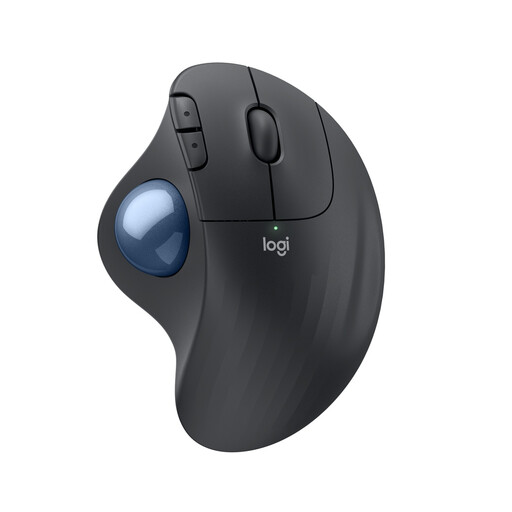
Logitech ERGO M575S – Graphite
This wireless, contoured thumb-operated trackball is an option for one person whose hand suits the shape and who works in a compact space.
The product description lists a scroll wheel with a middle click, plus forward and back buttons.
Choose Bluetooth or a USB receiver. Logi Options+ is used to customise the buttons and pointer speed. The app is listed for Windows and macOS.
View at Joybuy
Frequently asked questions
What should we choose if several people with different preferred hands are working on a handout?
Start by looking for a finger-operated trackball explicitly designed for ambidextrous use. Kensington describes the Orbit with Scroll Ring as suitable for both right- and left-handed people; it's still worth trying the ring and buttons together.
Does a wired trackball need additional software?
The wired Kensington Orbit with Scroll Ring is described as a plug-and-play USB device. KensingtonWorks is used for more advanced button and speed settings; check whether you’re allowed to install it on a managed work computer.
What can I do if the ball feels jerky?
First, follow the cleaning instructions for the specific model. Kensington says that dirt building up in the ball socket can increase friction and recommends regular cleaning.
How much desk space does a trackball need?
A trackball still needs space for its body and, if needed, a wrist rest. Measure the free space beside your keyboard and papers, then compare it with the dimensions of the specific version.
What should I check when connecting it to a shared computer?
Check whether there’s a compatible USB port available, or whether you can use Bluetooth or a USB receiver. If the computer is managed, you should also check whether you’re allowed to install any required settings software.


