Who might benefit from a trackball

If you have little desk space

If there’s barely enough room to move a mouse alongside your keyboard and study notes, a stationary trackball lets you move the cursor without moving the device. Logitech describes the ERGO M575S as suitable for small or cluttered workspaces.

If you switch between overviews and details

When moving between long views and small diagram elements, scroll controls and adjustable pointer speed may be important factors in your choice. Controls vary by model and may include a scroll wheel, scroll ring or DPI button.

If you want to switch hands

If you share your workspace or want to use the trackball with either hand, check whether the specific model is designed for left- or right-handed use. Kensington describes the Orbit models mentioned here as ambidextrous.

What to look for when buying

Thumb trackball

A good fit if: you prefer a contoured hand rest and want to control the ball with your thumb. Logitech also lists a DPI button on the MX Ergo S for switching pointer speed.

Consider: whether the shape and thumb control suit your hand; manufacturers’ claims don’t prove that the device will have a health benefit for you.

Finger-controlled trackball with scroll ring

A good fit if: you prefer a scroll ring or want to switch hands. Kensington describes the Orbit models mentioned here as ambidextrous.

Consider: the wired Orbit needs a suitable USB port; for the wireless model, make sure its connection options work with your computer.

What matters What to check when buying Who this matters most to
Desk space Compare the device’s housing and, if applicable, the hand rest with the available space; for wired models, also consider cable routing. If there’s little room alongside my keyboard and papers, I want to move the cursor without sliding the device across the desk. Desk space is the top buying priority for around 36% of consumers.
Cursor control and scrolling Check whether the ball, scroll wheel or scroll ring suits the way you work, and how you can adjust pointer speed. When drawing long schematics, I want to move quickly through views and select small elements. For around 29% of consumers, navigating a schematic is the top priority.
Handedness and fit Check whether the specific model is designed for your dominant hand, how its hand rest fits and whether the controls are easy to reach. If I share my workspace or want to switch hands, I need a model designed for that. For around 21% of consumers, choosing the right hand to operate it with is the most important selection criterion.
Connection and ongoing requirements Check that USB, Bluetooth or the receiver is compatible with your computer; also check what’s included and whether the device needs specific software. I want to use the trackball without extra connection hassles and know in advance whether it comes with a cable I need. For around 14% of consumers, having the right connection is the top priority.

Common buying misconceptions

  • “Stationary” doesn’t mean it’ll fit on any small desk

    A trackball doesn’t need space for you to move the whole device to control the cursor. However, the housing, your hand and, if applicable, a hand rest still need room.

    Measure the space next to your keyboard and compare it with the dimensions of the specific model.

  • A thumb trackball isn’t automatically ambidextrous

    The Kensington Orbit models mentioned here are described as ambidextrous; you can’t assume this just from the product category.

    If you want to switch hands or share your workspace, check the specific model’s handedness and how easy its controls are to reach.

  • Don’t overlook what’s included or any software requirements

    Logitech says that the USB-C cable isn’t included with the MX Ergo S. You may also need compatible software to customise certain buttons.

    Before buying, check what’s included, the connections and the software requirements for the features you want. If you need a USB-C cable, you may have to provide one separately.

Brands to consider

Logitech

The ERGO M575S and MX Ergo S models mentioned here are thumb trackballs designed for a fixed workspace.

  • Logitech describes the ERGO M575S as suitable for small or cluttered workspaces. The manufacturer also lists a DPI button and a housing that tilts by 20° on the MX Ergo S.
  • According to Logitech, the USB-C cable isn’t included with the MX Ergo S. Ergonomic claims come from the manufacturer and don’t guarantee a particular effect for you.

Kensington

The Orbit models mentioned here are finger-controlled trackballs with a scroll ring: one wired and one wireless.

  • Kensington describes both models mentioned here as ambidextrous. The manufacturer lists four DPI settings for the Orbit Wireless K70992WW.
  • The wired Orbit K72337EU needs a USB port. For the wireless model, make sure its connection option is compatible with your computer.

Perixx

The PERIMICE-520 is a wired trackball with adjustable tilt and a tilting scroll wheel.

  • Perixx lists USB-A, 400/1600 DPI, six programmable buttons and housing dimensions of 139 × 102 × 50 mm.
  • The manufacturer says you’ll need to download a driver to programme the buttons. Comfort and tilt claims come from the manufacturer.

Joybuy products for stationary cursor control

This product selection features a thumb trackball for stationary cursor control at a small desk.
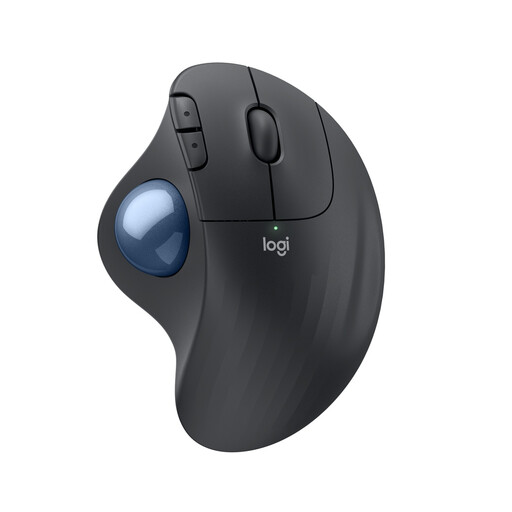
Logitech ERGO M575S – Graphite

Logitech ERGO M575S – Graphite

This wireless thumb trackball stays in place as you move the cursor. Logitech describes the ERGO M575S as suitable for small or cluttered workspaces.

Joybuy

Frequently asked questions

Do I need special software for a trackball?

Not necessarily for basic use: Kensington describes the wired Orbit K72337EU as a plug-and-play device. For button, cursor or scrolling customisation, the manufacturer lists TrackballWorks; Logitech lists Logi Options+ for customisable features on the MX Ergo S. Check the software requirements for your specific model and operating system.

What can I do if the cursor sticks?

Start by following the care instructions for your specific model. Elecom recommends regularly cleaning the ball and bearing area on the DEFT PRO, as dirt can affect how the ball moves. This care advice won’t necessarily apply to other models.

What are my rights if a product develops a fault after I buy it in Germany?

When you buy goods as a consumer, you have statutory rights against the seller. These are separate from any voluntary manufacturer’s guarantee. The German consumer advice centre generally refers to a two-year statutory warranty period, with repair or replacement offered as the first remedy. Check the terms of any additional guarantee separately.

What product requirements should I check for a wireless trackball?

Check the product labelling, manufacturer’s information and required product documentation for the specific item you’re considering. The German Federal Network Agency lists CE marking, product identifiability, manufacturer details, German-language instructions and a declaration of conformity among the points to check. The CE mark is a declaration made by the manufacturer under its own responsibility; it doesn’t show that the selected model has been individually checked by a government authority.