Listeners with existing passive speakers
If you want to keep using your speakers, check their connections and impedance against the specifications of the specific amplifier.


Start by considering which passive speakers and music sources you want to keep using. Depending on the model, a traditional integrated amplifier offers different connections for separate audio sources, while a streaming amplifier can combine network features and room correction. For listening at low volumes, easy-to-control playback and, where needed, a suitable headphone output matter more than the wattage figure alone. Room correction is no substitute for choosing the right speakers or being considerate of housemates and neighbours.
If you want to keep using your speakers, check their connections and impedance against the specifications of the specific amplifier.
If other people or your neighbours need some peace and quiet, consider the volume controls, your living situation and, if appropriate, a suitable headphone output.
If you switch between separate audio sources and streaming, check which connections or built-in services you actually want to use.
A good fit if: you use passive speakers and separate sources such as a CD player, digital audio sources or a compatible MM turntable.
Consider: connections and power ratings vary by model. Built-in network streaming is not confirmed for the devices mentioned here.
A good fit if: you mainly want to use passive speakers with supported network services and make use of room correction.
Consider: streaming and RoomFit need to be set up correctly. The settings available depend, among other things, on the model and microphone.
| Buying priority | What to check | Who is this especially important for? |
|---|---|---|
| Speaker compatibility | Check whether your speakers are passive or active, and match the connection and impedance. Compare wattage figures only when the load and measurement conditions are the same. | If I want to keep using my passive speakers, I first want to check that their connections and impedance are compatible with the amplifier. Around 36% of consumers prioritise compatibility with their existing speakers. |
| Listening at low volumes in an open-plan living space | Check whether the model offers the volume or tone controls you want, and whether its room correction can be set up to suit your space. | If I want to listen to piano sonatas without disturbing others in an open-plan or poorly soundproofed home, playback that is easy to control is important. Around 29% of consumers put considerate listening at low volumes first. |
| Connections and music sources | List the sources you use and check for the analogue, optical or coaxial inputs, MM phono input and streaming services you need. | If I switch between a turntable, CD player, digital sources or streaming, I want to choose only the connections I actually need. Around 21% of consumers prioritise having the right choice of sources. |
| Private listening with headphones | Check that the headphone output and connector type are compatible with your headphones. | If I sometimes prefer listening through headphones rather than speakers, I want to be sure that the connection and headphones are compatible. Around 14% of consumers put private headphone listening first. |
The power ratings for the Yamaha A-S301 and Marantz PM6007 apply under specific conditions. The MONACOR SA-100 lists channel-specific figures alongside a general 50-W rating; this should not be read as 50 W per channel at 8 Ω.
Compare your speakers’ specifications with the amplifier’s channel ratings, making sure they are specified on the same basis. Also take impedance and measurement conditions into account.
Bluetooth on the Denon PMA-600NE and the network services listed for the WiiM Amp Pro are different ways of connecting.
Decide which services and audio sources you use, then check that the model you choose supports them.
Depending on your choice of sources, you may need an additional network streamer.
RoomFit adjusts playback settings, but it cannot tell you whether music will disturb others in a poorly soundproofed home. The German Environment Agency notes that noise in the home can cause disturbance.
Use room correction to suit your listening position, keep the volume in check and check the noise rules that apply where you live.
The A-S301 is a traditional integrated amplifier with analogue and digital connections, as well as adjustable Loudness. The R-S202D is a stereo receiver with Bluetooth and DAB/DAB+.
The PMA-600NE combines a traditional stereo integrated amplifier with Bluetooth, digital inputs and MM phono.
The PM6007 has several analogue and digital inputs, MM phono and a documented headphone output.
The Amp Pro combines amplification for passive speakers with network streaming and RoomFit.
The SA-100 is a compact stereo amplifier for analogue line-level sources, with tone controls and a headphone socket.
This selection is for listeners who want to use passive speakers with Bluetooth or RCA sources.
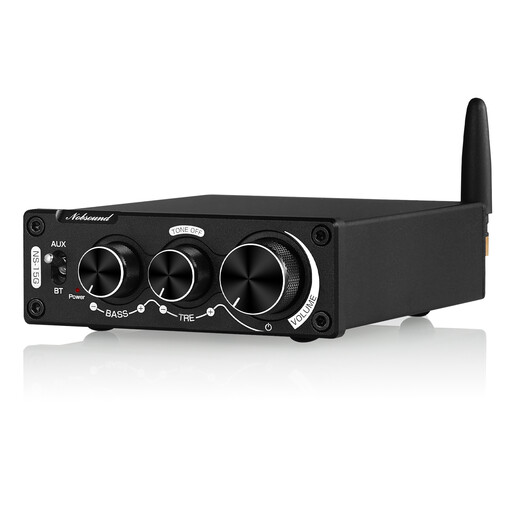 No image available
May suit passive speakers with compatible impedance and Bluetooth or RCA sources. The stated range is 4–8 Ω; check this against your speakers’ specifications before connecting them.
No. Having a compatible plug is not enough. Check whether your speakers are passive or active. For passive speakers, match the connection and impedance against the specifications of the specific amplifier. Compare wattage figures only when the load and measurement conditions are also taken into account.
Follow the safety and ventilation guidance in the manual for your particular device. For example, MONACOR requires the SA-100’s ventilation openings to be kept clear and warns against interfering with the mains-powered device. These specific instructions for one model are not general measurements that apply to other amplifiers.
Check whether you need a separate network streamer or phono preamp for your sources. The EU’s Your Europe website states that purchases of goods from traders within the EU come with a minimum two-year legal guarantee from the date you receive the goods. This is separate from any voluntary manufacturer’s guarantee.
The German Environment Agency does not specify a single nationwide quiet time or generally applicable volume limit for stereo systems. For noise caused by people’s behaviour, it points to rules set by the federal states and local authorities, as well as house rules. Check the requirements where you live and in your building. Rules for specific outdoor equipment do not apply to stereo systems.