What should you look for when buying?
Start by checking the card format and whether you can access the files on your device. Then consider how easy the reader will be to use in your seat, and finally whether faster transfers matter for your files.
| What matters to you |
What to check before buying |
Who needs to consider this? |
| Card format |
Match the SD or microSD slot to your trail camera card. Also check the SDHC or SDXC label and capacity; the SD Association assigns different capacity ranges to these standards. |
If I want to plug the card in on the train, the reader needs to support its form factor and standard. Around 34 % of consumers put card format first. |
| File access |
Check the USB-C connection, file system and access options on the specific device. Apple Support lists the file systems supported for external storage on an iPhone and explains how to access them using a suitable app. |
If you want to open your photos directly on your own phone or laptop, check that the combination works beforehand. Around 33 % of consumers prioritise this. |
| Ease of use in your seat |
Check the design and, where relevant, cable length to make sure they suit the space available. Extra ports or a charging input only matter if you’ll use them while the reader is connected. |
If I want to view the card in a cramped train seat, the reader needs to be practical to use with my device and card. Around 20 % of consumers particularly value ease of use in their seat. |
| Transfer speed |
Check the UHS support of both the card and the reader. TP-Link notes that a quoted transfer rate doesn’t guarantee the same speed on your own device. |
If you copy large photo or video files, compare the interfaces supported by your card and reader. Around 13 % of consumers put transfer speed first. |
USB-C card readers and hubs on Joybuy
This selection includes USB-C card readers and hubs with card-reading functionality for viewing trail camera footage. Before buying, check that the card format and connection are compatible with the device you’ll be using.
 No image available
Acer ODK6V0 7-in-1 USB-C hub
For laptop users who need extra ports as well as a card reader.
SD and TF card reader, 3 USB 3.0 ports at 5 Gbit/s, HDMI with 4K at 30 Hz and 100 W PD pass-through.
Joybuy
 No image available
3-in-2 USB-C hub with SD card reader
An option if you’re looking for a USB-C hub with a card reader rather than a dedicated reader.
The product title lists an SD card reader. Check that the connection is compatible with your specific device.
Joybuy
 No image available
4-in-1 USB-C card reader with USB-A
For users looking for a card reader with both USB-C and USB-A connections.
The product title lists SD, MicroSD, TF and SDHC. Check that the reader supports your trail camera card format.
Joybuy
 No image available
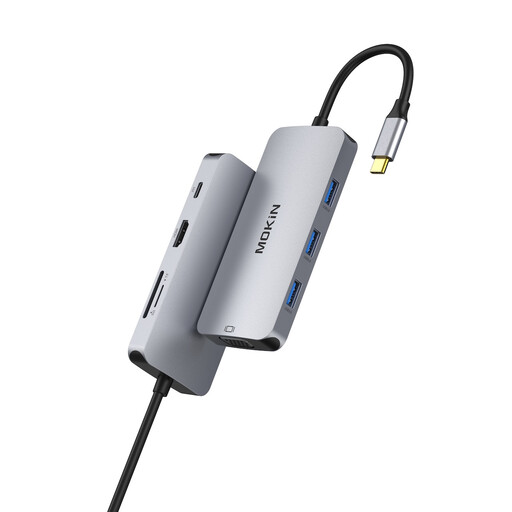
MOKiN USB-C hub with SD/TF
For laptop users who need extra ports as well as a card reader.
The product title lists HDMI, three USB 3.0 ports and PD. According to the product details, the hub is designed for laptops with a fully functional USB-C or Thunderbolt port, not devices in MHL mode.
Joybuy
 No image available
WOZINSKY 14-in-1 USB-C hub with SD and TF card reader
For laptop users who need extra ports as well as card-reading functionality.
The product title lists SD and TF card readers and a 15 cm cable.
Joybuy
Frequently asked questions
How do I find photos on an iPhone with USB-C?
If the connection and card format are compatible, Apple Support says you can access external storage in the Files app by going to ‘Browse’ and then ‘Locations’. You can also import photos and videos into Photos. Apple lists FAT and exFAT among the supported file systems, and requires a single data partition. Test your card before you travel.
Do I need to handle an SDXC card differently from an SDHC card?
Yes. Check the card format, reader and device together. The SD Association defines SDHC as over 2 GB to 32 GB with FAT32, and SDXC as over 32 GB to 2 TB with exFAT. Don’t format a card if it contains photos you still need, just to test a reader.
What do warranty and statutory rights mean when buying in Germany?
According to consumer information from the European Union, when you buy from a business seller as a consumer, you’re generally entitled to a minimum statutory guarantee of two years from the date you receive the goods. Your point of contact is the seller. A voluntary manufacturer’s warranty doesn’t replace these rights. This rule doesn’t apply to private sales.
Where should I dispose of an old card reader in Germany?
An old card reader should be disposed of as electrical waste at an authorised collection point, such as a local council recycling centre. The German Federal Ministry for the Environment also explains the circumstances in which retailers are required to take back electrical equipment.


