
Lieferung heute & morgen

Qualitätsgarantie
App herunterladen
Kategorien
The advancing integration of artificial intelligence into audio devices has created a new product category: translator earbuds. These devices aim to overcome language barriers in real-time, often combining this function with other technologies like Active Noise Cancellation (ANC) and innovative control concepts. For international travellers, business professionals, and tech enthusiasts, they represent a potentially valuable addition to their gear. This article analyses the technical features relevant to selecting such earbuds and presents two models with different specialisations.
Choosing the right model depends on a precise analysis of your individual needs. The following technical parameters are crucial for making an informed decision.
A key differentiator is how the translation function is implemented.
The number of supported languages is also a quantifiable factor. Models with integrated AI often specify an exact number that can serve as a benchmark.
For use in noisy environments like airports, trains, or open-plan offices, the quality of the Active Noise Cancellation (ANC earbuds) is crucial. Performance is often specified in decibels (dB) and describes how effectively ambient noise can be reduced. Adaptive ANC systems automatically adjust the intensity of the noise cancellation to the surroundings, which can enhance user comfort.
Modern wireless earbuds with a touchscreen on the charging case offer an advanced layer of control. Earbuds with a display charging case allow direct access to functions like music selection, volume control, or translation mode activation without needing to use the connected smartphone. This can increase efficiency in daily use. In addition, intuitive touch controls directly on the earbuds for basic actions (answering calls, play/pause) are an established standard.
Battery life should be considered from two perspectives:
A fast-charging feature, which provides several hours of use after a short charging time, is particularly relevant for users on the go. Bluetooth has become the established connection standard, with newer versions like Bluetooth 5.4 or higher offering a more stable connection and lower latency.
The design (in-ear, semi-in-ear, open-ear) affects wearing comfort and passive noise isolation. The IP protection rating (e.g., IPX5) provides information about protection against water and sweat and is an important indicator of suitability for sports activities or use in the rain.
Based on the criteria above, we present two models that showcase different technological priorities.
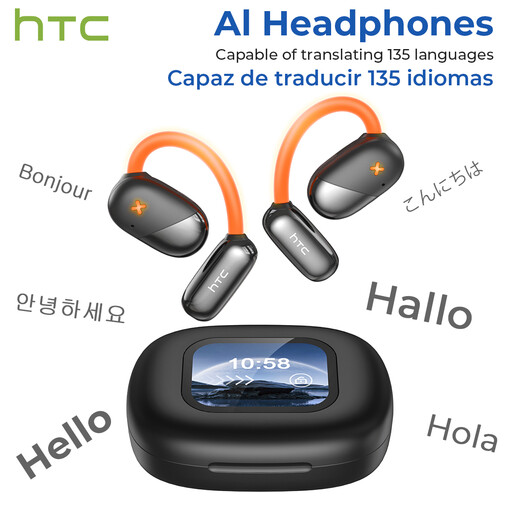
Why we recommend this product The HTC NE33 are consistently designed with the translation function as their core feature. According to the manufacturer, the integrated AI supports online translation in 135 languages and offers dedicated modes like "Translation Mode" and "AI Chat Mode." The charging case with its full-colour LCD touchscreen underscores this focus by enabling direct access to translation and other core functions.
Pros
Who It's For This model is aimed at users for whom Bluetooth earbuds with real-time translation are the primary requirement. This includes internationally active business professionals, staff at trade fairs and conferences, and travellers seeking a dedicated solution to overcome language barriers.
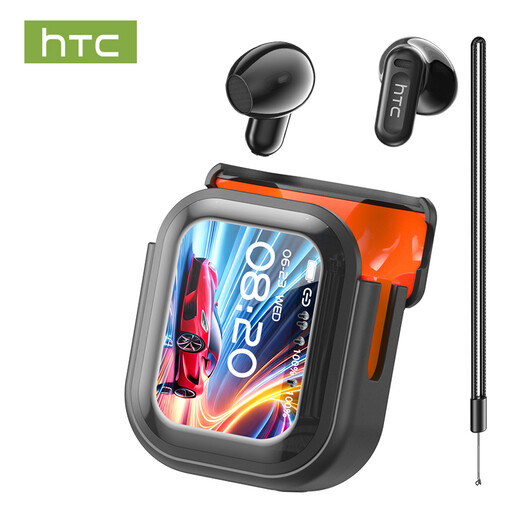
Why we recommend this product The technological focus of the HTC NE20 is on an advanced audio experience and noise cancellation. According to the manufacturer, its adaptive hybrid ANC achieves a reduction of up to -50 dB and intelligently adapts to scenarios like being on an aeroplane or in a café. The long battery life and 6-microphone array for clear calls make them a powerful everyday companion. The translation function is facilitated through third-party apps.
Pros
Who It's For These HTC wireless earbuds are ideal for users who primarily value excellent noise cancellation, high audio quality, and long battery life for music, podcasts, and phone calls. The ability to translate via an app is a useful additional feature, but not the device's primary focus. They are therefore well-suited for commuters, digital nomads, and office workers.
The models presented cover specific use cases. Should your requirements demand a different combination of features, such as a stronger focus on sports suitability or audiophile sound quality, you will find a broader selection of devices in our main category.
Discover more models in the Headphones and Earbuds category.
1. How does real-time translation in earbuds work? Most systems operate on a similar principle: A microphone on the earbud or the connected smartphone captures the spoken language. This audio data is sent to an AI software—either on the device or in the cloud—which translates the text. The translated audio output is then played directly into the user's earbuds.
2. Do translator earbuds always require an internet connection? For online translation, which offers a large number of languages and high accuracy, an active internet connection on the paired smartphone is typically required. A few highly specialised devices offer offline packages for a limited number of languages, but the models presented here require an online connection.
3. What does ANC in earbuds mean? ANC stands for Active Noise Cancellation. This technology uses microphones to analyse ambient sounds. An internal chip then generates an anti-phase sound wave (anti-noise) that neutralises the external sounds before they reach the wearer's ear. This allows for an undisturbed listening experience, even in noisy environments.