
Lieferung heute & morgen

Qualitätsgarantie

Willkommens-Angebote freischalten: KOSTENLOSE Lieferung | Bis zu 80 % RABATT | Kostenlose 30-Tage-JoyPlus-Testphase
App herunterladen
A transparent 2 mm PVC table cover protects the tabletop without completely concealing the wood grain, colour or decorative finish. It is used in private homes, offices, cafés, schools and care facilities whenever liquids, stains, scratches and everyday wear need to be reduced.
A thickness of 2 mm feels more substantial than thin table films, but it also adds weight and requires more careful fitting. The key factors are therefore not just the price, but the combination of dimensions, surface, edge design and temperature rating.
A transparent PVC table film can form air bubbles or adhere to glass and high-gloss surfaces. Several suppliers explicitly point out that such surfaces may be problematic. On delicate tabletops, placing a thin fabric layer between the table and the film can help. Before buying, check whether the manufacturer excludes the relevant surface type.
The term heat-resistant table film is used inconsistently. According to WOLTU’s product description, certain models are designed for temperatures up to 80 °C. Other listings merely state general heat resistance or warn against temperatures above 60 °C. A pot taken directly from the hob or oven can deform the film.
In practical terms, the film may be suitable for warm plates and cups, but trivets should still be used beneath very hot cookware.
PVC table films are often delivered rolled up. Waves may appear after unpacking. In addition, some product descriptions indicate possible shrinkage of approximately 1 to 5 mm. A film ordered exactly to the table’s edge may therefore end up slightly too small.
When choosing made-to-measure table protection, allow for the dimensional tolerance specified for the particular product. Depending on the model, the film can be trimmed with a sharp knife or scissors. Use a straight guide and a stable surface when cutting.
A 2 mm table film creates a comparatively firm protective layer against spilled liquids, food residue and everyday scratches. However, it is not impervious to sharp objects: knives, drawing pins and rough ceramics can damage the surface.
For families with children or creative activities at the table, a wipe-clean table cover with a smooth surface is particularly practical. Dirt can generally be removed with a soft, damp cloth. Abrasive cleaners and rough sponges may impair transparency.
Before buying, measure the tabletop’s length and width at several points. For a rectangular tabletop, a rectangular table film is usually the appropriate basic shape. On tables with rounded corners, a straight cut may protrude; models with bevelled edges often feel more comfortable when resting your arms on the table.
Common sizes in the selection range, for example, from 70 × 110 cm and 80 × 140 cm up to 100 × 200 cm. Smaller dimensions are suitable for desks, compact kitchen tables and side tables. Large dining tables, by contrast, require sufficient width to protect the entire usable surface.
A straight edge is functional and easy to trim. A 45° bevelled edge can create a more comfortable transition and reduce the sharpness of the edge at the side of the table. Models with a textured underside may sit more securely on matt wood or plastic surfaces.
Extra caution is required with glass and high-gloss lacquer. Bubbles, adhesion or visual changes may occur. Always follow the manufacturer’s instructions before placing the film on the table.
The following models have been categorised by size, material thickness, cleaning instructions and intended use. The product data reflects the information provided in the respective listings.
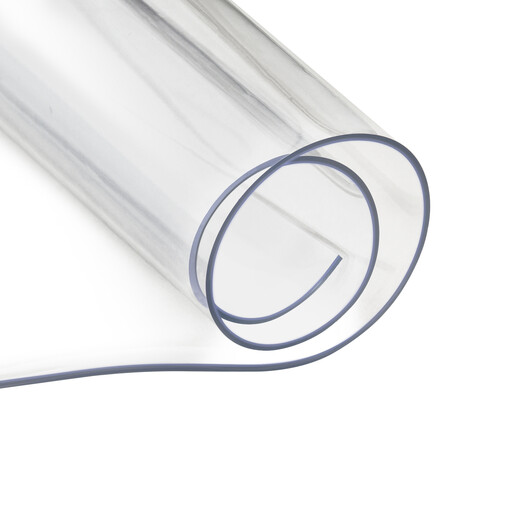
Why it is a good fit: The compact dimensions are suitable for smaller kitchen, work or side tables, offering an uncomplicated introduction to transparent table protection.
The product description specifies 2 mm PVC, a waterproof, wipe-clean surface and several available sizes. Check the specific tabletop material before use.
2 mm material thickness; transparent, smooth surface; cleaning with a damp cloth according to the supplier’s information.
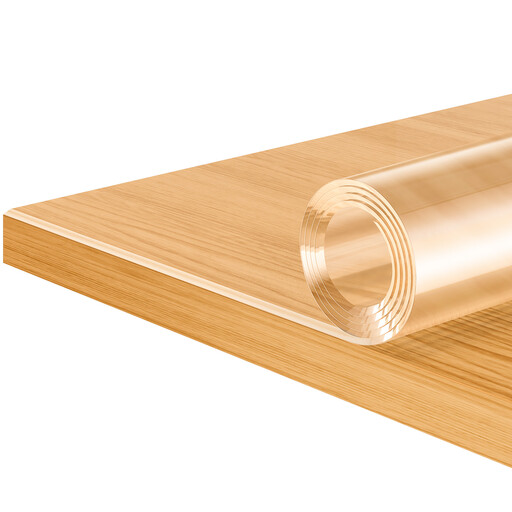
Why it is a good fit: The generous rectangular dimensions are designed for longer dining tables, buffets or large work surfaces.
The 45° bevel avoids an abrupt, straight edge. The stated shrinkage tolerance of 1–3 mm should be factored into your size planning.
Bevelled edge; water- and grease-resistant surface according to the product information; transparent PVC with a thickness of 2 mm.
Why it is a good fit: This model is designed for kitchens, dining areas and workspaces exposed to regular spills, mess and abrasion.
According to the supplier, the surface is heat-resistant up to 80 °C. This does not replace a trivet for hot pots and does not protect against cuts from sharp objects.
Waterproof and wipe-clean; stated heat resistance up to 80 °C; can be trimmed according to the product description.
The complete selection includes transparent table-protection films in various sizes, designs and material options for different tabletop surfaces.
A waterproof table cover prevents liquids from reaching the tabletop directly. Nevertheless, spilled drinks should be wiped up promptly so that they cannot run beneath the film at the edges. For lacquered, oiled or delicate surfaces, testing first in an inconspicuous area is recommended.
Service life depends on usage, exposure to sunlight, cleaning and contact with sharp or hot objects. Without a manufacturer’s guarantee, no general lifespan can be stated. Visible scratches, persistent clouding or deformation indicate that the cover should be replaced.
Many rectangular models can be trimmed to the desired size and shape, according to the supplier’s information. Use a straight cutting edge, a sharp tool and a stable surface. Children and pets should be kept away from the tool and small film offcuts while the film is being trimmed.
Not every model is suitable. Air bubbles or adhesion may occur on glass and high-gloss surfaces. The specific product warnings are decisive. If the manufacturer recommends an intermediate layer, place a thin cloth between the tabletop and the film.