
Lieferung heute & morgen

Qualitätsgarantie

Willkommens-Angebote freischalten: KOSTENLOSE Lieferung | Bis zu 80 % RABATT | Kostenlose 30-Tage-JoyPlus-Testphase
App herunterladen
A transport trolley can make shopping, plants, boxes or tools much easier to move. Even so, unclear load capacity specifications, impractical dimensions and poorly designed wheels cause problems with many purchases. Anyone who focuses only on a large figure in the product description often overlooks important details for everyday use in the home, garden, garage or workshop.
A stated maximum load does not automatically apply to every usage situation. A two-wheeled trolley is subject to different forces than a four-wheeled platform trolley. Unevenly distributed loads can also affect stability.
You should therefore check which wheel configuration the load capacity applies to and whether the manufacturer requires the load to be distributed evenly. A folding transport trolley for light shopping is not automatically suitable for heavy paving stones or toolboxes.
A folding trolley can require very little storage space when folded. However, the volume when unfolded is also important. For boxes, gardening accessories or shopping, the internal dimensions and capacity are more relevant than the external dimensions alone.
Also check whether the handle extends fully and whether the folded dimensions actually fit in the intended storage area, boot or cupboard.
A wheeled trolley is generally comfortable to move across level floors. However, small wheels can reach their limits on thresholds, rough paving or uneven garage floors. For tool trolleys and workshop trolleys, locking brakes are also important so that the trolley does not roll away unintentionally while you are working.
The maximum load capacity should match your regular use. For occasional shopping or light household items, 25 kg may be sufficient. For plants, toolboxes or building materials, a higher load capacity is advisable. Even with a trolley rated for 75 or 125 kg, you should still check that the surface is level and that the load is positioned securely.
Avoid permanently pushing the manufacturer's stated limit. Heavy items should be placed as low down as possible and should not extend beyond the sides.
Plastic models made from PP or PE are often lighter and easy to clean. Metal reinforcements can make the construction more stable. For long-term use in a workshop or garage, however, a powder-coated steel body with sufficiently large wheels is worth considering.
Powder coating can protect the surface against everyday wear and tear. However, it does not mean that a tool cabinet with drawers is watertight. In damp rooms, you should check the specific information on water resistance.
A folding transport trolley should open without excessive effort and lock securely in place. Look out for:
With a sack truck, the angle of inclination is also relevant. A two-wheeled trolley can be manoeuvred in a space-saving way, but requires more control when carrying heavy loads. A four-wheeled platform trolley can stand more securely when the load is distributed correctly.
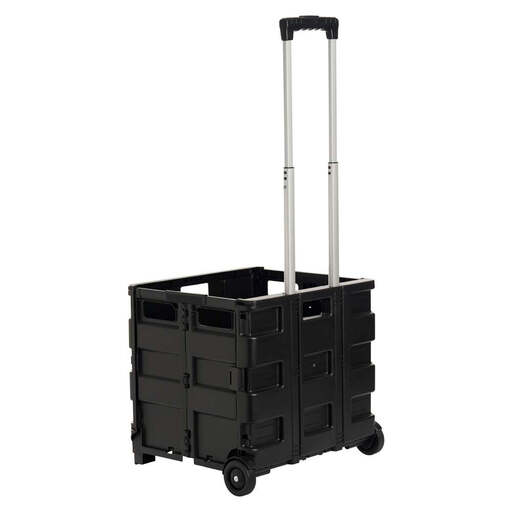
Why this product suits this profile: This trolley is designed for shopping, household items and lighter transport tasks. It offers a capacity of 42,5 litres and folds down to a depth of 8 cm.
The 25 kg load capacity is clearly specified. The folded dimensions of 45,5 × 45,5 × 8 cm make it easier to check the actual storage space required.
42,5-litre capacity, an extendable handle with a height of 97,5 cm and a net weight of 2,65 kg.
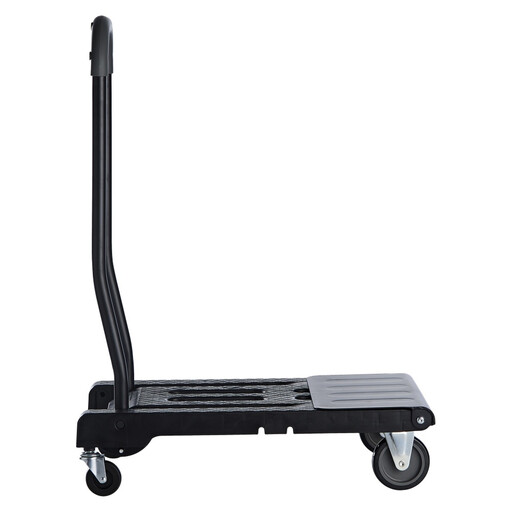
Why this product suits this profile: Switching between two and four wheels allows for different ways of transporting items in the garden, workshop and home.
The load limits are listed separately: 75 kg with two wheels and 125 kg with four wheels. This makes it easier to plan the intended use.
55 × 35 cm transport surface, folding construction and two selectable wheel configurations.

Why this product suits this profile: This mobile tool cabinet with a lockable double-door system is aimed at users who want to keep their tools organised and protected from unauthorised access in the garage or workshop.
Four wheels and brakes on the rear wheels are clearly specified. The compartment layout reduces the risk of storing small parts loose inside the cabinet.
Cold-rolled steel, one large, three medium and three small drawers, plus lockable doors.

Why this product suits this profile: This workshop trolley combines drawers, side surfaces and wheels for users with many hand tools and a need for regular access.
The stated load capacity of 550 lbs should be compared with the intended total weight before purchase. The wheels have locking mechanisms.
Cold-rolled steel, ten compartments, four wheels, removable hooks and protective mats for the drawers and work surface.
We have put together a complete, regularly updated list of products that fully meet these strict selection criteria and the safety regulations applicable in the EU.
Before buying, measure the route the trolley will need to take. Door widths, stair landings, lift doors and narrow garage entrances determine whether a wide workshop trolley or a compact folding trolley is the better choice.
Also bear the following in mind:
That depends on how it will be used. 25 kg may be enough for shopping and household items. For garden materials, toolboxes or boxes, models rated for 75 kg or more are advisable. The wheel configuration, surface and even distribution of the load are also crucial.
Folding models are primarily designed for level, stable surfaces unless the manufacturer states otherwise. High kerbs, stairs and rough surfaces can place greater strain on the wheels, base plate and joints. For these routes, a suitable sack truck may be a better option.
A transport trolley is primarily used to move items. A tool trolley or tool cabinet with drawers is additionally designed for permanent tool storage, organisation and, in some cases, locking. For mobile work in the workshop, drawers, locking castors and a sturdy work surface are important criteria.