Photographers working in tight spaces
If you want to capture entire warehouse façades and views of bridges, first check whether the lens gives you a wide enough angle of view from your chosen spot.


To capture entire warehouse façades, first check whether the specific lens gives you a wide enough angle of view from where you can stand. Zoom or interchangeable lenses offer more flexibility for different compositions than prime lenses. If you want to carry as little as possible on a walking tour, a compact prime-lens camera may be worth considering. In the rain, the camera body and attached lens need to be suitable for use together. Stabilisation is no substitute for correct exposure or a sufficiently wide angle of view.
If you want to capture entire warehouse façades and views of bridges, first check whether the lens gives you a wide enough angle of view from your chosen spot.
As the light fades, it helps to manage exposure, bright windows and dark brickwork carefully rather than relying on stabilisation alone.
If you often take your camera with you, weigh up travelling light against the flexibility of a zoom, extra lenses and the protection your equipment needs.
A good choice if: You need different angles of view for façades and details. The Canon EOS R50 supports RF and RF-S lenses.
Bear in mind: Choosing lenses means carrying extra equipment; the equivalent focal-length range for the Canon kit mentioned here starts at 29 mm.
A good choice if: You want to frame different shots on your walk without changing lenses. Sony lists the RX100 VII as having a 24–200 mm full-frame equivalent range.
Bear in mind: The manufacturer’s specifications list a 1.0-inch sensor and an aperture range of F2.8 to F4.5. These figures alone don’t tell you how the camera performs at dusk compared with other models.
A good choice if: You’re happy to work with a fixed angle of view. Ricoh lists the GR IV as 28 mm equivalent, while Fujifilm lists the X100VI as 35 mm equivalent.
Bear in mind: Without optical zoom or the option to change lenses, your composition depends on where you stand. The specific angle of view is key when photographing an entire façade.
Hamburg’s official website describes the Speicherstadt’s brick buildings, canals and bridges as photographic subjects, particularly at dusk. So check the angle of view, exposure, portability and protection offered by the complete camera-and-lens setup.
| What you need | What to check before buying | Who is it important to? |
|---|---|---|
| Capturing entire façades | The full-frame equivalent focal length of the specific lens or kit, not just the camera name. | If I want to capture an entire warehouse façade from a tight spot, I’ll check the angle of view first. Around 36% of shoppers are likely to have this need. |
| Bright and dark areas in the image | Check the exposure settings and RAW or exposure-bracketing features of the specific model. | I want to control exposure carefully when photographing lit windows against dark brickwork. Around 29% of shoppers are likely to prioritise dusk photography. |
| Luggage and framing options | Compare the weight of the complete setup; weigh up a prime lens against the zoom range you need. | On a longer walk, I want to carry less but still be able to frame my shots well. Around 21% of shoppers are likely to prioritise portability. |
| Use in the rain | Read the protection ratings for the camera body and the specific lens separately. | If I want to take photos in wet weather, I need a complete setup that’s suitable for the conditions. Around 14% of shoppers are likely to prioritise use in the rain. |
According to Canon, the angle of view of the Canon RF-S 18–45 mm is equivalent to 29–72 mm in full-frame format. So the 18 mm printed on the lens isn’t the same as an 18 mm full-frame equivalent.
When photographing entire façades, compare the full-frame equivalent focal length of the kit actually on offer. Depending on the composition you want, you may need an additional wide-angle lens.
Stabilisation compensates for camera movement, but it won’t prevent blur caused by moving people. As the light fades, exposure still matters.
Check your exposure and movement in the scene rather than basing your buying decision on the stated stabilisation alone.
A protected camera body doesn’t mean that every attached lens is also protected against dust and splashes.
Read the protection ratings for the body and the specific lens separately. Depending on the combination, you may need a suitable lens or additional protection.
The details below apply to the specific models and lenses mentioned, not to every product range from these manufacturers.
The EOS R50 with RF-S 18–45 mm IS STM is suited to travellers who want to use different lenses.
The RX100 VII is a compact camera with a built-in zoom for framing different shots without changing lenses.
The GR IV is for photographers who want to work with a built-in 28 mm prime lens.
The X100VI is for travellers who want to shoot through a viewfinder with a fixed 35 mm angle of view.
The OM-5 Mark II is a camera body for travellers who want to consider weather protection and choose a suitable lens.
The following selection includes compact vlogging, action and 360° cameras. Before buying, check that the photo angle of view and controls suit your architectural photography.
 No image available
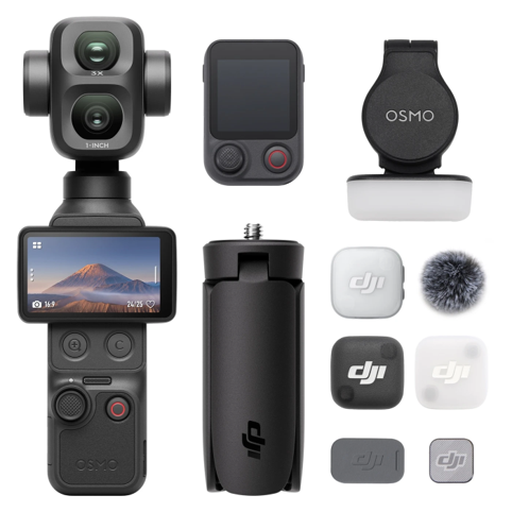
This vlogging combo is designed for use on the go; check the actual photo angle of view for capturing Speicherstadt façades.
The product description lists a 20 mm f/2 lens and a 1-inch CMOS sensor. According to the description, 4K/240 fps is supported only in slow-motion mode.
 No image available
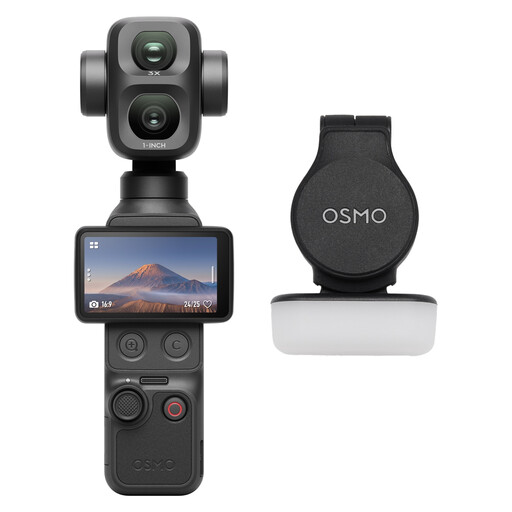
If you want to frame different shots on the go, check whether the zoom listed in the product title covers the angle of view you need.
The title lists a 1-inch CMOS sensor, 2× lossless zoom, 3-axis stabilisation, 107 GB of built-in storage and 4K/240 fps.
 No image available
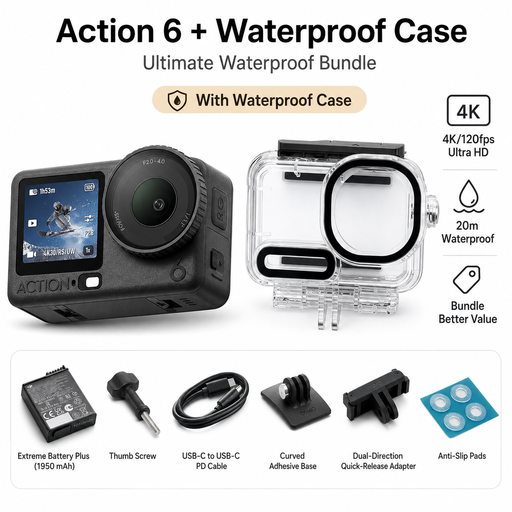
The description lists an ultra-wide-angle lens for very wide subjects; check whether its look suits your architectural photography.
The description lists a 154° ultra-wide-angle lens and 20 MP photos. For underwater use, the safety notice says the case must be closed correctly.
 No image available
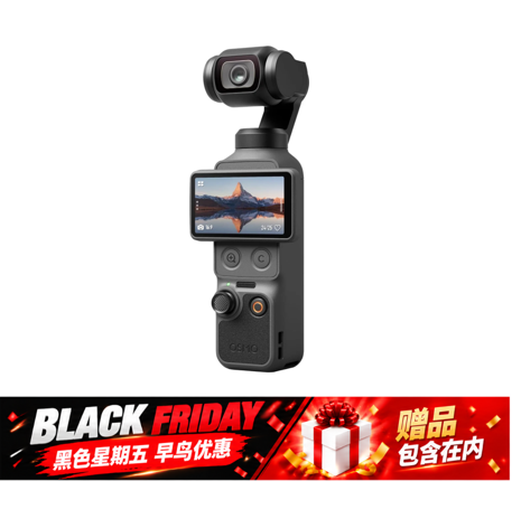
If you want to switch between wide views and distant details on a walking tour, check that the stated zoom range suits your subjects.
The product description lists up to 6× lossless zoom, a 12× zoom range, a 1-inch main sensor and a telephoto lens with a 1/1.3-inch sensor.
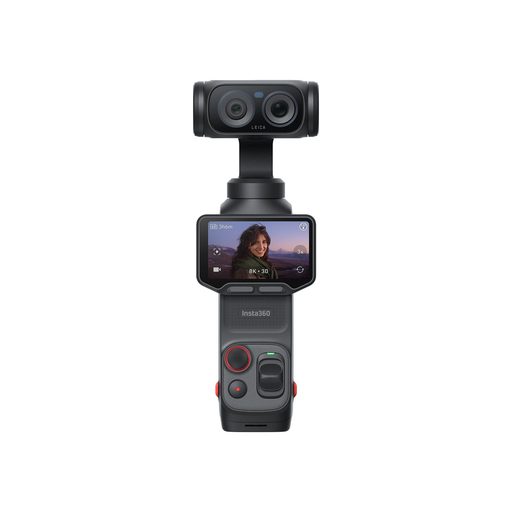 No image available
For panoramic views, the product description lists 360° photos; check whether this format suits the façade shots you have in mind.
The description lists 120 MP panoramic photos and native 8K/30 fps 360° video.
Compare the full-frame equivalent angle of view of the specific lens with the space available at your chosen spot. The examples mentioned start at 24 mm for the Sony RX100 VII, 28 mm for the Ricoh GR IV, 29 mm for the Canon EOS R50 with RF-S 18–45 mm, and 35 mm for the Fujifilm X100VI. A shorter equivalent focal length captures a wider view from the same spot, but it doesn’t guarantee that every façade will fit in the frame from every location.
Check the exposure in the image itself. If your specific camera model supports it, you can also use exposure bracketing and combine the shots later. Canon describes this method for high-contrast scenes; check whether it’s available and how it works on the model you’re considering.
No. Protection for the body doesn’t prove that every attached lens is protected too. OM SYSTEM lists an IP53 rating for the OM-5 Mark II and offers weather-sealed lenses; Canon describes the RF-S 18–45 mm as not dust- or splash-proof.
In general, the seller is responsible for your statutory consumer rights, not automatically the manufacturer. The Verbraucherzentrale explains that new goods are generally covered by a two-year statutory warranty period from the date of delivery. This is separate from any voluntary manufacturer’s guarantee.
Under certain conditions, Section 59 of the German Copyright Act (UrhG) allows the reproduction and public sharing of works that remain permanently in public streets, roads or squares. For buildings, this applies only to their exterior appearance. It does not give blanket permission to photograph interiors or private property, or override other rights relating to an image.