
当日/次日达

品质保障

开启新人专享福利: 全场免邮 | 低至 2 折 | 免费试用 30 天 JoyPlus 会员
下载 Joybuy
A travel mug should keep coffee, tea or water at the right temperature while you are out and about, without creating extra hassle in everyday life. In practice, disappointment is often caused not by the insulation itself, but by unsuitable lids, the wrong size or complicated cleaning.
If you want to buy a coffee cup to go, an insulated travel mug or a stainless steel drinking cup, you should therefore look beyond lengthy temperature claims. What really matters is whether the mug suits your vehicle, bag, workplace and personal drinking habits.
A lid with a drinking opening can reduce splashes, but it is not necessarily suitable for carrying the mug lying down in a bag. The design should be checked carefully, particularly when it includes pressure-equalisation openings or straws. A leakproof travel mug should have a clearly described seal and a secure closure.
Hot drinks also present an additional safety consideration: the lid must be fully locked, and care should be taken with the first sip. Even a model described as leakproof should not be overfilled.
A capacity of 600 millilitres or more can be useful for long car journeys, the office or training. However, for a small car cup holder, a slim travel mug for car and office holding 300 to 475 millilitres is often a better fit.
The following dimensions are therefore important to check before buying:
A reusable drinking cup is only practical for everyday use if the lid, sealing ring and drinking opening can be cleaned regularly. Not every model is dishwasher-safe. Some products may only be washed by hand, while others are suitable for the top rack of the dishwasher.
Straw mugs include additional individual parts. They make drinking more comfortable, but require thorough cleaning with a suitable brush.
A double-walled travel mug with vacuum insulation will generally keep drinks at the desired temperature for longer than a simple double-walled plastic mug. The exact duration depends on factors including the starting temperature, fill level, how often the mug is opened and the ambient temperature.
Manufacturer claims such as “up to 4 hours hot” or “up to 16 hours cold” should therefore be treated as guidelines. For commuters, keeping a drink hot for the journey to work is often sufficient. If you want to carry cold drinks throughout the day, you should also check the cold-retention specification.
A stainless steel travel mug is more resistant to breakage than glass and is suitable for everyday transport. Stainless steel intended for food contact is often described as 18/8. It is also important to check whether the inside is coated. An uncoated interior can make everyday cleaning easier and help preserve a neutral taste.
Plastic models are often lighter. They can be useful for short journeys or at your desk, but depending on their design, they offer different levels of durability and insulation from a stainless steel vacuum mug.
A flip-top lid can often be operated with one hand, making it suitable for the commute. A screw lid with a narrow drinking opening can make transport more secure, while a larger opening makes it easier to add ice cubes and clean the mug.
A straw is practical for cold drinks. However, the relevant instructions for use should always be followed with hot drinks. Not every straw or lid is designed for this purpose.
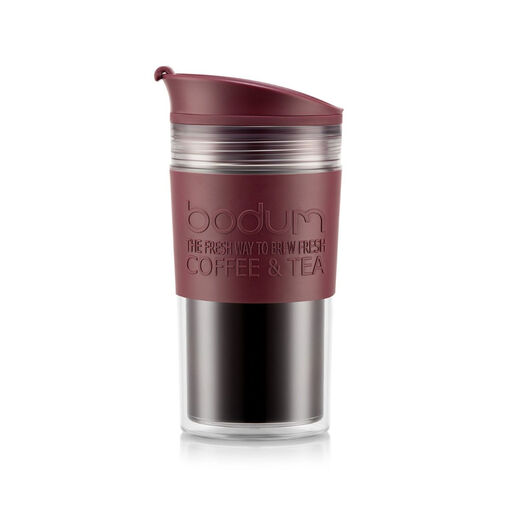
Why this product suits the profile: This compact travel mug holds 350 ml, is designed to fit many car cup holders and is suitable for commuting, use at your desk and short trips.
The Flow-Control screw lid is designed for controlled drinking. However, according to the product description, the mug is not completely leakproof and should be carried upright.
Double-walled system, 350 ml capacity, non-slip silicone band and dishwasher-safe design.
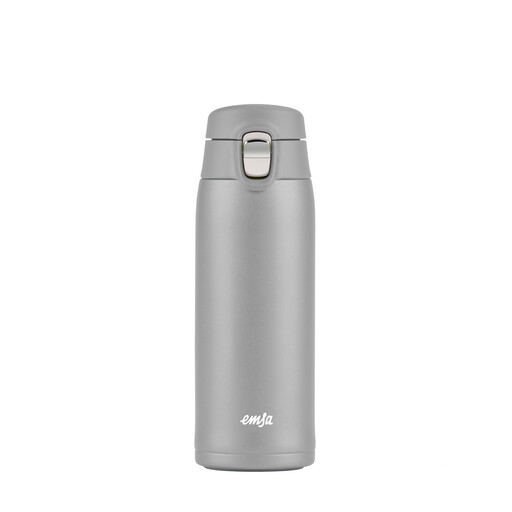
Why this product suits the profile: This slim stainless steel mug combines a flip-top system with a capacity of 0,4 litres and is designed for the daily commute to the office or use in the car.
The product details specify a tightly closing flip-top lid and dishwasher cleaning. This makes the closure and care requirements clearer than with models that provide no cleaning information.
Stainless steel construction, 8-hour heat retention, 16-hour cold retention according to the manufacturer, 0,4-litre capacity and 100% leakproof according to the product description.
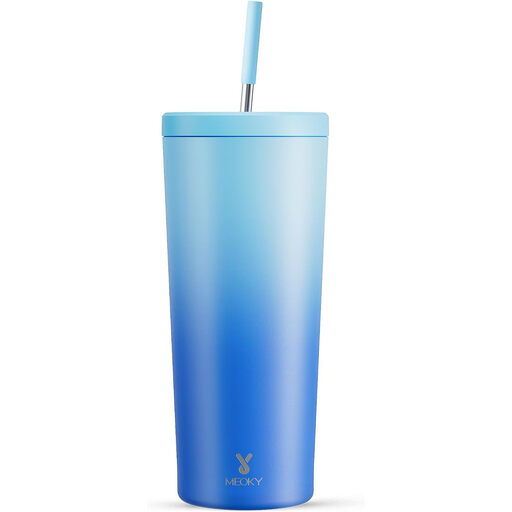
Why this product suits the profile: Holding around 710 ml, this insulated travel mug is aimed at people who want to refill less often on long journeys, at the office or during training.
The details distinguish between use with the straw and transport without the straw. The mug is intended for cold drinks; according to the warnings, it is not suitable for carbonated or hot drinks.
18/8 stainless steel, double-walled vacuum insulation, tapered shape for many car cup holders and stated cold retention of up to 24 hours according to the product description.
We have put together a complete, regularly updated list of products that fully meet these strict selection criteria and the safety regulations applicable in the EU.
This depends on the insulation, fill level, lid and starting temperature. For the models mentioned, manufacturer claims range from up to 3 or 4 hours to longer periods. For a realistic assessment, preheat the mug with hot water before filling it and open it as infrequently as possible.
The mug body, lid and sealing ring should be cleaned with warm water and washing-up liquid after every use. A narrow cleaning brush is recommended for straws. If only hand washing is permitted, the mug should not be put in the dishwasher. Drinks containing milk should not be left in the mug for extended periods.
With careful cleaning and intact seals, a travel mug can be used in everyday life for a long time. The condition of the closure, sealing ring and interior is more important than any fixed expiry date. Cracks, deformation, persistent odours or a lid that no longer closes securely are reasons to replace it.