
Lieferung heute & morgen

Qualitätsgarantie

Willkommens-Angebote freischalten: KOSTENLOSE Lieferung | Bis zu 80 % RABATT | Kostenlose 30-Tage-JoyPlus-Testphase
App herunterladen
A travel mug should reliably keep you company with coffee, tea or cold drinks – in the car, at the office, at university or while camping. In practice, however, it is often only after buying one that you discover whether a model really suits your everyday routine. A leaking lid, an overly wide base or complicated cleaning can quickly make an initially appealing purchase impractical.
The following points will help you assess marketing claims and choose an insulated drinking cup based on objective criteria.
Terms such as “leak-proof”, “splash-proof” or “watertight” can describe different features. A lid with a drinking opening may prevent splashes, but it is not necessarily suitable for carrying horizontally in a bag.
You should therefore pay attention to the specific type of closure:
The term “100% leak-proof” should always be considered in relation to the intended use. According to the product information, the Meoky model is designed to be completely leak-proof when the straw is removed. However, it is not recommended for carbonated drinks.
A vacuum-insulated cup or a stainless-steel travel mug can keep a drink’s temperature stable for longer than a single-wall cup. However, the actual duration depends on factors including the fill level, starting temperature, surrounding conditions and how often the mug is opened.
With a model featuring a drinking opening or straw, additional heat may escape. If you take coffee with you on your commute in the morning, do not just look at the stated number of hours. The lid design and closure are also important.
A travel mug should not only look good. Other important factors include:
A slim travel cup is easier to fit into bags and cupholders. A large tumbler offers more capacity, but may be too wide or too tall for some car holders.
For a short commute, 250 to 350 ml is often enough. This size also works well as a coffee cup for on the go and will often fit beneath coffee machines or into standard cupholders.
Models with a capacity of 400 to 500 ml offer more flexibility for longer commutes, lectures or day trips. Large tumblers from around 600 ml are useful for long days and cold drinks, but require more space and naturally weigh more when full.
Stainless steel is widely used for travel mugs because it can be robust and neutral in terms of odour and taste. With double-wall models, the insulation design is key. Specifications such as 18/8 stainless steel describe a common grade of stainless steel.
For plastic lids and straws, the designation BPA-free drinking cup is relevant. It refers to the plastic components used and should be explicitly stated in the product information. However, this does not automatically mean that every component is suitable for every temperature or type of drink.
Also follow the safety instructions. Many travel mugs are not microwave-safe. Carbonated drinks, dry ice or contents that build up significant pressure can cause problems with certain closures.
A drinking cup with a lid often consists of several individual parts. The more seals, drinking openings and inserts it has, the more important thorough cleaning becomes.
Useful features include:
Some models may only be cleaned by hand. According to the product information, the Meoky tumbler is intended for hand washing. The Thermos TC Drinking Mug, on the other hand, is described as dishwasher-safe. Before buying, check this information against your own cleaning habits.
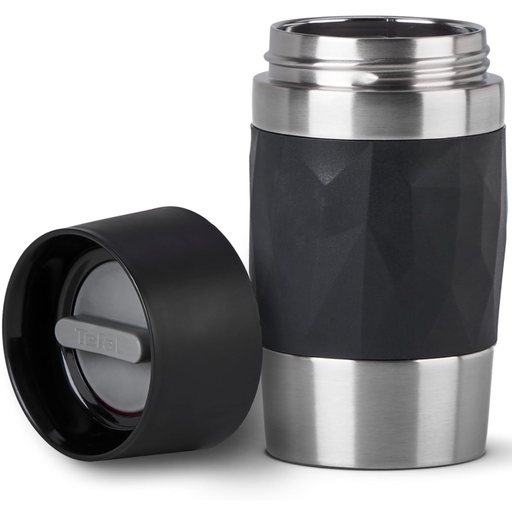
Why this product suits this profile: Its compact size is designed for short commutes, everyday office use and standard drinks holders. The 360-degree drinking opening provides access from different directions.
The product information states that it has double-wall vacuum insulation and an airtight seal. This means the choice is not based on design alone.
0.3 l capacity, stainless-steel construction, dishwasher-safe according to the product information and a compact design.
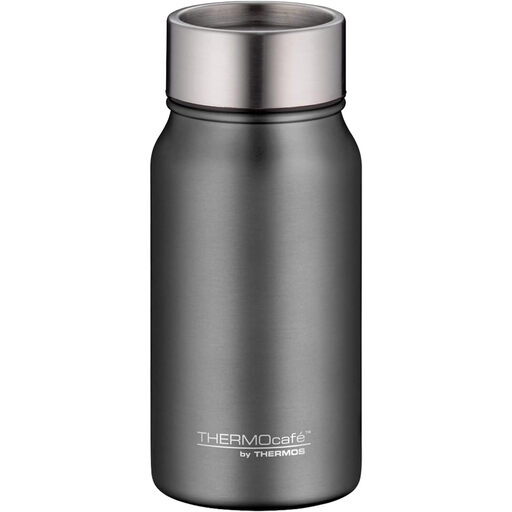
Why this product suits this profile: This double-wall stainless-steel mug is aimed at users who value clearly stated insulation performance, a push-button lid and easy cleaning.
According to the product description, the lid is removable and the mug is dishwasher-safe. This makes it easier to inspect the closure and sealing area.
Up to 8 hours of heat retention and 16 hours of cold retention, a push-button lid and BPA-free construction according to the product information.
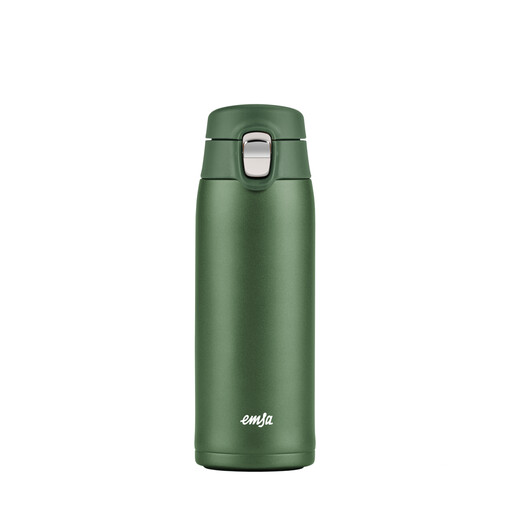
Why this product suits this profile: The slim design, one-handed operation and 0.4 l capacity suit commuters, travellers and outdoor users who need a reliable mug on a regular basis.
The product information states that it has a flip-top closure and a leak-proof design. Before transporting it, make sure the lid is fully clicked into place.
According to the product information, up to 8 hours for hot drinks and 16 hours for cold drinks, a slim stainless-steel design and one-handed operation.
We have put together a complete, regularly updated list of products that fully meet these strict selection criteria and the safety regulations applicable in the EU.
Even a robust reusable cup needs regular care. Rinse the cup as soon as possible after use and clean the lid, sealing ring and drinking opening separately. When washing by hand, a soft brush and warm water with mild washing-up liquid are helpful.
Check the seal regularly for cracks, deformation or build-up. A damaged ring can affect leak resistance. Do not fill hot drinks right up to the brim before closing the lid. Also follow the manufacturer’s instructions regarding microwaves, dishwashers, carbonated drinks and milk-based beverages.
For coffee on your commute, 250 to 350 ml is often sufficient. If you travel longer distances or want to drink over several hours, you can choose 400 to 500 ml. Larger models are particularly suitable for water and cold drinks, but need more space in your rucksack or car.
Its service life depends on the material, closure, sealing ring and care. Stainless-steel bodies are robust when used correctly. Seals and plastic parts, however, can wear out over time. Check the lid regularly and replace damaged components where spare parts are available.
Many models are designed for both hot and cold drinks. However, this does not automatically apply to straws, certain lids or milk-based beverages. The safety instructions for the specific product are what matter. Take particular care with hot liquids to avoid the risk of burns, and do not overfill the mug.