
当日/次日达

品质保障

开启新人专享福利: 全场免邮 | 低至 2 折 | 免费试用 30 天 JoyPlus 会员
下载 Joybuy
A travel mug should reliably keep coffee, tea or cold drinks with you during your commute, a day at university or a trip. In practice, however, poor purchases are not caused solely by material or capacity. Products are often chosen primarily for eye-catching designs, ambitious temperature claims or supposed leak protection. What really matters is the construction, the lid and the cleaning effort involved.
A drinking cup with a lid may reduce splashes without being suitable for transport in a bag. Screw lids, drinking openings and straws in particular use different sealing systems. Check whether the manufacturer explicitly describes the product as leakproof for transport and under what conditions this applies.
Even a correctly closed lid cannot prevent every problem: overfilling, hot liquids or pressure from carbonated drinks can put strain on the seal. Instructions such as “transport upright” or “not suitable for carbonated drinks” should be taken seriously.
Claims such as “hot for several hours” or “cold for an entire day” are manufacturer specifications for the product. They can be affected by the starting temperature, fill level, ambient temperature and how often the lid is opened. A small double-walled cup, for example, loses heat more quickly than a large insulated bottle when it is only partially filled.
Those who mainly drink coffee on the way to work often need different features from someone carrying cold water for many hours. A vacuum-insulated cup is designed to maintain temperature for longer, but it is not automatically the best choice for a daily cappuccino.
Lids, sealing rings and straws may require more care than the cup itself. Check whether the product is dishwasher-safe and whether the lid can be completely disassembled. Products that require hand washing may take more time when used every day. Thorough cleaning is particularly important for milk-based drinks, juices and sweetened tea.
For coffee and tea on the go, 300 to 400 ml is often a practical size. These cups are more likely to fit beneath coffee machines and in standard vehicle cup holders. Capacities of 475 to 600 ml are suitable if you want to go longer without refilling. Larger models holding around 720 ml or 1.2 l are better suited to water, cold drinks or extended periods away from the office.
Diameter matters just as much as volume. A slim travel mug can be more practical in a car than a wide tumbler. When using one in a vehicle, check the dimensions of the cup holder, as “fits in the cup holder” does not apply to every car model.
A stainless-steel travel mug is durable, shatter-resistant and, when properly designed, relatively resistant to retaining odours. A double-walled construction reduces heat exchange with the surroundings. With vacuum insulation, the space between the walls is largely free of heat-conducting air.
Plastic models can be lighter. According to the product specifications, the BODUM Travel Mug 350 ml is made from BPA-free plastic and features a double-walled system. Double-walled glass cups, on the other hand, are better suited to desks or household use, as they do not offer the same level of shatter resistance as stainless steel.
A flip-top lid can be opened with one hand and may be particularly practical when commuting. A screw lid often provides a secure position for transport, but takes longer to open. 360-degree drinking openings, narrow spouts and straws are designed for different usage scenarios.
When carrying hot drinks, do not overfill the cup. Drink carefully, as the contents may remain extremely hot even after a considerable amount of time. Microwaves, freezers and ovens are not suitable for the stainless-steel models mentioned here.
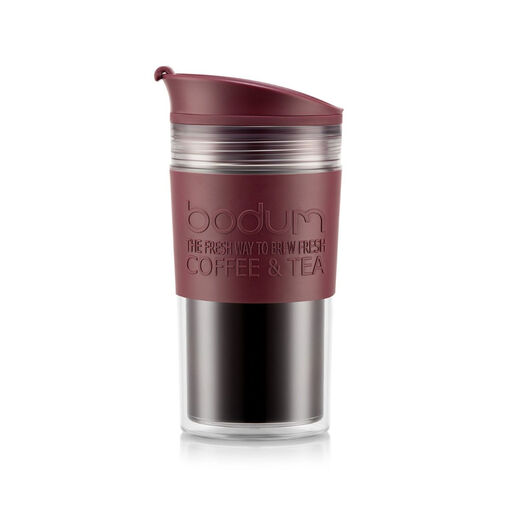
Why it fits the brief: Its compact size is well suited to commuters, offices and many standard cup holders. The mug is designed for both hot and cold drinks.
The manufacturer notes that the lid reduces splashes, but the mug is not completely leakproof and should be transported upright.
350 ml capacity, double-walled construction, silicone grip zone and dishwasher-safe design according to the product description.
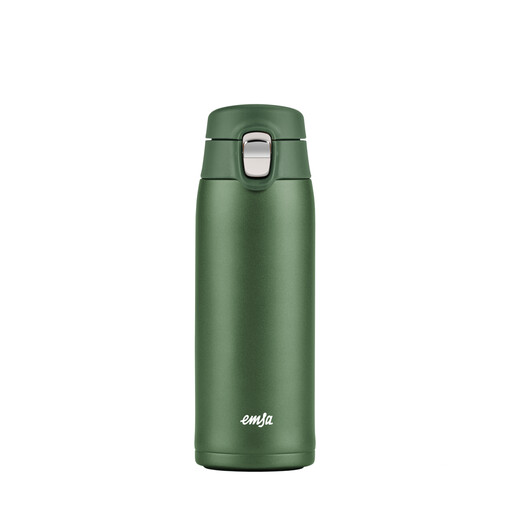
Why it fits the brief: A slim stainless-steel model for the daily commute, the desk and short trips.
The product specifications list a flip-top lid and leakproof construction. Before transport, make sure the lid is fully engaged.
0.4 l capacity, slim stainless-steel construction and, according to the product description, up to 8 hours hot and 16 hours cold.
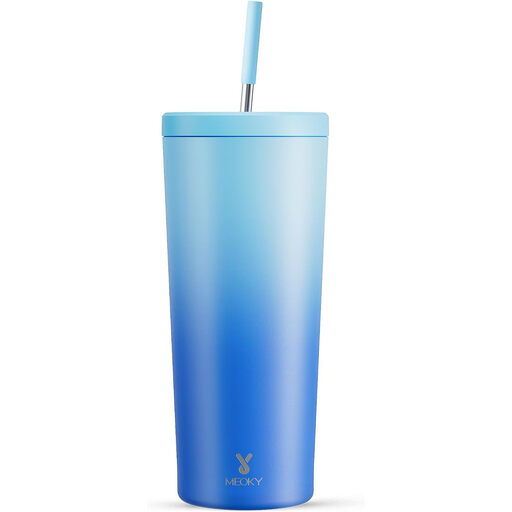
Why it fits the brief: The larger format is aimed at travellers, outdoor users and anyone who carries cold drinks for many hours.
The specifications distinguish between transport without the straw and use with the straw. Hand washing is also required, which should be factored in before purchase.
24 oz, or around 710 ml, 18/8 stainless steel, vacuum insulation, a non-slip base and a tapered bottom that fits many cup holders.
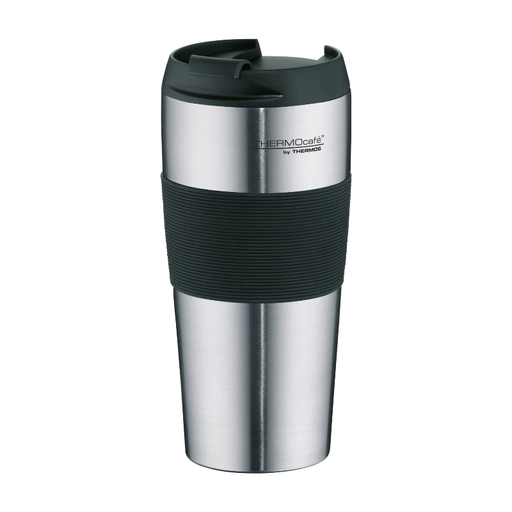
Why it fits the brief: A compact thermal mug for coffee, tea and short journeys, with a flip-top lid that can be operated with one hand.
Instead of promising indefinite temperature retention, the manufacturer provides specific guidelines: up to 4 hours hot and up to 8 hours cold.
Double-walled stainless steel, 400 ml capacity, grip zone, BPA-free construction and, according to the product information, suitability for the top rack of the dishwasher.
Our complete selection makes it easy to find more products by capacity, material, lid design and intended use.
Rinse the cup as soon as possible after use. Check the sealing rings regularly and dry them thoroughly after cleaning. Do not use abrasive cleaners if the manufacturer advises against them. With careful handling, a stainless-steel body can remain in use for many years; however, the seal or lid may wear out sooner and may not be available separately for some models.
Also take care with drinks that have a strong flavour. Coffee, tea and fruit juice can leave behind odours if the lid and seals are not cleaned thoroughly. Carbonated drinks should only be used when this is explicitly permitted in the product information.
For coffee or tea, 300 to 400 ml is often sufficient. This size is convenient and can usually be filled more easily beneath a coffee machine. If you carry water or cold drinks for many hours, you may prefer a model holding 475 to 750 ml.
Its service life depends on the material, seals, cleaning routine and mechanical stress. With proper care, the stainless-steel body can remain usable for many years. Regularly check the lid, closure and sealing ring for cracks or deformation.
That depends on the model. Some products are fully or partially dishwasher-safe, while others are intended exclusively for hand washing. The decisive factor is the care guidance provided by the manufacturer, particularly for the lid, seals and coatings.