
Lieferung heute & morgen

Qualitätsgarantie

Willkommens-Angebote freischalten: KOSTENLOSE Lieferung | Bis zu 80 % RABATT | Kostenlose 30-Tage-JoyPlus-Testphase
App herunterladen
A travel thermal mug should reliably keep coffee, tea or cold drinks with you on the go. In practice, however, problems often arise not from the insulation itself, but from unclear information about the closure, unsuitable sizes or difficult cleaning. Commuters, professionals, students and travellers should therefore check a few technical details before buying.
Terms such as “splash-proof”, “spritzsicher” or “leak-proof” do not necessarily describe the same thing. A splash-proof lid may work when the mug is carried upright in a rucksack, while the mug may leak when stored horizontally. With a leak-proof thermal mug, a securely lockable lid, an intact seal and clear manufacturer information are crucial.
You should also check whether the lid is suitable for carbonated drinks. Several models in this selection are explicitly not recommended for use with carbonated beverages.
Statements such as “keeps drinks warm for 8 hours” are only meaningful when the conditions are also specified. Relevant factors include the starting temperature, fill level, ambient temperature and desired minimum temperature. According to the product information, the LocknLock thermal mug keeps drinks above 60 °C for up to 4 hours; for keeping drinks cold, up to 28 hours below 8 °C is stated. These are manufacturer specifications and do not guarantee the same results in every everyday situation.
A lid with several seal components, drinking openings or straws can be practical, but it requires more care. Residue in hard-to-reach areas can affect hygiene and odour. Look for a wide opening, removable lid components and clear information about whether the mug is dishwasher-safe.
For a short commute, 250 to 350 ml is often sufficient. These sizes will usually fit beneath coffee machines and in many car cup holders. If you spend several hours in the office, at university or travelling, you may prefer a capacity of 400 to 550 ml.
The external dimensions are particularly important for use in the car. A tall mug with a large diameter may not fit in the available cup holder, despite having a suitable capacity in millilitres. A slim design also makes storage in side pockets and rucksacks easier.
A stainless-steel thermal mug is durable and suitable for everyday transport. Double-walled or vacuum-insulated models reduce heat exchange between the drink and its surroundings. Uncoated stainless steel can help minimise any change to the drink’s flavour; ceramic-coated interiors, on the other hand, provide a smooth surface but need to be cleaned with appropriate care.
Borosilicate glass allows you to see the drink and is often supplied with a time scale. However, it is generally more susceptible to impact damage than stainless steel. Plastic models can be lighter. With all materials, you should consider the specific information on BPA, seals, coatings and heat resistance.
A drinking mug with a lid should close securely and suit the way you intend to use it. A one-handed closure can be useful on a bicycle, train or when walking between lecture halls. In a rucksack, verified leak protection is more important than especially quick opening.
Look for:
A double-walled thermal mug generally keeps the outside more comfortable to hold when filled with hot drinks and reduces condensation with cold drinks. However, the actual temperature retention depends on the individual model and how it is used.
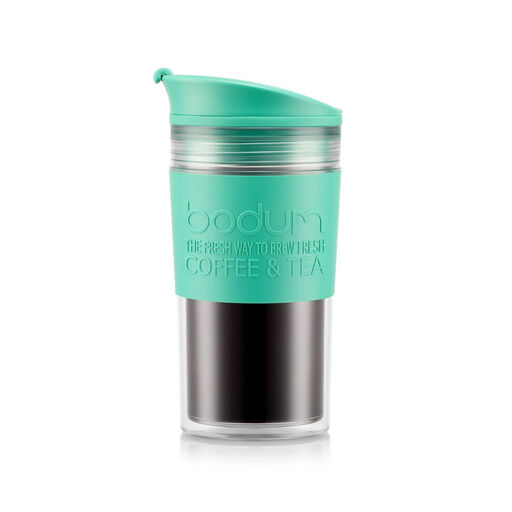
Why this product suits this profile: The compact 350 ml size is ideal for commuting, coffee from the machine or use at your desk.
The double-walled system and splash-proof lid address the most common issues on short journeys. However, the product information refers to a splash-proof closure, not one that is explicitly fully leak-proof.
350 ml capacity and double-walled construction; designed for upright everyday transport.
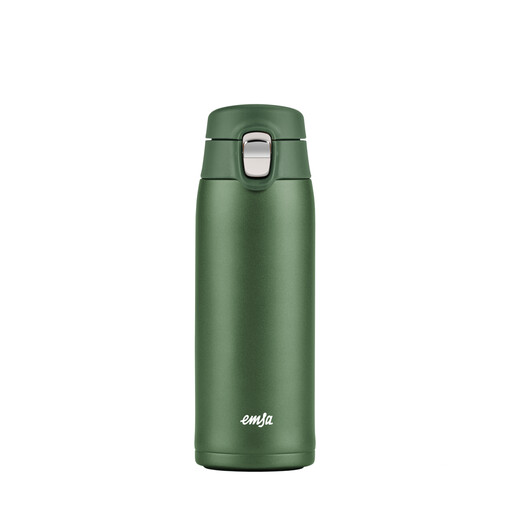
Why this product suits this profile: Commuters get a slim stainless-steel model with a flip-top closure and manufacturer claims of keeping drinks warm for 8 hours and cold for 16 hours.
The specifications state that it has a fully leak-proof flip-top lid. You should still check the lock before carrying it and clean the seal regularly.
0,4 l capacity, stainless-steel body, slim design and one-handed operation according to the product description.
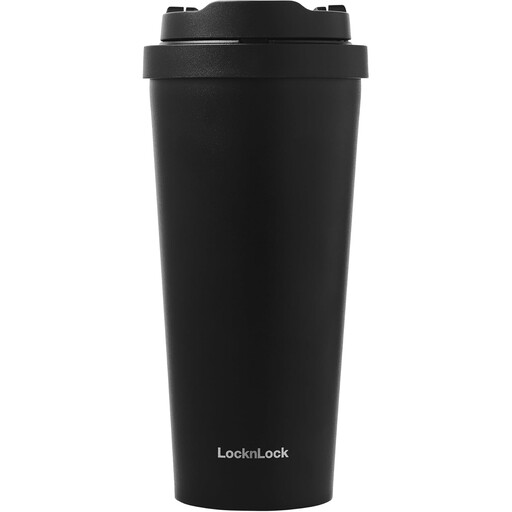
Why this product suits this profile: The larger capacity is ideal for long days at the office, travelling and use as a thermal mug in the car or office.
A one-touch lid with a safety lock is designed to prevent accidental opening. According to the product information, the wide opening makes filling and cleaning easier.
550 ml capacity, double-walled vacuum insulation, STS304 stainless steel and a format designed for standard cup holders according to the product description.
We have put together a complete, regularly updated list of products that fully meet these strict selection criteria and the safety regulations applicable in the EU.
Rinse a reusable coffee mug immediately after use whenever possible. Coffee, milk and sugar can build up around seals and drinking openings in particular. Disassemble the lid according to the manufacturer’s instructions and allow all parts to dry completely.
Do not overfill the mug with hot drinks. Before packing it away, check that the lid is fully closed. Damaged seals, cracks or distortion are reasons to stop using the mug. Preheating it with hot water can affect temperature stability, but does not replace the manufacturer’s information on insulation performance.
For short journeys and smaller amounts of coffee, 250 to 350 ml is easy to handle. 400 ml is suitable for a larger cup or tea. 475 to 550 ml provides more liquid for long working days, but takes up more space and may be heavier.
This depends on the individual model. Some mugs are dishwasher-safe, while others should only be cleaned by hand. The key information concerns the body, lid and seals. With coated interiors, hand washing may help protect the surface material.
Its service life depends on the quality of the stainless steel, seals, closure mechanism and care. Clean the lid regularly, avoid abrasive sponges and replace damaged seals where spare parts are available. Temperature claims in hours describe insulation performance, not automatically the service life of the mug as a whole.