
当日/次日达

品质保障

开启新人专享福利: 全场免邮 | 低至 2 折 | 免费试用 30 天 JoyPlus 会员
下载 Joybuy
A travel mug should transport coffee, tea or water safely while keeping it at the right temperature for longer. In practice, however, problems often arise: the lid is not leakproof, the mug does not fit in the cup holder, or cleaning becomes unnecessarily difficult because of narrow openings and seals that are difficult to remove.
That is why it is worth looking at the actual construction before buying, rather than focusing on attention-grabbing marketing claims. This buying guide explains which criteria matter when choosing an insulated travel mug, a coffee-to-go mug or a drinking cup with lid for commuters, travellers and outdoor users.
A splash guard does not automatically prevent liquid from leaking into your bag. The type of closure, sealing ring and instructions on whether the mug may be transported on its side are what really matter. A screw-top lid with a seal generally offers different levels of security during transport than a simple push-fit or twist lid.
For models with a straw, you should also check whether the lid closes completely when the straw is not inserted. Carbonated drinks can create pressure inside sealed containers and are expressly unsuitable for several products.
Claims such as “keeps drinks hot for several hours” or “keeps drinks cold for many hours” depend on the capacity, starting temperature, surroundings and how often the mug is opened. A double-walled travel mug with vacuum insulation is constructed differently from a single-walled metal mug with a plastic coating.
Even a mug that insulates drinks cannot replace safe handling of hot liquids. The lid should be closed completely before transport, and care is needed when taking the first sip because of the risk of scalding.
A travel mug can become impractical for everyday use if the lid, sealing ring or straw can only be cleaned by hand. Narrow drinking openings also make it harder to inspect the inside properly. Before buying, check the care instructions, which components can be dismantled and how accessible the seal is.
For a short journey to the office, 250 to 350 ml is often sufficient. This is roughly the size of a cup of coffee and helps keep the weight down. For long commutes, travelling or sport, 400 to 750 ml may be more suitable. A model with a capacity of 1.2 litres is mainly intended for users who do not want to refill frequently.
The external dimensions are important for cars and rucksacks. A slim travel mug is more likely to fit standard cup holders. With a large tumbler, you should take the diameter, height and handle into account.
Stainless steel travel mugs are resistant to knocks and, as a rule, absorb fewer odours when they have an uncoated interior. Terms such as 304, 316 or 18/8 stainless steel refer to different material grades; on their own, however, they do not indicate how long a drink will stay hot or cold.
Double-walled vacuum insulation reduces heat exchange between the contents and the surrounding environment. Single-walled models, on the other hand, can be lighter and are suitable for use at a desk when insulation time is less important.
Calling a travel mug leakproof only makes sense when the specific closure supports this. Look for:
The product information should also include guidance on hot liquids, milk-based drinks and the maximum fill level.
The following models differ in capacity, closure, insulation and care requirements. The features listed are taken from the respective product descriptions.
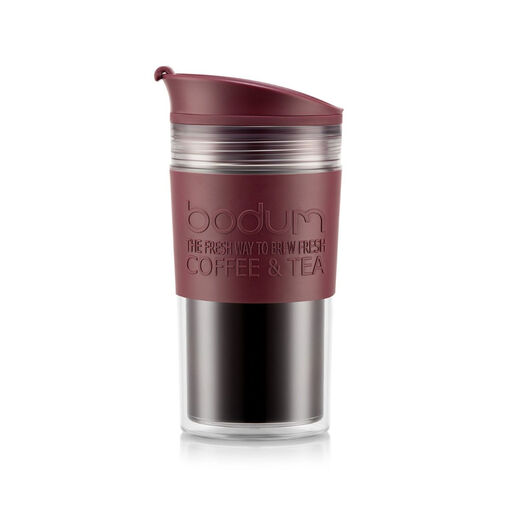
Why this product suits this profile: The 350 ml capacity is ideal for a single serving of coffee. The mug is designed to fit many cup holders and features a double-walled system and a silicone band.
The product description expressly states that the lid protects against splashes, but is not designed to be completely leakproof when transported on its side.
350 ml capacity, double-walled construction and dishwasher-suitable components according to the product information.
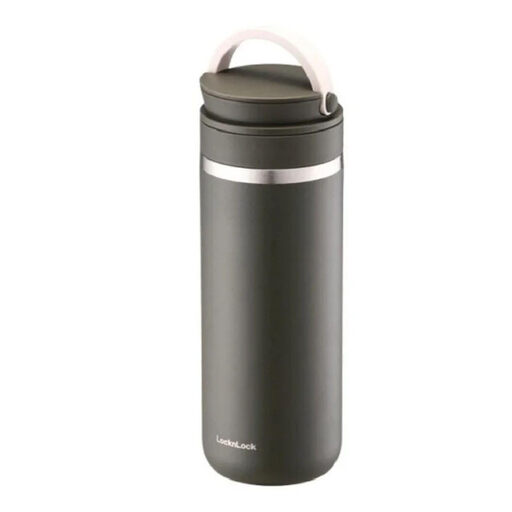
Why this product suits this profile: The double-walled vacuum insulation combines 316 stainless steel on the inside with 304 stainless steel on the outside. The lid has a narrow drinking opening and a wider opening for filling and cleaning.
The construction includes a screw-top closure and a silicone seal. At the same time, hand washing is required, so this should be factored into your regular care routine before buying.
475 ml capacity, integrated handle, non-slip base and stated temperature-retention figures according to the product description.
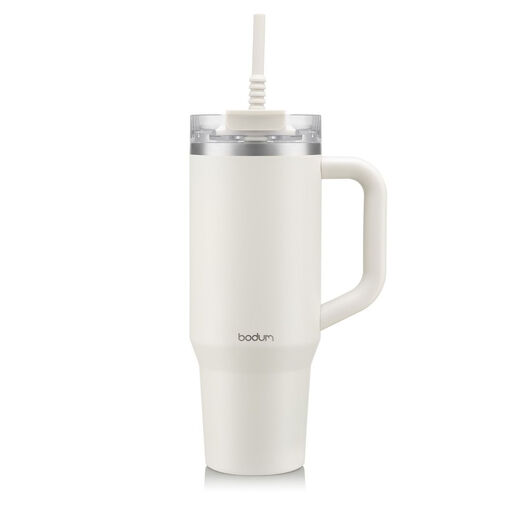
Why this product suits this profile: The large capacity is ideal for long working days, travel, training or situations where refilling is difficult. The handle, lid and straw are all part of the design.
The capacity is clearly stated. Nevertheless, before buying, you should check whether 1.2 litres will fit your cup holder and suit your intended method of transport.
1.2-litre capacity, plus handle and straw according to the product information.
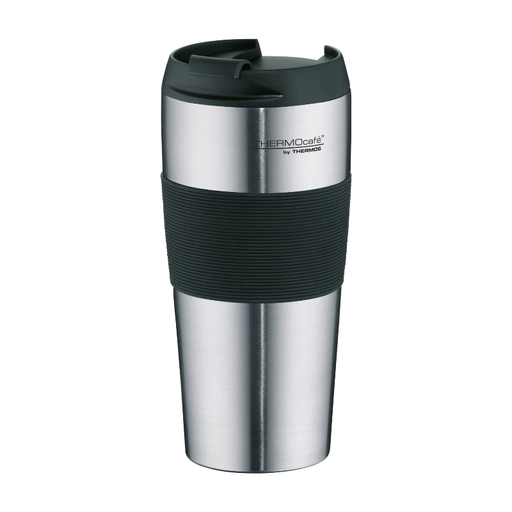
Why this product suits this profile: The 400 ml capacity is designed for coffee, tea or water at the office and on the way to work. According to the product description, the flip-top lid can be operated with one hand.
According to the product information, it can also be cleaned in the top rack of the dishwasher. The lid must still be closed completely before the mug is transported.
Double-walled stainless steel, 0.4-litre capacity and stated hot- and cold-retention times.
We have put together a complete, regularly updated list of products that fully meet these strict selection criteria and the safety regulations applicable in the EU.
This depends on the insulation, capacity, starting temperature and how the mug is used. Vacuum-insulated models often state longer retention times in their product data than single-walled mugs. These figures are guidelines, not a guarantee for every everyday situation.
Not necessarily. Some models are approved for the top rack of the dishwasher, while others may only be cleaned by hand. Before buying, you should assess the mug body, lid, seal and straw separately.
For many cup holders, compact mugs of around 300 to 400 ml are practical. Nevertheless, the height and diameter must match the specific vehicle. Large tumblers with a handle or a capacity of more than half a litre are generally better suited to a rucksack, desk or sports bag.