If you want to bake treacle sponge
If you specifically want to make the baked version, a suitable countertop oven could be an alternative to a built-in oven. Good Food recommends an ovenproof dish with a 1.5-litre capacity.


For the baked version, a freestanding mini oven may be suitable if your dish fits with enough room for the mixture to rise, and you can maintain the clearances specified in the appliance instructions at the chosen location. Good Food’s baking recipe uses a 1.5-litre ovenproof dish and specifies 180 °C without a fan or 160 °C with a fan; the traditional steamed treacle sponge, on the other hand, calls for a pan or steamer, not an oven.
If you specifically want to make the baked version, a suitable countertop oven could be an alternative to a built-in oven. Good Food recommends an ovenproof dish with a 1.5-litre capacity.
You’ll need to consider the appliance’s external dimensions and required clearances, as well as the height of your dish and where you’ll place the oven. A smaller cavity alone doesn’t tell you whether everything will fit.
If you want to make the pudding steamed in a covered basin, the method described by Good Food requires a suitable pan or steamer. You don’t need to buy an oven for this.
Suitable if: You want to bake from a recipe in a freestanding oven. For the baked version, Good Food specifies 180 °C without a fan or 160 °C with a fan, and a cooking time of 35–40 minutes.
Worth noting: These recipe instructions are not tested cooking times for a specific mini oven model; you’ll need to check the dish and where you plan to place the oven separately.
Suitable if: You want to steam the covered pudding basin. Good Food recommends a 1-litre basin and around 1½ hours in a steamer or suitable pan.
Worth noting: The steaming method described is not the same as baking in a mini oven.
| Buying criterion | What to look for | Who is it important to? |
|---|---|---|
| Cooking method | First decide between the baking recipe and the steamed recipe; they use different dishes and appliances. | If I want to make the baked version rather than the steamed pudding, I’ll choose an appliance to suit the recipe. Around 36% of consumers put the cooking method first. |
| Worktop space and positioning | Measure the available space and check the instructions for the specific model for clearance requirements and unobstructed ventilation openings. The Steba instructions require 10 cm of clearance behind the KB M19. | If my worktop space is limited, I need an appliance that fits there with the required clearances. Around 29% of consumers prioritise worktop space and positioning. |
| Dish and heating method | Compare the width, depth and height of your actual dish with the interior dimensions, and check the shelf positions. Choose conventional heat or fan-assisted heat to suit the recipe. | If I want to use a particular dish, I’ll check both that it fits and that the heating method is suitable. Around 21% of consumers prioritise the fit of their dish and the heating method. |
| Ease of use and running costs | Check the timer, continuous operation and removable parts. For electricity costs, consumption under comparable use is a better guide than rated power alone. | If ease of use, cleaning and transparent running costs matter to me, I’ll compare these points before buying. Around 14% of consumers prioritise ease of use and running costs. |
The classic recipe described by Good Food is cooked in a covered basin in a pan or steamer; the baking recipe is a different method.
Decide which version you want to make before buying.
An oven bought just for this pudding could take up extra space without being needed for the steamed version.
The cavity capacity doesn’t tell you whether a deep ovenproof dish will fit. Ariete’s stated plate diameter refers to a rounded pizza recess, not every type of dish.
Compare the width, depth and height of your dish with the interior dimensions and shelf position of the specific oven.
Depending on the interior dimensions, you may need a smaller dish.
The instructions for the Steba KB M19 require 10 cm of clearance behind the appliance, as well as unobstructed ventilation slots. This requirement applies to this model and not to all ovens generally.
Before buying, check the positioning instructions for your chosen model and measure the space, including the clearances specified.
The rated power alone doesn’t tell you how much electricity a baking session will use or what it will cost.
Compare actual consumption only for a similar baking task and pattern of use.
The BG 1055/E is a freestanding mini oven with an 18-litre cavity. Rommelsbacher says it can accommodate baking tins up to 25 cm in diameter.
According to Steba, the KB M19 has a 19-litre cavity, with its interior and exterior dimensions published.
The TO 20 SilverStyle is a freestanding oven with a cavity of around 20 litres and published interior dimensions.
According to Ariete, the blue Vintage 0979/05 is a low-profile countertop oven with an 18-litre capacity.
According to Tristar, the OV-3615 is a 10-litre mini oven for smaller baking tasks.
This selection includes appliances that product descriptions say are suitable for baking. Before you buy, check that the interior dimensions suit your dish and that you can position the appliance safely.
 No image available
For the baked version; compare the interior dimensions with your dish first.
32 l; 1.600 W; temperature range 100–250 °C; 60-minute timer; crumb tray.
 No image available
A compact option for the baked version; check your dish’s dimensions against the interior.
10 l; upper and lower heat; temperature range 100–230 °C; 60-minute timer; external dimensions 37 × 26,5 × 21 cm.
 No image available
For the baked version; check that the dish fits and that the shelf positions suit your recipe.
28 l; three heating modes and three shelf levels; temperature range 100–230 °C; 60-minute timer.
 No image available
The product details list baking as a function. Check carefully that your specific dish will fit inside.
6,5 l; temperature range 80–200 °C; timer up to 60 minutes; viewing window and interior light; rotary controls.
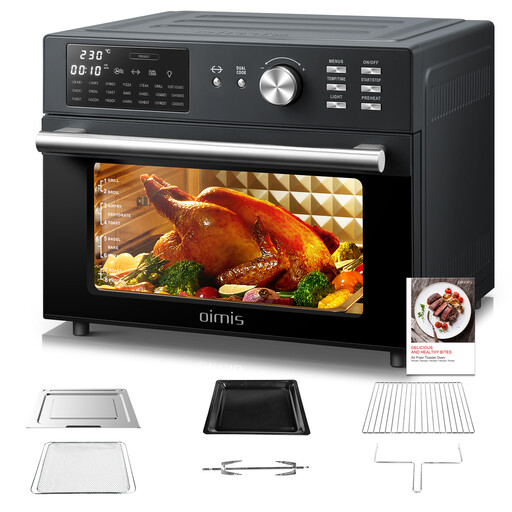 No image available
Baking is listed as a function; check your dish against the interior dimensions before choosing this appliance.
30 l; 1.800 W; 21 preset functions; appliance dimensions 456 × 430 × 365 mm.
The recipes described by Good Food treat baking and steaming as different methods: the classic version is steamed in a covered 1-litre pudding basin for around 1½ hours. If you want to use an oven, follow a baking recipe; the version described there uses a 1.5-litre ovenproof dish.
Good Food specifies 180 °C without a fan or 160 °C with a fan, and a baking time of 35–40 minutes. These instructions are for the recipe and haven’t been tested as settings or timings for each individual mini oven.
Don’t decide based on the appliance’s external dimensions alone. The instructions for the Steba KB M19 say it must not be used as a built-in oven and require 10 cm of clearance behind it, as well as unobstructed ventilation slots; follow the instructions for other models.
Rated power alone doesn’t tell you how much it will cost to make treacle sponge. If a product is faulty in Germany, statutory consumer rights apply against the seller; a manufacturer’s guarantee is separate and is subject to its own terms.
No. The German Federal Ministry for the Environment states that old electrical appliances must be collected separately, including at local collection points. Retailers’ take-back obligations depend, among other things, on the size of the retailer and the circumstances of the purchase.