What should you consider when choosing?
Tabletop fan oven
A good fit if: you don’t want to use a built-in oven and your tin fits with enough room to spare.
Keep in mind: the oven capacity and stated tin diameter don’t tell you whether the height, handles and available worktop space will be suitable.
Built-in fan oven
A good fit if: you have a suitable space for installation and plan to use the oven for other baking too.
Keep in mind: the installation space and room needed must suit your kitchen. You don’t necessarily need a larger appliance just to bake one sponge.
Traditional steamed sponge
A good fit if: you’d rather steam your sponge than bake it.
Keep in mind: the Good Food recipe uses a covered basin and takes 1½ hours to steam; you don’t need a fan oven.
For the baked version, a good starting point is your recipe and whether your tin will fit. Good Food’s oven-baked recipe calls for a 1.5-litre tin and a fan oven set to 160 °C. The proportions below illustrate common priorities when choosing an oven; they are not market statistics.
| What matters |
What to check when buying |
Who is it important to? |
| Tin size and portion size |
Compare the outside dimensions of your tin with the appliance specifications, taking its height and handles into account. |
If my chosen tin needs to fit with its rim and handles, I check the actual measurements rather than relying on the capacity in litres. Around 40% of consumers put the fit of their tin first. |
| Worktop or installation space |
Check the appliance dimensions and any instructions for placing or installing it. |
If there isn’t a suitable space for a built-in oven in my kitchen, I’m more likely to consider a tabletop model, provided I have enough worktop space. Around 30% of consumers prioritise a suitable installation or placement option. |
| Baking or steaming |
Choose your recipe and check for a fan or convection function if you’re baking it. |
If I’d rather steam my sponge, I choose a suitable steaming recipe instead of assuming I need a fan oven. Around 20% of consumers put the cooking method first. |
| Energy use, cleaning and servicing |
Compare stated energy-use figures only when they’re based on the same method; check the care and servicing information for the specific model. |
If I plan to use the oven regularly in future, I look beyond its baking functions to energy use and cleaning too. Around 10% of consumers prioritise ongoing use. |
Ovens at Joybuy
The ovens below include built-in models with a fan function, as well as tabletop models for different baking needs. Before buying a tabletop model, check in particular whether the manual specifically lists a fan or convection function.
 Image unavailable
Bosch HBA571BB4 Series 2 built-in oven
For the baked version if you have a suitable space for installation and plan to do other baking too.
71-litre capacity; 3D Hot Air; temperature range 30–275 °C; pyrolytic self-cleaning.
Joybuy
 Image unavailable
Comfee built-in oven, 60 cm, 70 litres
An option for the baked version if you have space for a built-in oven and want to use the listed heating functions.
70-litre capacity; 60 cm wide; 3 kW; fan-assisted convection with a rear fan; grill and pizza functions; AquaClean steam cleaning.
Joybuy
 Image unavailable
Bosch HBG578ES3 Series 6 multifunction oven
For the baked version and other baking projects, provided you have a suitable space for installation.
71-litre capacity; 3D Hot Air; fan-assisted operation and several heating methods.
Joybuy
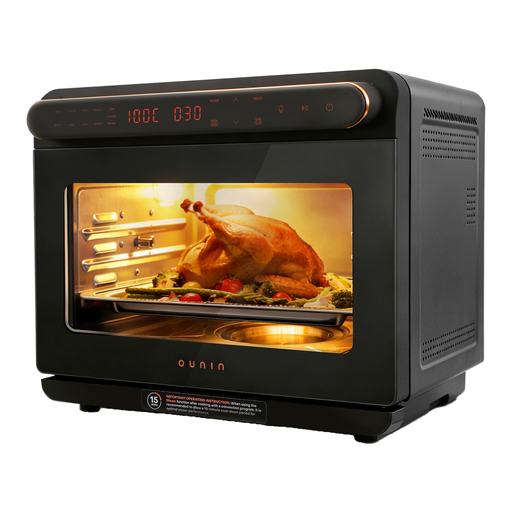 Image unavailable
OUNIN 24-litre steam combi oven, 10-in-1
Suitable for baking only if the manual confirms the fan or convection function your recipe needs.
24-litre capacity; 1-litre water tank; baking and Steam Bake listed as functions.
Joybuy
 Image unavailable
Woltu BF12sz mini oven, 32 litres
Suitable for cakes in a tabletop oven only if the manual lists the fan or convection function your recipe requires.
32-litre capacity; 1,600 W; temperature range 100–250 °C; timer and crumb tray.
Joybuy
Frequently asked questions
Can I simply set my oven to 160 °C fan for treacle sponge?
The settings of 160 °C fan and 35–40 minutes come from a specific Good Food oven-baked recipe for a 1.5-litre tin; they aren’t a general rule for every quantity or appliance. Follow your chosen recipe, check that the sponge is cooked through and consult your oven’s manual.
How can I tell whether I can safely place a tabletop oven where I want it?
Compare the dimensions and placement instructions for the specific model with your worktop, and read the manual before use. The oven’s capacity alone doesn’t tell you whether the location is suitable.
Does a small tabletop oven in Germany need an EU energy label for ovens?
Not all small or portable ovens fall within the scope of the relevant labelling rules. The European Commission excludes these types of oven from that scope; what matters is how the specific appliance is classified.
What happens if there’s a fault after I buy?
When you buy from a trader, your statutory consumer rights apply. According to Your Europe, the European Union’s consumer portal, goods bought in the EU are covered by a minimum two-year legal guarantee from the date you receive them. This is separate from any voluntary manufacturer’s warranty.
How should I transport cream or other perishable picnic food?
The German Federal Institute for Risk Assessment recommends keeping perishable food as cold as possible until it’s eaten. For longer journeys in summer, it advises using a cool box for foods that spoil easily. This applies to accompaniments and other ingredients that need to be kept chilled; it isn’t a general statement about the shelf life of every baked sponge.


