
Lieferung heute & morgen

Qualitätsgarantie

Willkommens-Angebote freischalten: KOSTENLOSE Lieferung | Bis zu 80 % RABATT | Kostenlose 30-Tage-JoyPlus-Testphase
App herunterladen
Integrating more movement into daily life, especially when working from home, can be a challenge. Limited living space and the desire for a quiet environment make finding the right fitness equipment difficult. A treadmill for home can be a practical solution, but the vast selection of models with different features can be overwhelming.
This article serves as your guide. We'll highlight the key criteria to consider when choosing a machine for your home and present a selection of models that are particularly well-suited for apartments and home offices due to their specific features.
To make an informed decision, it helps to understand a few technical specifications and their practical implications. The following points are especially relevant for users with limited space who want a discreet piece of workout equipment.
Available space is often the most important criterion. A folding treadmill is a standard feature on many modern machines, but the differences are in the details. Some models fold vertically to be stored against a wall, while others, like a Walking Pad, are extremely flat and can slide under a sofa or bed. Pay close attention to the folded dimensions to ensure the unit will fit in its intended storage spot. A compact under-desk treadmill is specifically designed to be used under a standing desk, allowing you to stay active while you work.
In an apartment or home office, a quiet treadmill is essential. A treadmill's noise level is measured in decibels (dB). Models with a noise emission below 60 dB are considered suitable for apartments. Particularly quiet machines operate at under 50 dB. The noise level depends on the motor's power, the frame's construction, and the cushioning of the running deck. A high-quality, brushless motor is often quieter and more durable.
For a varied and effective workout, additional features are a plus. A treadmill with an incline simulates walking or running uphill. This engages your muscles more intensely and increases calorie burn without needing to increase your speed. The incline can be adjusted either manually in steps or automatically at the touch of a button. Connectivity to fitness apps (like Zwift or Kinomap) also enables virtual running routes, progress tracking, and participation in online competitions, which can boost long-term motivation.
The following models have been selected for their specific features that meet the needs of users in apartments and home offices.
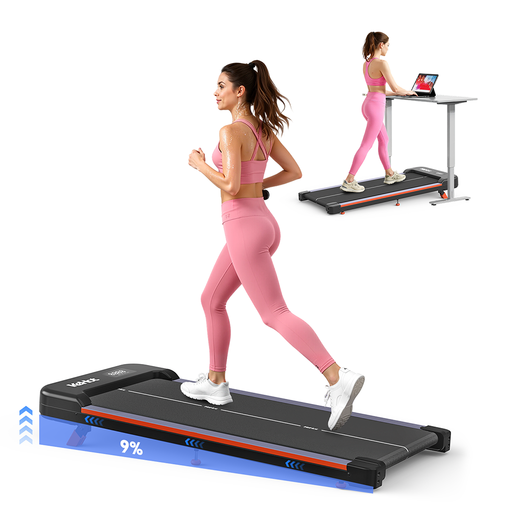
Why it stands out: This model combines the ultra-compact format of a walking pad with a fixed 9% incline, enabling an intense walking workout in the smallest of spaces.
Pros:
Who is it for? This device is ideal for individuals looking for a dedicated under-desk treadmill or a compact walking pad for intense walking workouts. It is not designed for jogging or running but focuses on maximising the training effect of walking.
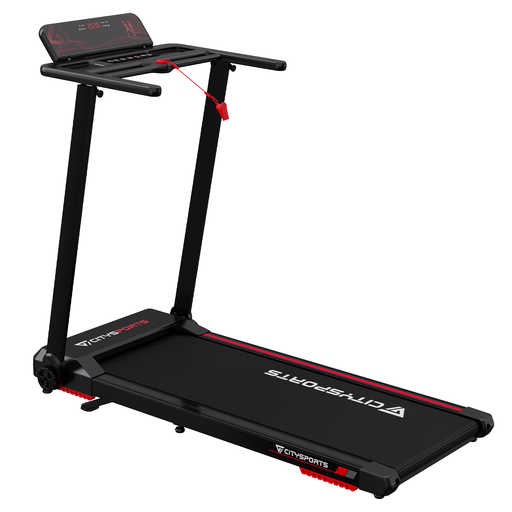
Why it stands out: The CITYSPORTS PRO WP9 strikes a balance between performance and compactness. It reaches speeds of up to 12 km/h and features a manual incline function, all while operating very quietly at under 45 dB, according to the manufacturer.
Pros:
Who is it for? This model is aimed at users looking for a versatile and exceptionally quiet treadmill that is suitable for both brisk walking and light jogging. The manual incline provides an additional training option for those who need a compact yet functional machine.
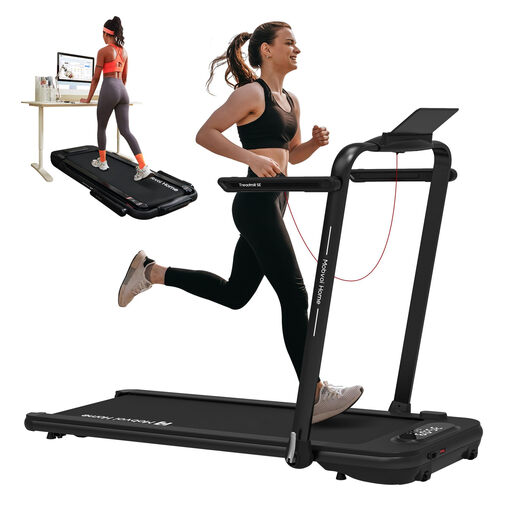
Why it stands out: The Mobvoi Home Treadmill SE is distinguished by its smart features, particularly the AI-powered coaching via the TicSports app, and its versatile 3-in-1 design.
Pros:
Who is it for? This treadmill is the right choice for tech-savvy users who value interactive and guided training. Its versatility makes it an all-in-one solution for walking while working, light jogging, and structured running workouts at home.
The selection presented here covers specific use cases. If you are looking for different speed ranges, running deck sizes, or additional features, there is a wider range of options to explore.
Discover more models in our Treadmills category.
The noise level of a home treadmill typically ranges from 50 to 70 decibels (dB). Models advertised as quiet often fall below the 60 dB mark. A value under 50 dB is considered exceptionally quiet, comparable to a soft conversation. The actual noise level also depends on the running speed and the user's weight.
Most devices designated as a Walking Pad or under-desk treadmill are designed for speeds up to a maximum of 6 km/h, which corresponds to a brisk walk. They are generally not designed for jogging or running, as this requires higher speeds, a longer running deck, and a more robust frame. Some hybrid models allow for speeds up to 12 km/h, making them suitable for light jogging.
A treadmill with an incline does not require more floor space during operation than a model without this feature. The incline mechanism is usually integrated into the frame. On some models, the overall height when folded may increase slightly. However, compact models with a fixed or manual incline are often just as space-saving as machines without an incline function.