
Lieferung heute & morgen

Qualitätsgarantie

Willkommens-Angebote freischalten: KOSTENLOSE Lieferung | Bis zu 80 % RABATT | Kostenlose 30-Tage-JoyPlus-Testphase
App herunterladen
Whether it’s a day hike in the low mountain ranges, a multi-day trekking trip or travelling with minimal luggage: trekking poles can support your walking motion and provide an extra point of contact on changing terrain. However, it’s not just a low price or an especially lightweight product that matters. The locking system, length, grip and material all need to suit your intended use.
This buying guide from the Joybuy Product Recommendation Officer shows which specifications are truly relevant before purchasing walking poles, and which marketing claims deserve a closer look.
The term “ultralight” is hard to assess without concrete figures. When choosing, buyers should pay attention to the weight per pole or per pair as well as the folded length. A smaller packed size is practical for train travel, in a suitcase or in a rucksack. However, more segments can mean additional connection points and therefore more potential areas for wear and tear.
An extendable pole must lock securely at every setting. Telescopic trekking poles often use twist locks, while external flip locks are quicker to operate visibly. What matters is that the mechanism is fully closed and that the segments are not extended beyond the marking. Sand, moisture and dirt can impair the function.
Aluminium trekking poles and carbon trekking poles have different properties. Aluminium is often chosen for its robust, clearly visible construction. Carbon can reduce weight, but it is not automatically suitable for every load or every surface. Material specifications do not replace checking the lock, wall thickness, grip and manufacturer’s instructions.
As a starting point: when standing upright with the pole placed vertically on the ground, your elbow should form roughly a right angle. This is only a guideline. For uphill sections, a shorter setting can be useful; for downhill, a longer one. Height-adjustable walking poles are therefore practical for changing terrain and different body heights.
The maximum length must suit your height and intended use. A pole with an extended length of 125 cm is not automatically suitable for everyone. Buyers should also check whether the desired length falls within the markings specified by the manufacturer.
An ergonomic grip should sit securely in your hand and not cause unnecessary pressure during prolonged use. EVA foam can feel grippy and absorb moisture; cork or plastic grips each have a different feel. An adjustable wrist strap prevents the pole from being lost if you briefly loosen your grip.
The tip must suit the path. Carbide or tungsten carbide tips grip well on natural trails and gravel. On tarmac, rubber tips can protect both the surface and the tip. A mud or snow basket prevents the pole from sinking too deep into softer ground.
Foldable trekking poles are particularly space-saving to transport. With a model that has several segments, users should check before every trip that all connections are correctly seated. A small packed size is only useful if the pole can be reassembled and securely locked without much effort on the go.
The specifications “for women and men” usually refer to the adjustable length and the grip design, not to a gender-specific technical construction. Seniors should additionally look for clearly visible locks, a manageable weight and a secure grip. However, walking poles are not walking aids for bearing full body weight.
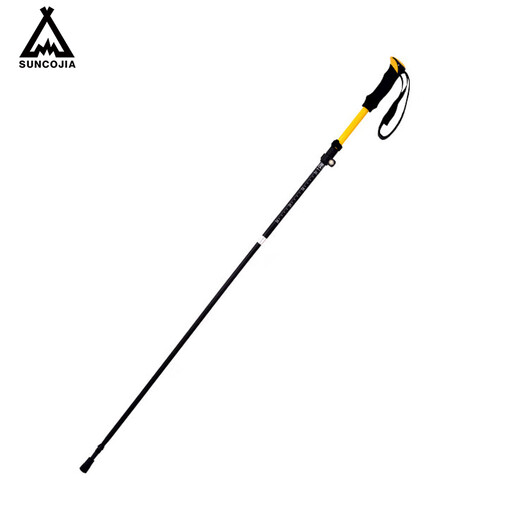
Why this product suits the profile: This model is aimed at women, men and seniors who want a lightweight, adjustable pair for hiking, travelling or camping. The stated maximum length is 125 cm, the packed size is 34 cm and the weight is 275 g.
Concrete details on length, weight and packed size make it easier to assess. The ABS lock is designed to secure the set length and can be checked before the trip.
7075 aluminium alloy, ergonomic non-slip grip, telescopic and foldable construction.
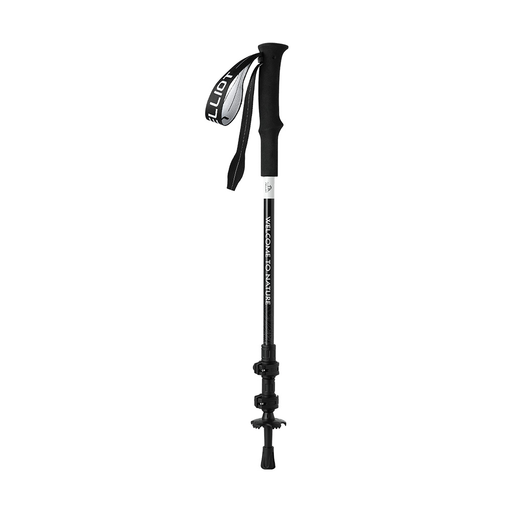
Why this product suits the profile: This three-section telescopic pole made from carbon fibre is of interest to users who value low material weight and a compact, adjustable construction in their gear.
The product name states the material, number of sections and telescopic construction. Before buying, customers should also check the full length and lock details on the product page.
Carbon fibre construction, three-section design, extended EVA grip according to the product name.
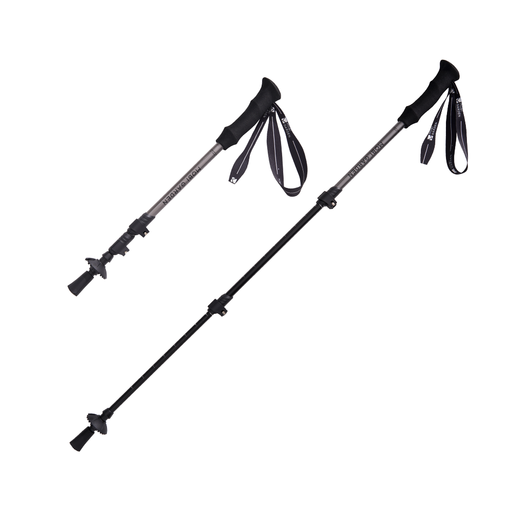
Why this product suits the profile: With three sections, a maximum length of 135 cm and approximately 210 g per pole, this model is designed for regular hikes and changing surfaces.
The external flip lock is accessible from the outside. The included rubber tip and mud basket allow adaptation to paved paths and natural trails.
7075 aluminium, EVA foam grip, tungsten carbide tip, adjustable nylon wrist strap.
We have put together a complete, regularly updated list of products that fully meet these strict selection criteria and the safety regulations in force in the EU.
Start with a setting where your elbow forms roughly a right angle. Ascents and descents may require adjustment. After every change, check that all locks are closed.
A fixed lifespan cannot be given in general terms. It depends on the material, intensity of use, terrain, transport and care. Regular checks of the locks, tips, grips and segments help to detect wear early.
That depends on the use. Aluminium offers a clearly understandable, robust construction and tends to bend rather than break under excessive load. Carbon is often chosen for its low weight, but should be carefully checked for cracks and damage. For your buying decision, the material, locking system, weight, length and planned terrain all matter together.