
Lieferung heute & morgen

Qualitätsgarantie

Willkommens-Angebote freischalten: KOSTENLOSE Lieferung | Bis zu 80 % RABATT | Kostenlose 30-Tage-JoyPlus-Testphase
App herunterladen
A single vehicle that accompanies your child from their first year to preschool age—the idea behind a 5-in-1 convertible tricycle is appealing to many parents. It promises durability, versatility, and a worthwhile investment in motor skill development. However, the market is flooded with models whose promises often fall short in practice. Before you make a decision, it's crucial to understand the typical weak points that can quickly turn a supposed all-rounder into an unused purchase.
Many buyers report three central problems:
A well-thought-out choice based on objective criteria will protect you from such disappointments.
To find a durable and functional kids' ride-on for ages 1-5, you should focus your attention on three core areas instead of being swayed by marketing buzzwords.
The longevity of a convertible tricycle lives and dies by its frame. Models with a steel frame or high-quality aluminium offer significantly more stability and load-bearing capacity than all-plastic constructions. Pay special attention to the connection points, especially where the push handle is attached. A solid mechanical lock is crucial here for safe steering by the parent.
The type of wheels significantly influences comfort and where the trike can be used:
A true 5-in-1 tricycle should be convertible with minimal effort, ideally tool-free. Check how the pedals are removed, how the rear wheels fold (for balance bike mode), or how the push handle is detached. A system that requires a wrench and a lot of patience for every conversion will rarely be used in daily life. The combination of a balance bike and tricycle in one is only an advantage if switching between modes can be done in minutes. Equally important are easily adjustable seat and handlebar heights to ensure an ergonomic posture at every stage of growth.
For a toddler tricycle from 1 year, certain safety features are indispensable. A harness system is mandatory. While a 2-point harness (lap belt) is the minimum, a 3- or 5-point harness provides significantly more support. Foldable footrests are important for the initial phase when the child is not yet pedalling. A critical function is steering control via the push handle. It allows parents to directly control the direction of travel, which is essential on public paths or in busy areas. A pedal freewheel function prevents the pedals from spinning and injuring the child's feet while being pushed.
Based on these objective criteria, we have identified a few models that represent a considered choice for different needs and user profiles.
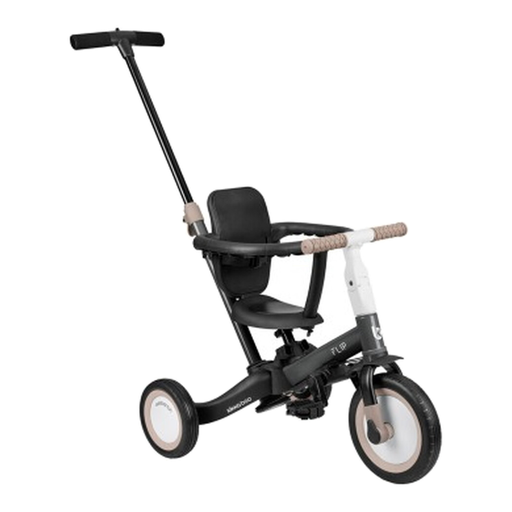
Why This Fits Their Persona: This model covers the entire usage period from 1 to 5 years, eliminating the need to purchase multiple vehicles (stroller, tricycle, balance bike). It is designed for maximum versatility and a long service life.
The robust carbon steel frame counteracts the typical instability issue. The combination of a rubber front wheel and PU rear wheels avoids the problem of loud hard plastic wheels and provides good ride comfort.
The 5-in-1 functionality is practically implemented here, covering push, tricycle, pedal-less tricycle, balance bike, and bicycle modes. The height-adjustable push bar with parental control is a central feature.
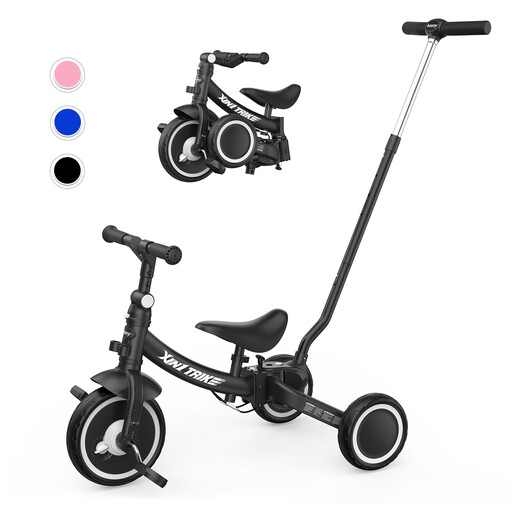
Why This Fits Their Persona: Ideal for parents who want to specifically promote motor development and a sense of balance. The focus is on the transition from a pushed tricycle to independent balance biking.
This model concentrates on the core functions of a tricycle and balance bike. By omitting extra modes, it allows for a simpler and more robust construction that is less prone to complex mechanical failures.
The conversion from tricycle to balance bike is designed to be straightforward. Its lighter weight compared to fully-featured 5-in-1 models makes it easier for the child to handle when learning to balance.
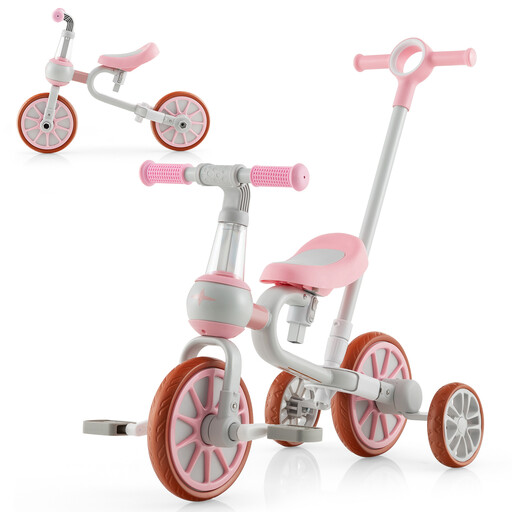
Why This Fits Their Persona: A pragmatic choice for families looking for a reliable tricycle with a push handle for the 2 to 4 age group, but who don't need or want to budget for the full feature set of a 5-in-1 model.
By focusing on the essential functions of a 3-in-1 tricycle (push, learn, ride), it avoids the complexity and potential weak points of more elaborate conversions. The design is optimised for these core tasks.
Offers the important features like an adjustable push handle and safety bar at an accessible price. A solid, functional solution without costly extra features.
We've compiled a complete, up-to-date list of products that fully meet these strict selection criteria and safety regulations.
Most models are designed for children from 12 months up to about 5 years of age. In the first phase (approx. 12-24 months), the vehicle is primarily used as a kind of "sport buggy," where the child sits, is secured by a harness, and is pushed by the parents. Suitability heavily depends on safety features like the harness, safety bar, and the stability of the push handle.
The choice of wheels should depend on the primary place of use. For use mainly indoors or on smooth patios, EVA wheels are sufficient. However, if the toddler tricycle will be used regularly outdoors on pavements or park paths, PU wheels or rubber tyres are the better choice. They offer more comfort, are quieter, and better absorb small bumps.
This is one of the most critical points and varies greatly between manufacturers. High-quality models allow for largely tool-free conversion using click-in systems or quick-release levers. With cheaper variants, switching between tricycle and balance bike mode may require loosening several screws. It is advisable to check the product description or manuals for information on the complexity of the conversion before buying.