
Lieferung heute & morgen

Qualitätsgarantie

Willkommens-Angebote freischalten: KOSTENLOSE Lieferung | Bis zu 80 % RABATT | Kostenlose 30-Tage-JoyPlus-Testphase
App herunterladen
A trolley gives you extra storage space and can be moved wherever you need it. In small flats, narrow kitchens or cramped bathrooms, a mobile utility trolley can be more practical than a fixed shelf. However, unclear load limits, unsuitable castors or too little space between shelves can quickly lead to the wrong purchase.
A narrow trolley may fit into an alcove, but that doesn’t mean every item will fit on it. The internal width of the shelves is what matters, not just the overall dimensions listed. A narrow design is often enough for spice jars or toiletries. Storage containers, ring binders and larger kitchen appliances need more depth and space between the shelves.
Some manufacturers state the total load capacity, while others give a limit for each shelf. These figures shouldn’t be treated as the same thing. On a multi-tier storage trolley, heavy items should be placed as low down as possible and distributed evenly. This makes the trolley less top-heavy when you push it. Never exceed the stated load capacity.
A trolley with castors should be easy to move, but stable once it’s in place. Lockable castors are particularly useful in the kitchen, bathroom and office. If there are no brakes, or brakes are fitted to only some of the castors, the trolley may move when you load it or open a drawer. The type of castor also matters for carpets, tiles and delicate flooring.
Measure the alcove, the space under your desk or the gap between kitchen units at several points. Also allow room for handles and castors to move. An alcove trolley around 15 to 20 cm wide is suitable for narrow gaps, while a kitchen trolley with a worktop needs considerably more floor space.
Wood-based materials such as PB or MDF have a smooth, enclosed surface and often go well with home and office furniture. However, they shouldn’t be exposed to moisture for long periods. Metal mesh or plastic surfaces are practical for bathroom organisers and open storage trolleys, as water can drain away more easily and they can usually be cleaned with a damp cloth. Bamboo offers a different look, but should also be kept dry.
For wooden products, look for specific material details such as PB(E1) or an FSC label, where these are provided for the product. This information describes the material or its origin; it doesn’t amount to a general claim about the quality of the entire product.
Four castors make a trolley easy to move. Castors that swivel through 360 degrees make it easier to manoeuvre in tight spaces. For a serving trolley or kitchen trolley, two brakes are often enough, as long as they’re easy to reach and work reliably. With a folding transport trolley or hand trolley, wheel diameter, handle height and ground clearance matter more than the number of shelves.
The load capacity should always suit how you plan to use the trolley:
Take extra care on uneven paths, high kerbs and stairs. A household trolley isn’t automatically suitable for carrying heavy loads outdoors.

Why this product suits this user type: At 15 cm wide, it fits into narrow spaces in the kitchen or bathroom. Three tiers provide neatly organised storage for smaller household items.
The dimensions and maximum total load of 6 kg are clearly stated, making it easier to judge whether it will suit your needs before you buy.
Three shelves, four castors and a castor-locking system, in a size of 40 x 15 x 75 cm.
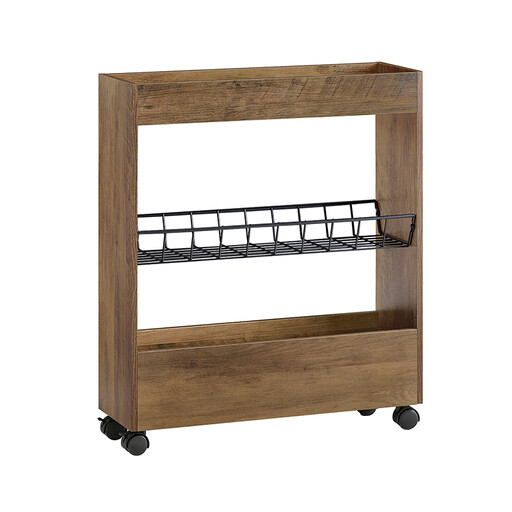
Why this product suits this user type: This model combines a slim width of around 20 cm with three open shelves, making it suitable for the kitchen, living room or a bathroom with a dry floor.
The product details state a maximum load of around 40 kg, four castors and two brakes. The advice to position it on a dry, level surface also sets clear limits on its use in the bathroom.
Slim design, open shelves for a clear view of the contents, and dimensions of around 20 x 70 x 60 cm.
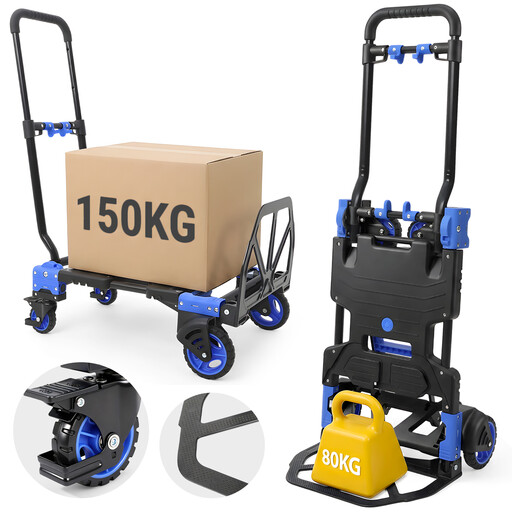
Why this product suits this user type: For shopping, the cellar, garden or workshop, a transport trolley with two modes is more useful than a storage trolley alone.
The load capacity is listed separately for each mode: 80 kg as a sack barrow and 150 kg as a platform trolley. This makes it clear that the load limit depends on how you use it.
Aluminium frame, height-adjustable handle, folding design and integrated parking brake.
We’ve put together a complete, regularly updated list of products that meet these strict selection criteria and fully comply with the safety regulations in force in the EU.
It depends on how you plan to use it. A few kilograms is often enough for bathroom essentials and spices. For books, groceries or appliances, you’ll need a significantly higher load limit. Distribute the weight evenly and place heavy items as low down as possible.
It depends on the material and care instructions. Metal mesh or plastic is practical for occasional exposure to moisture. With MDF or chipboard, avoid standing water and prolonged exposure to high humidity. After wiping the trolley down, make sure the surface is left dry.
A serving trolley or kitchen trolley is usually designed for crockery, drinks and groceries indoors. A transport trolley, hand trolley or platform trolley often has a higher load capacity and a handle designed for carrying heavier loads. If you regularly carry shopping, tools or garden materials, check the specifications for the wheels, ground clearance and how the load should be distributed.