
Lieferung heute & morgen

Qualitätsgarantie

Willkommens-Angebote freischalten: KOSTENLOSE Lieferung | Bis zu 80 % RABATT | Kostenlose 30-Tage-JoyPlus-Testphase
App herunterladen
A trolley can make it much easier to move shopping, crates of drinks, household accessories or camping gear. However, models vary considerably in their wheels, load capacity, folding mechanism and intended use. If you focus only on a large capacity or high load limit, you could end up with an unstable frame, stiff wheels or a trolley that takes up unnecessary space in your cellar.
This buying guide explains what shoppers in Germany should look for before buying and which type of trolley suits different needs.
A stated maximum load does not automatically mean the trolley will be comfortable to move when carrying that weight. Frame design, wheel size, centre of gravity and surface all matter too. For example, a lightweight shopping trolley designed for pavements is not made for uneven woodland paths or heavy crates of drinks.
You should never exceed the load limit. With a folding trolley, it’s also a good idea to distribute the load evenly and place heavier items at the bottom.
“Folding” does not necessarily mean that a trolley will fit easily into a small cupboard or car boot. Check its actual folded dimensions, weight and folding mechanism. Even when folded, a large-capacity camping trolley takes up more space than a folding sack truck.
If you’ll be transporting it frequently, choose a mechanism that doesn’t require tools or complicated assembly.
Four wheels are not automatically suitable for every surface. Small castors are best suited to smooth floors in the kitchen, bathroom or living area. Larger outdoor wheels with good ground clearance are more practical on gravel, grass or sand.
Brakes are an important safety feature on a transport trolley used on slopes or uneven ground. Never leave a trolley unattended on a slope if it has no brakes.
A shopping trolley often needs only compact dimensions and a moderate load capacity. A platform trolley or 2-in-1 transport trolley, on the other hand, should be assessed according to its mode of use. For example, the aluminium model described here has a capacity of 80 kg in sack truck mode and 150 kg in platform mode.
Also consider whether the load will be spread across a surface, several shelves or a fabric basket. A rolling storage unit for the home needs different features from an outdoor hand trolley.
Common materials include steel, aluminium, MDF, bamboo, polyester and Oxford fabric. Aluminium can reduce the trolley’s own weight, while steel frames are often used for furniture and storage solutions that need a sturdy construction. For fabric trolleys, the cover should be wipe-clean and allowed to dry fully after cleaning.
For regular use, protected joints, sturdy fittings and easy-to-clean wheels are also important. After each use, check outdoor models for sand, soil or small stones caught in the wheels.
Compare the trolley’s external dimensions with your doors, lift, car boot and intended storage space. An adjustable handle can be useful on a transport trolley shared by people of different heights. For a shopping trolley, low weight is often more important than an especially high load capacity.
Turning circle matters too: a kitchen trolley with four swivel wheels moves differently in tight spaces from a two-wheeled trolley that you pull behind you.
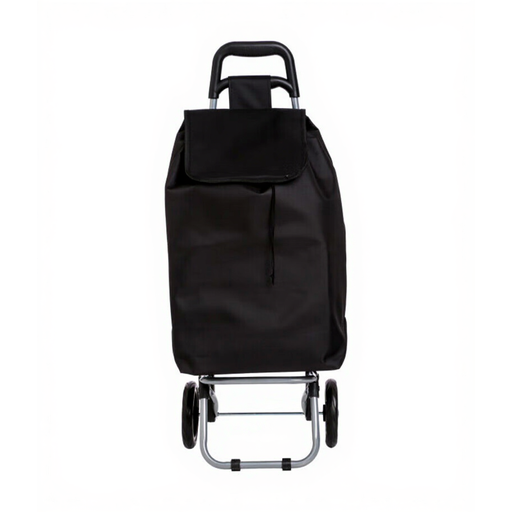
Why this product suits you: This two-wheeled shopping trolley is designed for trips to the market and everyday journeys on flat ground. Its removable bag can be loaded and cleaned separately.
The product description specifically recommends smooth, standard surfaces and an evenly distributed load. Very uneven terrain and high kerbs are not suitable.
Removable satin-finish bag, steel frame and compact dimensions of 35 × 27,5 × 91 cm.
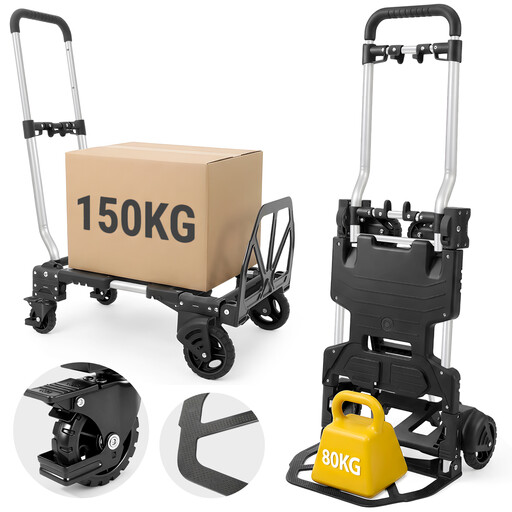
Why this product suits you: This model combines a sack truck and platform trolley, making it suitable for a range of moving tasks at home, in the cellar or in the office.
The load capacity is listed separately for each mode: 80 kg as a sack truck and 150 kg as a platform trolley. An integrated locking mechanism helps keep it securely in place when parked.
Aluminium frame, adjustable handle, double-bearing TPR wheels and a space-saving folding design.

Why this product suits you: This large camping trolley is designed for day trips, picnics and carrying plenty of gear. It has a capacity of 127 litres.
The specifications state a maximum load of 200 kg, a folding time of around three seconds and two front brakes. The trolley must be fully opened and locked before use.
127-litre capacity, folding frame, 360-degree swivel wheels and dual front brakes.

Why this product suits you: This mobile shelving unit is designed for the kitchen, bathroom, living room or workspace, with three shelves for handy storage.
The maximum load is listed as 25 kg. This gives you a more realistic idea of how to use it, rather than focusing only on the number of shelves.
Dimensions of 43 × 28 × 74 cm, four swivel castors and a steel frame with MDF shelves.
We’ve put together a complete, regularly updated list of products that meet these strict selection criteria and the safety regulations in force across the EU.
Its lifespan depends on the load, surface, storage and care. Don’t exceed the stated load capacity, clean the wheels and joints regularly, and store fabric or metal trolleys in a dry place. Outdoor models should be left to dry fully before folding.
A sack truck, platform trolley or 2-in-1 transport trolley could be suitable for heavy boxes or crates of drinks. What matters is the load capacity in the relevant mode, a sturdy frame and suitable wheels. A small shopping trolley is not necessarily designed for these tasks.
A manual trolley doesn’t need electricity to operate. However, ongoing costs can arise from wear parts, cleaning or replacing damaged wheels. If you use it frequently, look for accessible wheels, sturdy fittings and a load limit that suits your needs.