
Lieferung heute & morgen

Qualitätsgarantie

Willkommens-Angebote freischalten: KOSTENLOSE Lieferung | Bis zu 80 % RABATT | Kostenlose 30-Tage-JoyPlus-Testphase
App herunterladen
A reliable trolley jack is an indispensable tool for anyone who performs their own maintenance, such as seasonal tyre changes. With the wide variety of vehicle types—from heavy SUVs to lowered sports cars—selecting the right model is crucial for both safety and efficiency. This guide provides clear, objective criteria to help you find the perfect hydraulic jack for your needs.
Before making a decision, consider three main technical features: lifting capacity, profile, and material. These factors determine whether a jack is suitable for your specific vehicle and intended use.
The lifting capacity indicates the maximum weight the jack can safely lift. A common recommendation is that the jack's capacity should be at least 75% of the vehicle's total gross weight. Since a jack only ever lifts one side of the vehicle, this might seem sufficient. However, for added safety—especially with vehicles that have uneven weight distribution, like many SUVs or vans—a model with a higher capacity is advisable. A 3-tonne trolley jack provides a solid safety margin and covers most standard cars, estates, and the requirements for an SUV jack.
A trolley jack's profile is defined by two key measurements:
Most trolley jacks are made from robust steel. These models are highly durable and well-suited for stationary use in a garage or as a classic workshop jack. Their heavy weight ensures excellent stability.
An aluminium trolley jack is a lighter alternative. Models made from aluminium alloys are easier to transport and manoeuvre, making them ideal for mobile use or for users who need to move the device frequently. Despite their lower weight, high-quality aluminium models often offer a lifting capacity comparable to their steel counterparts.
Based on the criteria above, we have curated a selection of models that cater to different needs.
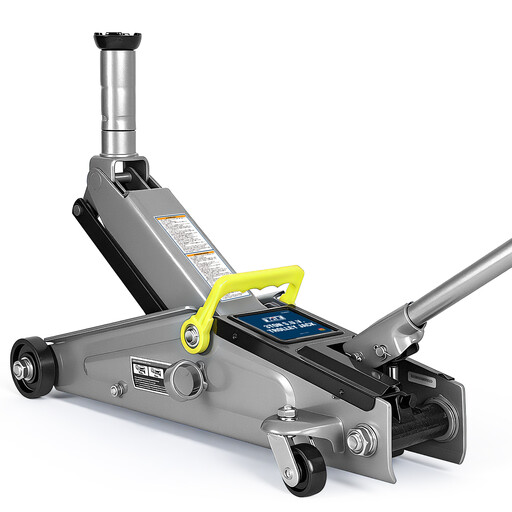
Why it stands out: This model from BIG RED TORIN combines a high lifting capacity with a wide lifting range. Its robust steel construction and integrated safety valve make it a reliable choice for standard maintenance on heavier vehicles.
Advantages:
Who it's for: Users looking for a stable and powerful hydraulic jack for their garage, who primarily work on standard cars, SUVs, or vans.
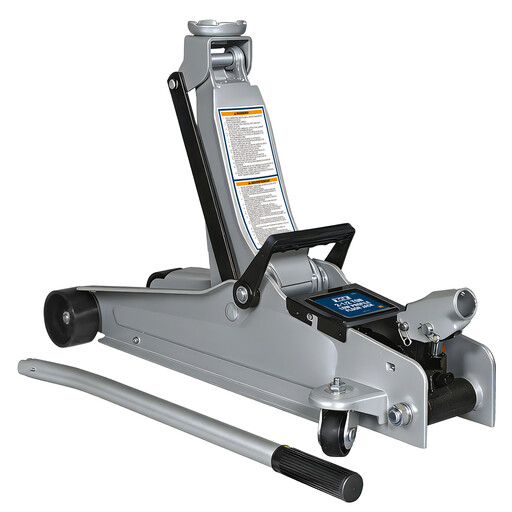
Why it stands out: Its extremely low minimum height of just 85 mm makes this low-profile trolley jack the ideal solution for vehicles with very little ground clearance. Despite its slim design, it offers a solid lifting capacity of 2.5 tonnes.
Advantages:
Who it's for: Owners of sports cars, performance vehicles, or other cars where a standard jack won't fit under the frame.
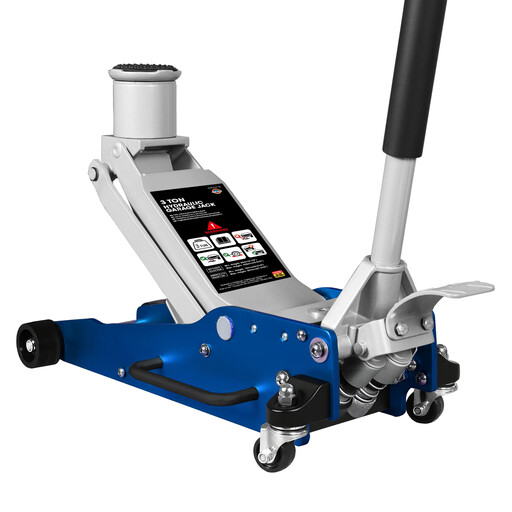
Why it stands out: This model is a versatile all-rounder. It combines the benefits of an aluminium trolley jack (lightweight) with those of a low-profile model (85 mm minimum height) and a high lifting capacity of 3 tonnes. The dual-piston pump also enables exceptionally fast lifting.
Advantages:
Who it's for: Ambitious DIY mechanics and semi-professional users who need a lightweight, fast, and versatile tool for a wide variety of vehicle types.
Choosing the right jack depends heavily on your individual circumstances. If the models presented here don't perfectly match your requirements, other alternatives are available.
Explore our full range of jacks and find the perfect solution for your workshop.
The required lifting capacity depends on your vehicle's gross weight. As a rule of thumb, the jack's capacity should be at least 75% of the vehicle's total weight. To ensure a safety margin, it's recommended to choose a model with a capacity that exceeds this. For a 2-tonne SUV, for example, a 3-tonne trolley jack would be a safe choice.
A low-profile trolley jack (also known as an "ultra-low profile" jack) has a very low minimum height. This is essential for vehicles with minimal ground clearance, such as sports cars or lowered cars, as a standard jack would not fit under the jacking point on the vehicle's frame.
A hydraulic jack operates on the principle of fluid dynamics. Pumping the handle forces oil into a cylinder, building up pressure that raises the lifting arm. Modern jacks are equipped with safety features like overload valves, which prevent lifting beyond the maximum capacity. Nevertheless, for safety reasons, it is absolutely essential to always secure the lifted vehicle with jack stands before working underneath it.