
Lieferung heute & morgen

Qualitätsgarantie

Willkommens-Angebote freischalten: KOSTENLOSE Lieferung | Bis zu 80 % RABATT | Kostenlose 30-Tage-JoyPlus-Testphase
App herunterladen
Trolling is an effective method for systematically covering large bodies of water and outsmarting trophy-sized predatory fish. However, success depends heavily on choosing the right lure. Especially with wobbler trolling, many anglers wonder which model is suitable for a specific depth, target fish, and water conditions.
This article serves as a guide. It presents objective criteria for selecting trolling wobblers and showcases a selection of models tailored to specific fishing scenarios. The goal is to provide you with a solid basis for making an informed decision, without resorting to marketing hype.
The choice of the right lure should be based on technical features and the prevailing fishing conditions. Three criteria are particularly important.
Running depth is the most critical factor in trolling. The lure must be presented in the water column where the predatory fish are holding. A deep-diving wobbler is essential for fishing in deep lakes, reservoirs, or the sea to reach the bottom or thermoclines. Models with large diving lips are designed to get down to depth quickly and maintain it even with varying trolling speeds. Pay attention to the manufacturer's specifications for maximum diving depth and compare this with the water depth and the position of fish on your sonar.
A trolling lure for pike, cod, or other hard-fighting fish must withstand immense stress. The wobbler's body should be made of robust hard plastic or wood. A through-wire construction further increases its stability. Equally important are the hooks: they must be sharp, strong, and corrosion-resistant, especially when saltwater wobblers are used. Hooks rated 3X-strong or higher are a sensible feature for large predator lures to prevent them from bending out during the fight.
The lure's size and shape should imitate the primary forage of the target fish. Elongated, slender wobblers (minnow shape) imitate fish like bleak or smelt and are universally effective. Fatter-bodied models can represent larger prey fish like bream or roach. The action—whether it's a side-to-side flash, a rolling motion, or an aggressive wobble—is determined by the shape of the body and the diving lip. It is advisable to test different models to find out which action provokes the most strikes on any given day.
Based on the criteria mentioned, we have compiled a selection of products suitable for various trolling requirements.
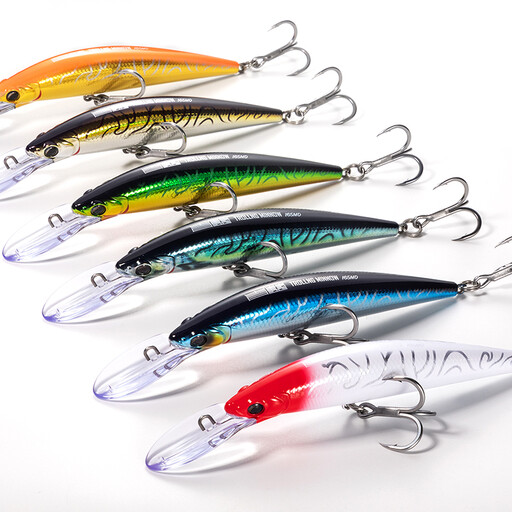
Why It Stands Out The ECOODA Cyan Blue Minnow 165DD is specifically designed for deep-water trolling. Its construction is aimed at reaching great depths quickly and stably. The large diving lip and substantial weight support this performance.
Benefits
Who Is It For? This deep-diving wobbler is an option for anglers specifically targeting large predators like pike, zander, and cod in deep waters or offshore environments. Its construction makes it a suitable saltwater wobbler.
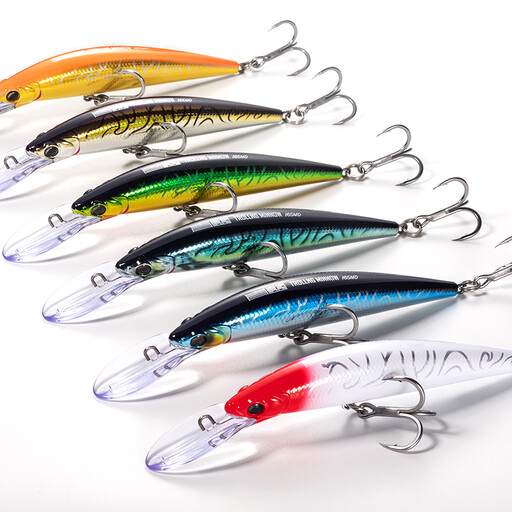
Why It Stands Out The 165MD (Medium-Dive) model from the ECOODA Wobbler series is the versatile counterpart to the deep-diver. It is designed for medium water depths, covering a wide range of fishing situations in lakes and inshore areas.
Benefits
Who Is It For? Anglers looking for a reliable all-round wobbler for trolling at moderate depths will find this to be a fitting model. It is suitable for situations where extreme deep-divers are not required.

Why It Stands Out This wobbler set offers a cost-effective way to stock your tackle box with a variety of models. The random selection of two designs and different colours allows you to adapt flexibly to the conditions on the water.
Benefits
Who Is It For? The set is ideal for anglers who like to experiment and want to have a wide range of lures available without having to invest in many individual models. It is suitable for both beginners and experienced anglers looking to supplement their lure selection.
If the models presented here don't exactly meet your requirements or if you are looking for more specialised equipment, you can find a wider selection in our Fishing Gear category. There you can browse through an extensive range of lures, rods, and accessories.
The optimal trolling speed depends on the wobbler model, the target fish, and the water temperature. A good starting point is usually between 2.5 and 4.5 km/h. It is recommended to vary the speed and observe the lure's action next to the boat to find the performance that provokes the most strikes.
A general guideline is: in clear water and with good visibility, natural colours (e.g., silver, blue, green, mimicking baitfish) are often successful. In murky water, at dusk, or on heavily overcast days, high-contrast shock colours (e.g., chartreuse, orange, pink) or UV-active models can be more visible and attract fish from a distance.
Although they are designed for trolling, many deep-diving wobblers can also be cast. Their large diving lip ensures that they gain depth quickly after hitting the water. This can be advantageous for reaching deep channels, ledges, or holes from the bank or a boat that would be inaccessible with shallower-running lures.